Advanced Trading–Apr 2013
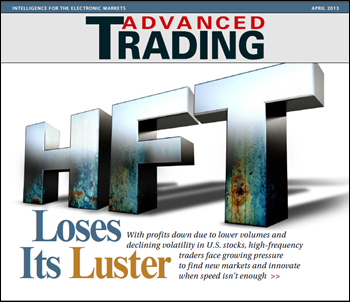
HFT firms profits reportedly have slumped from nearly $5 billion four years ago to $1 billion last year
GETCO, the largest HFT player in the U.S.markets profits from HFT shrank 82% last year.
Move from Ultra High frequency to Mid frequency strategies might happen as the former gets arbed out.
According to a study by TABB Group, HFT is expected to rise to 52% of average daily volume this year. HFT will generate $2 billion in revenue in 2013, TABB Group predicts in a report on U.S. equities. But is the slump in profits going to impact the marketplace liquidity that institutions rely upon?
In a few short years it has followed a standard business cycle and may well be heading toward decline. This doesn’t mean it will extinguish itself or that non-HFT traders should abandon their concerns over the practice. It means that HFT practices, both good and bad, will become “institutionalized.”
New regulations aimed at curtailing high-frequency trading may be focused on a business that’s actually yesterday’s news.
Five Reasons HFT is less profitable
Volumes in U.S. equities fell 18.5% last year, averaging about 6.5 billion shares daily, compared with 7.8 billion shares in 2011, according to TABB Group.
Volatility on the CBOE VIX plummeted about 19% in the first nine months of 2012, and
32% during the past 12 months through January, according to a GETCO filing.An increase in internationalization of order flow in U.S. cash equities cut into the market share of electronic market makers.
More firms have entered the HFT space, so the competition is intense and the window
for profitability is shorter.Broker-dealers have invested millions in low-latency network technology and algorithms,
so it’s harder for HFT to pick them off.