Happy Mind, Happy Life
Contents
The blogpost is about the book “Happy Mind, Happy Life” written by Dr. Rangan Chatterjee.
Tripod
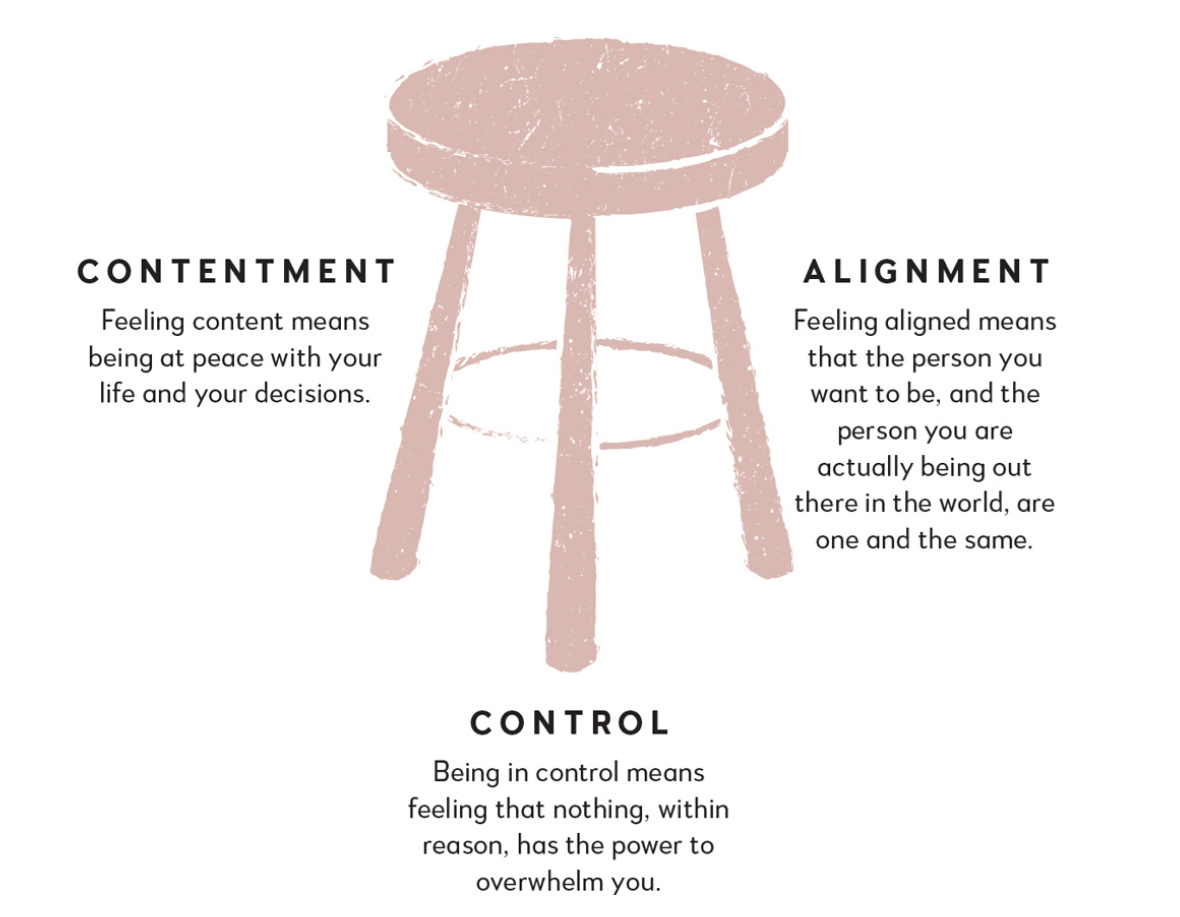
The author mentions ten different things that we can put into practice to experience happiness in our lives. All the ten suggestions rest on a tripod philosophy that says the happiness in our life depends on three essential structures that govern our feelings:
- Contentment
- Alignment
- Control
These three elements form the “tripod” of core happiness.
Ten Ways
The principles laid out in this section are:
Write Your Happy Ending
We are driven by “Want Brain”, which is forever chasing external rewards, thinking they will give us happiness. This is one of the biggest causes of our misery and makes us sleepwalk through life. In order to understand the happiness that exists in our lives, it is a matter of training ourselves to be aware of those moments. We can accomplish this by reflecting on the moments that have made us happy, either in a journal or in some place that we can refer to periodically. By being aware of those moments, we develop a strong affinity towards the feeling of happiness.
The author says writing down what we might like to have accomplished when we are on our deathbed is a useful exercise to steer us in a direction we will feel less guilty about.
Eliminate Choice
This is becoming tougher as the world is forever wanting to give us more choices than we can ever digest. By deliberately limiting choices in life, we tend to be happier. Food for thought - what are the areas in our life where we are actually reducing choices or seeking to limit ourselves to a few options only?
In my own life, when I think of this, maybe restricting the number of hours I spend in office meetings has made a huge difference.
I think this also comes down to the activities we do in a day. If we limit ourselves to a few activities and do them well, it might yield better output than juggling many parallel tasks that yield subpar results.
Treat Yourself with Respect
The other day I was looking at some of my previous journal entries and it was obvious that I was berating myself for not doing certain things, berating myself for doing certain things. All in all, there were some days when I was experiencing an awful lot of self-disparaging thoughts in my mind. It could have been because of various ways I have lived my life, especially in the last two decades.
This chapter offers a great analysis of all such behaviors and says that it is our “Want Brain” that makes us demean ourselves.
The links between self-compassion, health and happiness are overwhelming
When we are in the midst of a high-pressure situation, we should speak to ourselves as we would our child, our best friend, or a work colleague we admire
Make Time
The suggestion here is to seek activities that make us forget about time. There are many activities that we can do in our day by consciously forgetting about time. Playing an instrument, for example, could be one such activity where our entire focus is on getting that one gamak taan right, that one taan with meend right, or playing one specific note until we feel it is perfect. This has no sense of time attached to it, but we are training ourselves to get lost in time.
Seek Friction
Totally agree on this. No Friction -> No Pain -> No Learning -> Stagnancy. Most of this chapter aligns with Buddhist philosophy: the person who makes us angry deserves to be treated as someone important – even thanked – because they have offered a window into parts of ourselves that would otherwise stay hidden. Anyone who demeans, berates, agitates, or speaks down to us is, in this view, a hero. They give us a chance to discover something about who we are. Anyone who prompts reflection is doing us a ton of good.
Talk to Strangers
This is again a difficult suggestion for me to follow. I have always been an introvert, and hence I prefer to do all my work in solitude. However, given the nature of my work, I need to present my solutions to many people across the world, and hence I have no choice but to speak to strangers who happen to be prospects for my firm’s offerings. So in these limited interactions where I am mostly performing, i.e. selling the firm’s offerings, I am not really benefiting from the kind of lessons that come from genuinely talking to strangers.
Indeed there are benefits to talking to strangers as suggested by the author in this chapter. Maybe I should ease up a bit and actively seek out strangers in my life. Two decades ago, I used to join organizations that had nothing to do with my work, to meet strangers and pursue common interests. Oh, that reminds me – I am not that bad. Every week, as a part of my weekly rituals, I do visit two groups where I encounter strangers, but I don’t think I talk to them as mentioned in this chapter. Maybe I should strike up conversations and see the positive benefits described in this chapter.
Treat Your Phone as a Person
The phone is all-pervasive and has become the single most addictive device afflicting humankind. No doubt the device has become extremely useful and convenient for many of us. The convenience and ease carry a cost. In this case, the cost is that it invades our thoughts constantly. The title of the chapter is meant to tease the reader into considering a thought experiment where we treat a phone as a person, and then we are exposed to the ludicrous state of our lives where we allow this person to follow us everywhere, from the bedroom to the restroom.
Somehow I have found the phone to be non-invasive, as I have adopted a policy of checking only when it is absolutely needed. Again, depending on the situation, like what I am going through now, I don’t feel the need to check any app at all. Whatever payments I need to make, I use the web, get done with the payment, and move away from the web-based app.
Have a Maskless Conversation
This is a tough suggestion personally for me, as I have always been shying away from people. Once we are open to exposing our vulnerabilities, it makes us uncomfortable, but it gives us a more nuanced understanding of self.
Go on Holiday Every Day
Instead of planning an elaborate holiday somewhere away from our workplace, it is better to create situations where we can take a holiday for a few minutes every day. It is certainly possible in our busy lives to take regular breaks and get detached from the immediate thoughts, pause and reflect on our life, suspend our thoughts and just be. In my own life, I have many such opportunities, such as:
- going on a long walk
- playing an instrument
- journaling
- reflecting on the week gone by
- reading a good book for a few minutes
- forgetting everything and listening to a podcast from a random source
- Thanks to various circumstances, I can work in solitude and that has been a blessing for the past few years.
- Meditating
Depending on the way we live our lives, we might choose one of many ways to access daily vacations. These vacations give us a sense of peace and ultimately help us achieve a semblance of all the legs of the tripod.
Give Yourself Away
This again resonates with Buddhist philosophy where we start treating others as more important than ourselves. We start cherishing others rather than cherishing ourselves. The author presents the case that if we do that, we are happy. But Buddhist teachings hold that cherishing others is the only way we can escape samsara and attain enlightenment. When I first heard about the way we can step away from self-cherishing and embrace cherishing others, I found it difficult to understand. But slowly, as I have started incorporating the same in my life, I find it makes me far more relaxed about my own situation and in turn creates a sense of harmony with life. I am still a long way from adopting this philosophy in every part of my life, but maybe I will as time goes on.
Takeaway
The ten things that the author mentions in the book are not new in the sense that it is likely we would have come across a version of each of these ten aspects in some form or another in our religious exposure, in our spiritual practice, or in other books and talks. However, the author distills them in such a way that we can relate to the stories. The fact that there are case studies mentioned from the author’s practice lends credence to many points mentioned in the book. If even one of the ten things mentioned in the book sticks with us or makes us change for the better, I think spending a few hours with the book might be a worthy investment of time and effort.