How a little becomes a lot
Contents
This blogpost is about the book “How a Little Becomes a Lot” written by Eric Zimmer.
Introduction
The chapter starts with the author, Eric Zimmer, taking the reader back to the days when he was a homeless heroin addict, and his counselor told him that his only route to recovery was long-term treatment. Eric resisted it for a bit and then, in a moment of clarity, decided to give in to long-term treatment. What follows is a long-term, day-by-day, moment-by-moment recovery that leads him to where he is now, a successful entrepreneur and podcaster. The journey that led him from that abyss to where he is now was made little by little, day by day. The book’s title is inspired by this journey, and also by a Tanzanian proverb that sums up the power of little steps.
Little by little, a little becomes a lot
We are all, in some way, answering two main questions over and over again:
What do I want to do? Who do I want to be?
The first question relates to changing external circumstances and the second relates to changing internal conditions. In a way, both are completely related.
The principles for developing a wiser inner life make it easier for you to change your outer life. And our behavior in the world affects our inner life to the same degree. At its deepest level, this book isn’t about transforming any one aspect of yourself - it’s about transforming how you relate to you, your struggles, and the process of change itself.
The intro lays out the map of the book, which has three parts. The first part of the book lays out the mechanics of beginning something new. The second part of the book is about setting inner practices and perspectives, ways to enter into wiser dialogue with ourselves, day in and day out, whether or not change is at the top of our minds at all. The third part of the book is the long tail of change.
Little by Little
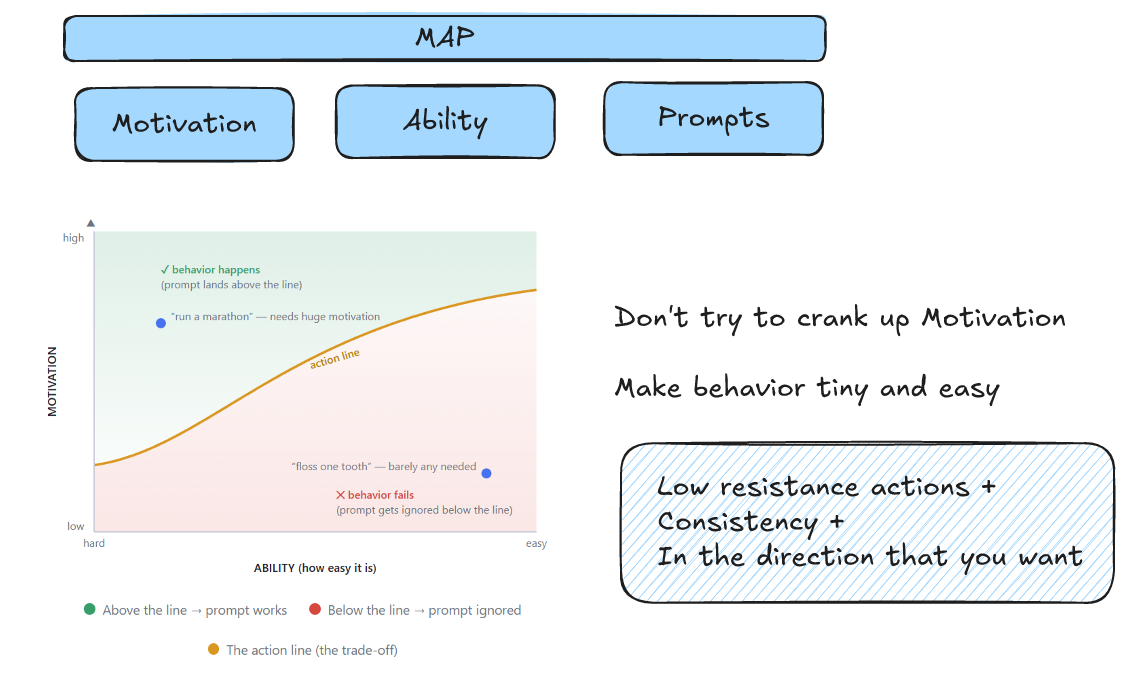
What is “little by little”? These are low-resistance actions, done consistently over time, in the same direction.
If you have mastered anything that seemed insurmountable in the beginning by following some version of doing it consistently, the above statement will automatically resonate with you. In my case, I was supremely bad at touch typing. My method of typing was the hunt-and-peck method, a method that involves hunting for keys and pressing them. My typing speed was a modest 35 wpm, and seeing people who could type 70 wpm and more seemed like magic.
This happened during COVID, when I was at home trying to type in something that one of the NLP gurus had put out as a beginner’s tutorial. I knew that typing and exactly replicating what was being done was a better route to understanding than merely running the code. However, I hit a massive roadblock. Typing the code verbatim took a very long time because of my lack of touch typing skills. I realized that it was never too late to learn this skill. So I set aside 5 minutes a day to practice. However, dumb practice with the same hunt-and-peck method was pointless. I did some touch typing courses online and took some practice tests. Somehow I was magically thinking that I could get good in a few weeks’ time. That never happened. But I did exactly what the author is trying to say in this book:
These are low-resistance actions, done consistently over time, in the same direction
But finding 5 minutes of time in a day is not difficult. Doing it consistently over time meant that I had to gamify things so that the activity became something I could look forward to on a daily basis. The nature of the activity, touch typing, is so outcome-driven, and metrics such as wpm and accuracy are so well wired into many of the practice sites, that it becomes easy to make the activity more exciting. I have been practicing touch typing for more than 5 years now. My average speed is about 75-80 wpm, and I have never consciously tried to increase the speed beyond that point; instead I have tried to focus on accuracy. Hitting 75 wpm to 80 wpm took time, but it was achieved only through deliberate practice rather than massed practice.
The chapter talks about the Fogg Behavior Model, where a combination of motivation and our ability to do things, along with prompts, decides whether we end up doing something or not. One can think of motivation and ability as both components of resistance. We can lower the resistance by either raising the motivation level or increasing our ability. However, we know that that route is not always the easy one. The alternative route is to do the smallest possible action that does not require much motivation, where we might be able to garner just enough ability to do the specific action.
As people take small steps and feel successful, it makes it easier to do and their motivation naturally goes up, which means, over time, they can do harder and harder things.
We believe, we get motivated and then act, but often it works the other way around. We act and motivation follows.
In one sense, just the above statement, when internalized, can change the way one behaves in life, and who knows, that little change in attitude can be transformational once it adds up.
The entire chapter is in one sense saying
Repetition breeds results
Pick any small activity that might be a requirement in the overall direction that you are heading in, set up a timer and do it - consistently. You will soon realize the massive benefits of spending a few minutes consistently. The message in this chapter is one I have come across in many books, but somehow it always reminds me of the book “The First Twenty Hours”, where spending twenty hours on anything you want to master gets you almost 80% of the working knowledge. In my own life, I have seen this happening again and again. The way my current life is structured, it is my job to learn something quickly and showcase it to prospects. Given the proliferation of cloud platforms, LLM frameworks, books and the ever-increasing complexity of tech skills needed to survive, I have always fallen back to this rule of spending 20 hours. If I find something very difficult, I break it down into simple tasks that I can do in bursts of 1 hour over 20 days. Most of the time, by the time I reach the 10th day, i.e. having put in 10 hours consistently, I have enough skills to get my work done. In that sense, this chapter thoroughly resonates with the way I go about learning new stuff.
What is Worth Wanting
I think the chapter is all about understanding the most important things in life and working towards them. The chapter mentions umpteen examples in which physiological conditions force the left and right hands to work against each other. Such patients are usually called split-brain patients. The point of highlighting such examples is to create a scaffolding for the main theme of the chapter - desires vs. values. Desires are what we want whether we like it or not. Values are motivations we choose to cultivate: the goals, morals, and values.
One of the terms I learned from the chapter is “Motivational Complexity” that drives us to want two or more things at once that might be in direct conflict. The analogy is that of a soup where it is difficult to reverse engineer an actual impulse to act and find out the values, desires, wants and beliefs from what happens in life.
The chapter also mentions mimetic desire and the way it often runs our lives.
Mimetic Desire
Overview
Mimetic desire is an idea from the thinker Rene Girard: we do not want things on our own; we want things because we see other people wanting them.
The Core Idea
Picture a room full of toys. A kid is happily ignoring all of them. Then another kid walks in and grabs one specific toy. Suddenly the first kid has to have that exact toy, not any of the others. Nothing about the toy changed. What changed is that someone else wanted it, and that made it look valuable.
Most of our desires are not really our own; they are borrowed. We copy (“mime,” like mimic) what other people want.
The Hidden Middle Person
We think our wanting goes straight from me to the thing, but really there is a hidden middle person: me, then that person, then the thing. Girard called that person the model, because we model our desires on them.
Everyday Examples
- You did not care about a brand of sneakers until your friend showed up in them.
- A house feels far more appealing the moment someone else makes an offer on it.
- Kids fight over the one toy while identical ones sit untouched.
- Marketing runs entirely on this. An ad is not really showing you a watch, it is showing you a person you would like to be, wanting the watch.
The Darker Twist
When you copy someone’s desire, you often end up wanting the same limited thing they want, so your model quietly becomes your rival. Two people reaching for one prize. That is how mimetic desire turns into competition, envy, and conflict, even between people who started out as friends or role models.
In One Line
Desire is contagious. We catch what we want from watching each other, and that is both why trends spread and why people clash.
Relevance of Mimetic desire
On the desire side, we can often categorize the goals we set for ourselves as “want-to” goals and “have-to” goals. Once we start noticing the values that we hold on to in our lives, we will be able to look at our goals and then slowly start shifting towards “want-to” goals rather than “have-to” goals.
Should one analyze at all?
I was a bit confused about the problem of motivational complexity vs. analyzing one’s desires. But rereading and clarifying with an LLM made me understand that it is foolhardy to analyze one single impulse, but it makes a lot of sense to analyze patterns and cues to our future life. Instead of analyzing one single instance that drove a behavior, it makes sense to look at a set of actions that follow the same pattern and then look for common themes that are driving such a pattern. Analyzing what the pattern points to is better than analyzing retrospectively.
The Architecture of Change
One might think that the best way to make a change in our behavior is self-control. Research on this topic states that it is very difficult to rely on this muscle for stopping us from doing stuff that we don’t want to do. The more we exercise it, the more our muscle gives in and the more we tend to give in. The way to make a change is to make sure that we create external circumstances that don’t force us to use self-control in the first place. Given the right amount of structure, those circumstances liberate you.
In the trigger -> routine -> reward loop, it is better to change the routine than to fight the reward that comes from a habit loop or to try to control the trigger.
Hence the author gives four ways
- fine-tuning our behavioral goals
- identifying the prompts and triggers
- reshaping our environments for actions
- anticipating the likely obstacles
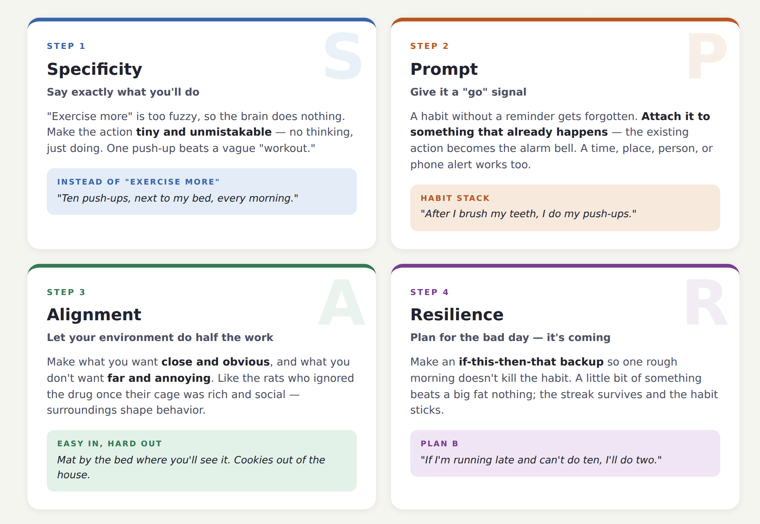
The author creates a catchy acronym - SPAR - to communicate the ways one can make lasting changes.
Specificity
Make sure that whatever you set out to achieve has specificity in it.
Prompts
Prompts are if-then conditions. One can use them in 6 different ways
- time-based
- location-based
- preceding-event
- other-people
- random
- emotional-state prompt
Alignment
The three factors that shape habits below conscious awareness: proximity, convenience and salience.
Resilience
The main idea is about implementation intentions. If there is some if-then
planning in place, then whenever things go wrong, you will automatically be able
to fall back into your routines.
The SPAR Framework - ELI5
Overview
SPAR is Eric Zimmer’s four-step method for setting up a habit so it runs almost on its own, instead of relying on willpower in the moment. The idea is to arrange things ahead of time so the good choice becomes the easy one. The letters stand for Specificity, Prompts, Alignment, Resilience.
Specificity
Say exactly what you will do. “Exercise more” is too fuzzy, so the brain does nothing. Instead: “ten push-ups, next to my bed, every morning.” No thinking, just doing. The smaller and clearer the action, the better. One push-up beats a vague “workout.”
Prompt
Pick a reminder that pokes you. A habit needs a “go” signal or you forget. Attach the new habit to something that already happens: “after I brush my teeth, I do my push-ups.” The existing action becomes the alarm bell. A prompt can also be a time, a place, another person, or a phone alert.
Alignment
Set up your surroundings so the good thing is easy and the bad thing is hard. Like the rats who ignored the drug once their cage was rich and social, your environment does half the work. Leave the mat by the bed where you will see it. Keep the cookies out of the house. Make what you want close and obvious, and what you do not want far and annoying.
Resilience
Plan for the day it goes wrong, because it will. Make an if-this-then-that backup: “if I am running late and cannot do ten, I will do two.” A little bit of something beats a big fat nothing. The streak survives and the habit sticks.
In One Line
Decide the exact tiny action (S), tie it to a reminder (P), arrange your stuff so it is the easy path (A), and have a plan B for bad days (R). The habit then mostly runs itself instead of you white-knuckling it every time.
Visual
Moments of action
In this chapter, the author takes a relook at self-control. Having made a case for its ineffectiveness in some of the previous chapters, the author uses the example from Ernest Hemingway’s The Old Man and the Sea to illustrate a few of the key concepts relating to self-control.
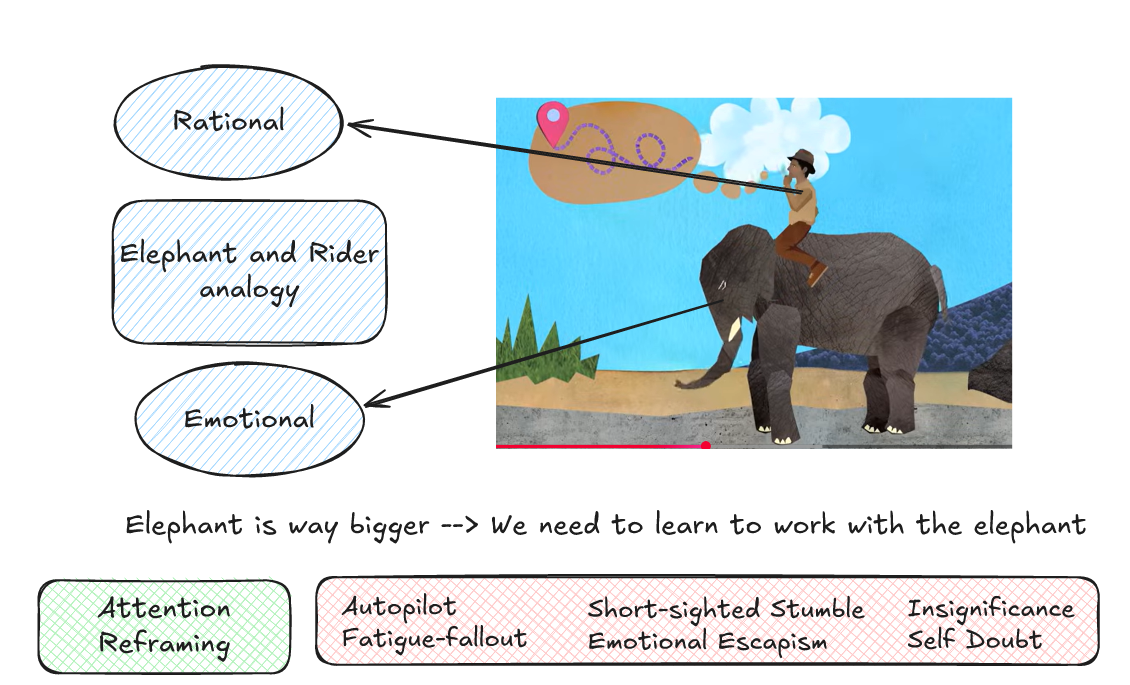
One can think of oneself as a rider on an elephant, where we, like the rider, behave at a conscious level, whereas the elephant represents the unconscious part of the brain and our physiological makeup. If we start reframing our world view in this way, then instead of fighting with the elephant, it helps us to seek strategies where we make the elephant behave the way we want it to behave, and maybe distract the elephant so that we can do what we want to do, without the elephant’s interference.
There are two tools introduced in this chapter that help us work with ourselves and not against ourselves - attention and reframing.
Attention is what we choose to focus on; framing is how we think about what we’re focusing on.
Think of it like a newspaper. Attention is the story the paper chooses to cover on page one, the headline our brain pulls from the flood of sensory input and internal chatter. Framing is the perspective the paper takes in that front-page story, meaning how we interpret what’s happening.
Both the terms are self-explanatory. When we are faced with a task that needs to be done immediately, it is important to focus on the task at hand and reframe all the emotional distractions in a way that leads us in a direction that we want to go.
The chapter talks about six challenges to self-control
- Autopilot pitfall
- There are several times in our lives where when we want self-control, all we experience is a massive auto-pilot mode. Being aware of this auto-pilot mode helps one to take control of the behavior
- Fatigue Fallout
- Hungry, Angry, Lonely and Tired (HALT) are some of the reasons why we find it difficult to maintain self-control
- Shortsighted Stumble
- We often find ourselves valuing immediate gratification over long-term effects. Playing the tape forward is the best way to make sure one at least gives enough attention to the kind of problems that shortsightedness brings on
- Emotional Escapism
- Self-Doubt Stalemate
- Insignificance
Be a Friend to Yourself
The chapter is about understanding and using self-compassion in our lives to train our thoughts. Self-compassion needs a nice balance between self-acceptance and self-improvement.
The key to self-compassion is to treat yourself like you would a friend or a child.
Eric Zimmer, in his book “How a Little Becomes a Lot”, talks about various ways in which the inner critic can play havoc in our lives. If we look at the amount of time we spend with each person in our lives, undoubtedly YOU lead the charts. This is applicable to any person. In that sense, the relationship that one has with oneself is the single biggest predictor of our moods. The way we treat ourselves has a significant impact on our thoughts. It is often said that we must develop a healthy sense of self-compassion in order to have a healthy relationship with ourselves. Self-compassion has two sides: on one hand it is the ability to empathize with whatever situation we are facing; the other equally important part, the one that is often forgotten, is that we need to be doing something about it. Hence developing self-compassion by default means that we are reflecting on our predicament in a way that is inclusive, not being extremely critical and at the same time doing something that is useful, i.e. taking some specific action.
The author offers a few ways to manage this inner critic so that it does not sabotage our life
- Name the inner critic: By giving it a name, a personality and a color, it is likely that we are able to distance ourselves from it and in the process be able to better analyze the situation at hand
- Listening from a distance: This involves looking at the inner critic and then deciding to follow an alternative route rather than agreeing or disagreeing with it as though we live in a binary world
- Comparison: Common breed isn’t ground for unkindness towards ourselves
By being cognizant of these three ways, one can catch unkindness when it is about to arise and create havoc in our lives.
Tiny disruptions - Still points
The author suggests ways to bring awareness into our daily lives by inculcating still points. A still point is a moment of reflection or practice that we intentionally build into our day. These are carefully thought-out if-then-when rules that help us pause in our lives and take stock of the situation. The trick is to do this consistently so that we are able to be cognizant of self-sabotaging thoughts whenever they arise.
We don’t see the world as it is, we see it as we are
Whatever happens at any point of our lives, it is important that we maintain the right perspective towards it. We might be facing terrible pressure to act in a certain way, we might be feeling bad given a particular situation we are in, but it is our perspective towards the situation that matters. If we are able to face the situation with equanimity, we see that life always throws at us various situations that might at first instance seem unfortunate, but in the long run, the situation itself might have led us to explore things that have helped us to become a better person. While having that sense of equanimity is a healthy attitude to have, our perspective might be biased or lost for several reasons. Some of those reasons could be similar to the ones that we experience when we lose our ability to maintain self-control.
The author explores a few of them. The one I found most useful is a raising-awareness exercise that involves reflection on the following questions
- What am I making this mean?
- What else could it mean?
- What meaning is most useful?
Once one starts writing a summary, one realizes that there are many parts to the book that the mind has conveniently forgotten. The act of writing a summary forces one to remember the salient points of various chapters and also helps one consolidate the various points that the author has been trying to make in multiple ways.
The other part of looking at summarizing the book is to remember some of the parts of the chapter without looking at a particular chapter. Now, let me attempt to summarize a chapter of the book that I had read many months ago. The chapter is titled, The Middle way. Here is what I remember about the chapter
Gautama Buddha in his journey towards enlightenment is distraught and weak after pursuing the path of depriving his body of any sort of nourishment. That’s when he is taken care of by Sujata, an individual who believes that moderation is the key to living a successful life. The Middle Way is an elaborate exploration of this key message, that one needs to apply the principles of moderation in every aspect of life.
As much as this is easy to read and understand, it is quite easy to violate this principle while we go about living our lives. If urgent work comes along that demands a LOT of effort, we cannot put in moderate effort. We will have to put in extreme effort if the situation demands it. However, in most situations, we tend to take an extreme stance. We throw moderation to the winds.
The Middle Way
The author highlights the importance of moderation in one’s life. Often one equates moderation with mediocrity. The author mentions a swedish concept of “lagom”, that means “just right”. It is about the elusive sweet spot between “too much” and “too little”.
The middle way is an approach to life that energizes rather than wears us down. It widens rather than narrows our perspective.
The author makes a case for watching the way we verbalize our thoughts in everyday life.
Extreme language produces extreme emotions.
Our use of adjectives, adverbs and pronouns makes us seek novelty rather than get comfortable with every day experiences
We find ourselves in Others
Overview
The chapter argues that after all the inward work of self-knowledge, the largest single factor in any personal journey is other people. It builds the case through the founding of AA, the Harvard Study of Adult Development, and four distinct ways community enriches a life.
Twelve Points
On the day before Mother’s Day 1935, Bill Wilson stood in the Mayflower Hotel lobby in Akron, five months sober and one thought away from drinking; instead of the bar he reached for a phone book, called a church at random, and was connected to Dr. Bob Smith. A planned fifteen-minute conversation ran six hours and became the founding moment of Alcoholics Anonymous.
The mechanism was never rescue but mutuality. Bill: “I knew that I needed this alcoholic as much as he needed me.” Programs labelled “self-help” are better understood as mutual-aid societies, where members help themselves by helping one another.
The author’s own view reversed over 500-plus interviews and nearly ten years. He would once have named “the ability to go inside yourself” and “inner discipline” as the essentials; he now names the help and support of others. Introspection remains necessary but cannot substitute for what lies outside our own heads.
The evidence is unusually strong. Robert Waldinger, director of the 85-year Harvard Study of Adult Development, boils it down to one principle: “Good relationships keep us healthier and happier. Period.” His team had expected blood pressure and cholesterol to be the key indicators and were initially reluctant to believe otherwise.
Relationships work as stress regulators. A partner taking your hand in a tense moment measurably lowers blood pressure; the absence of warm relationships, or the presence of toxic ones, leaves the stress response redlining over years. In 2023 the U.S. Surgeon General declared loneliness a public health crisis, and Nicholas Epley finds that lacking strong relationships often contributes more to unhappiness and stress than lacking money.
Community was once inescapable and is now optional, which is the modern problem. Losing your tribe used to mean losing your survival; today the opportunity cost of opting in is high, because there are endless undemanding ways to spend an evening alone. Putnam documented the decline of churches, civic clubs and bowling leagues in 2000, before the internet added a thousand ways to feel connected-but-not-really.
Identification has two layers, and only the second one holds. “Me too” ends the isolation of feeling like a one-off freak; watching how others actually cope is what supplies the road map. Choosing a guide means choosing on values, not surfaces, a lesson learned by picking one sponsor for being named Thor and the next for driving a Mercedes before settling on kindness, thoughtfulness, and experience staying sober while raising a child.
We need both the small circle where we are readily understood and the larger, more mixed room that stretches us. AA literature puts it as “We are people who normally would not mix.” The limit of identification is that it is not imitation: reducing a bond to “we’re the same” builds a prison for everyone in it.
Encouragement measurably changes outcomes. In Wing and Jeffery’s 1999 research, 66 percent of participants who joined a weight loss program with three others maintained the loss, against 24 percent of those who joined alone, nearly triple the success rate. Public commitment adds accountability, with reported gains of 15 to 25 percent on health goals from sharing progress. It cuts both ways: “If you stay in the barbershop long enough, you’re bound to get a haircut.”
Discernment is what encouragement cannot give. Solomon’s paradox means we advise others well and see ourselves through fog, but what we usually want in a fraught moment is unequivocal validation. Amanda Rose’s co-rumination cycle describes the result, where talking a problem through with a loyal friend feels supportive while deepening the distress. Bernard Rimé argues real recovery requires cognitive reappraisal, a genuinely new angle.
Parker Palmer’s Circles of Trust model the alternative, practising “no fixing, no saving, no advising, and no correcting” and offering only open-ended questions. Palmer walked into one such circle praising a prestigious job offer and question by question realised he did not want it. His premise: “Left to our own devices, we have an endless capacity for self-absorption and self-deception.” The practical instruction is to ask more questions, far and wide, since every adviser has their own biases.
Emergence is the reason the arithmetic of “you are the average of the five people you spend the most time around” is wrong, treating relationships as commodities when the real result is 1+1=3. Lennon and McCartney produced a third thing neither could have made alone; Yanai and Lercher in Nature recommend simply talking to someone, since conversation generates ideas rather than exchanging them; Monet found Impressionism in a communal dining room at La Ferme Saint-Siméon. As the Congolese proverb has it, “A single bracelet does not jingle.”
The How
Connection is slow and reciprocal. Jeffrey Hall’s figures: roughly 94 hours to move from acquaintance to casual friend, 164 more to friend, and 219 more to close friend. Mutuality shortens nothing but changes everything; showing up to give, not only to receive, is what makes a relationship more than a transaction.
Start in your own backyard rather than hunting for something new. Ask where you already go monthly, who sends you non-spam email, and who sits unanswered in your text history. Prioritise connection over comfort, favour ongoing commitments over one-off events, and invest deeply in one community rather than skimming several.
Our predictions about social risk are simply wrong. Epley’s “Hello, Stranger” found London commuters expected awkwardness and came away uplifted, a pattern that repeats with gratitude notes, small gifts, and deeper questions. Waldinger’s most important finding is that it is never too late, since people keep finding relationships and love when they least expect it.
Setback, Reset, Repeat
There is no question about the fact that everyone is going to fail at something in their lives. If there is no failure, how does one go about learning anything? Instead of taking the failures in one’s stride, one might get dejected, disappointed and paralyzed for a long time. In this state of mind, there is a chance that one can get into a rabbit hole of berating oneself for all the things gone wrong and never get out of that state and move on.
This chapter offers a simple framework for all of us who get off track for
whatever reason. It begins by introducing the twin words slips and relapses.
A slip is a one-time stumble; an unplanned drink, a bad decision, a moment of forgetting. It’s like hitting a bump but staying on the road. A relapse, on the other hand, is when we veer off completely - when the internal “why bother” takes over and we stop trying altogether.
A slip can lead to a relapse - but it doesn’t have to. It’s the story you tell yourself about the slip that determines what happens next.
A slip is part of the path. A reset is how we stay on it. And what we need to reset in these moments isn’t more judgement; it’s a system for getting back on track.
RENEW Framework
The author introduces a framework via a mnemonic that can help one get back on track
- R : Recognize it’s normal to get off track
- E : Embrace your Why
- N : Neutralize the Emotional Drama
- E : Extract the lesson
- W : Walk forward with action
Allowing Everything to be Exactly As It Is
The chapter starts with the author asking, “What would today be like if you were to allow everything to be exactly the way it is?”
This often entails accepting life as it is, not in a passive way, not in a way that shows submission, not in a way that shows blind resistance. The chapter makes a case for a special kind of acceptance that helps us pause, reflect and then take the next best action. This kind of acceptance is also a way to acknowledge that not all problems need to be tackled today, and some do not need to be tackled at all, as they might be opportunities in disguise.
Buddhism has an idea of “near enemies”, states that look almost like the path of wisdom but miss their mark. With acceptance, approval is the nearest enemy. Repression is another near enemy. By following acceptance, it does not mean that we are approving of something, it does not mean that we are repressing our innate feelings. It is more subtle and nuanced than that.
We all experience pain in life - that is inevitable. I have come across a similar statement in Murakami’s book on running: pain is inevitable, suffering is optional. The author in this chapter gives two equations that help one understand the meaning of acceptance in a better way without confusing it with near enemies
- Suffering = Pain x Resistance
- Happiness = Reality - Expectations
Both equations encapsulate deep philosophies of life that, when internalized, make it easy to accept things as they are.
In that sense, resistance might be the opposite of acceptance, but that does not mean acceptance implies inaction. Famous revolutionary movements are a result of resistance-led action.
The chapter ends with a few hacks to acceptance
- Start small and obvious
- From Let it Go to Let it Be
- Switch to I’d prefer
- Saying Yes to the moment
- Open Hand
- A Door to being
The Gift of Presence
The chapter explores the importance of paying attention to everyday life. There are two ways that life makes us pay attention: 1) top-down attention - a deliberate type of attention where we use our pre-frontal cortex to pay attention to something; this is the same sort of attention that we bring into play while solving problems 2) bottom-up attention, where we are forced to pay attention because more often than not it is a question of survival. Top-down attention takes effort from us. It is slow, deliberate and needs work to be done as there are umpteen distractions that the world offers every minute.
What we consistently notice and value becomes the essence of who we are. Attention doesn’t just shape our experience; it shapes us.
There are many obstacles to presence, and the author details a few of them
- Busyness
- Distraction
- Problem-focused mentality
One does not need to read a book to understand that these are the factors that rob us of attention or presence. In my own life, these three factors appear in varying proportions in a day or week, and presence to the current moment becomes difficult.
Two ideas to becoming present
The first idea is to focus on the present for just a moment or two - again and again. These little moments compound and will help us become present for a longer period of time as we periodically do this exercise.
The second idea is to depend on the senses as a portal to focus on the now. Most of the time we live life in an auto-pilot mode and our novelty seeking brains make sure that we miss all the ordinary moments of life. By using our senses to focus on something we already know, like noticing a particular tree and its branches, we tend to start exercising the part of the brain that helps us focus on the now
When do I pay attention?
Most of the time, I pay attention to anything only when I am solving a problem. In that sense, I am mostly looking at ways to arrange concepts and principles that I already know and trying to create something that I can use to solve a problem at hand. Maybe the meditation class that I go to every Tuesday is also a time when I deliberately choose to be present. Besides that, I don’t think I deliberately exercise my brain to focus on the now.
Takeaway
I bought this book as an impulse purchase . I am happy to have done so as I have enjoyed reading the book. Even though there are principles that I have come across in other books, I think the way the author narrates a story around various principles is something that makes the book worthy of a read.