The Other Side of Change
Contents
This blogpost is about the book “The Other Side of Change: Who We Become When Life Makes Other Plans” written by Maya Shankar.
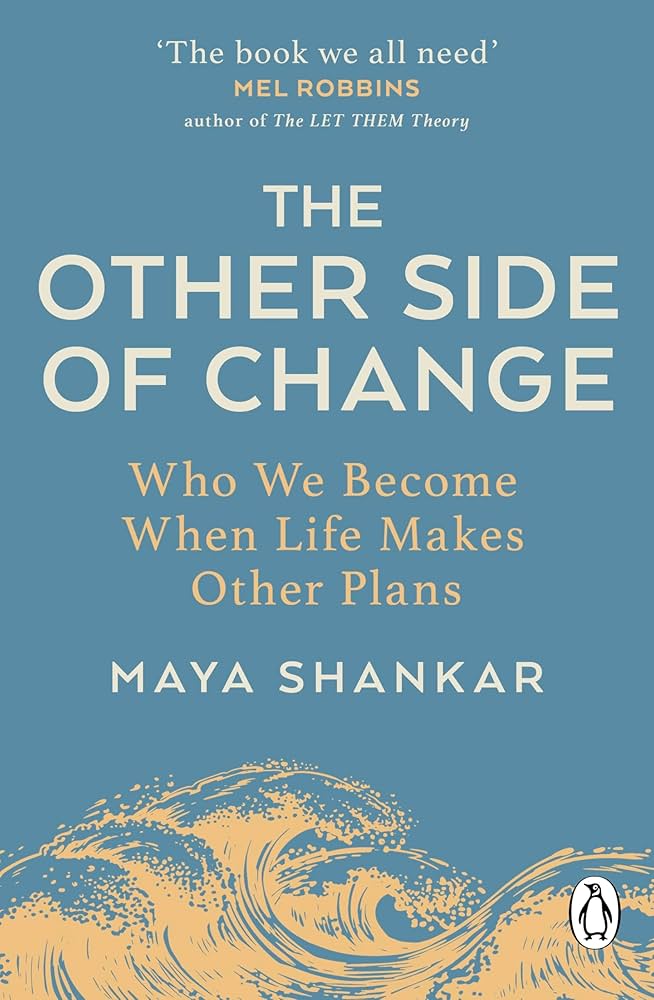
Managed to read this book during my week away from work. The book is a collection of real life stories that the author has collated via her podcast. Each story is real and all the character names are real. Each story is about what happens to someone when faced with a radical turn of events. The author narrates real life stories to illustrate cognitive psychology principles that can be understood and internalized by anyone. I think the point of using stories as a backdrop, is to enable the reader recall the main principle that the author wants to highlight.
Structure: seven chapters, one principle each. Shankar’s own thread runs through all of them — the violin injury in ch.1, the search for a possible self in ch.2, her COVID insomnia in ch.3, and the whole of ch.7. The appendix (“Your Change Survival Kit”) restates each chapter’s tools in list form.
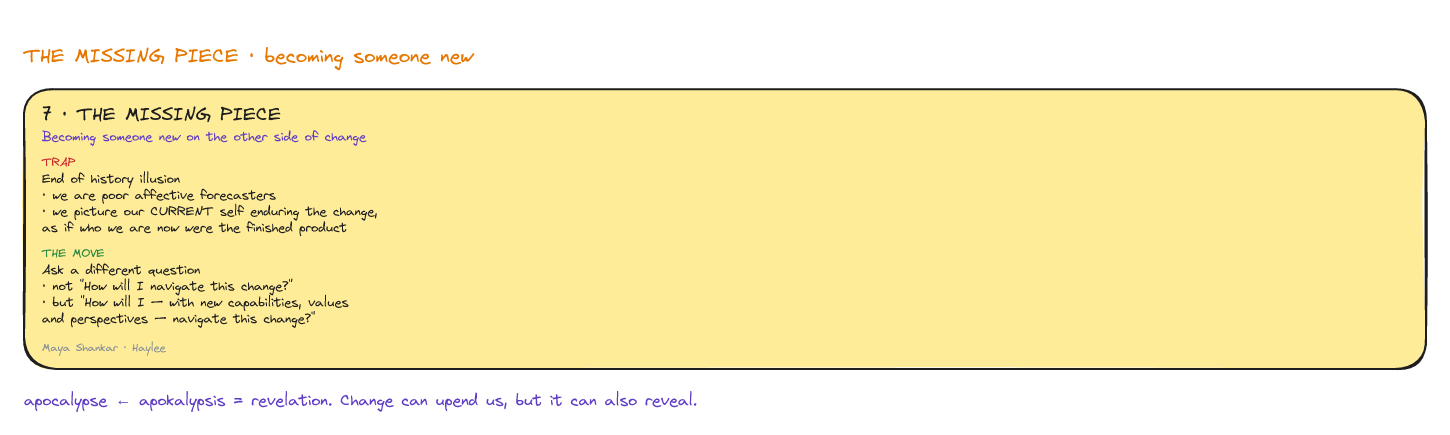
The preface gives the book its framing image: apocalypse comes from the Greek apokalypsis, which means revelation. Change upends, but it also reveals.
Locked In

Olivia Lewis

Kate Allatt
Principle illustrated
Revisiting our self-identity. Denial is a psychological immune response — it buffers us from grief, guilt, fear and helplessness in the short term, and costs us in the long term.
Two orders of it. First-order denial rejects the basic facts — the diagnosis, the death. Second-order denial accepts the facts but rejects their implications: minimising the seriousness, projecting an overly optimistic path ahead, avoiding anything that contradicts the story. Olivia’s was the second kind. She accepted that she’d had a stroke; what she refused was that recovery might be partial. She had her grandfather vet every video before she watched it, so no recovery story unlike Kate Allatt’s could reach her.
The short-term/long-term trade-off has direct evidence behind it. In a study of patients hospitalised for heart problems, the high-denial group did better in the short run — less time in intensive care, fewer cardiac symptoms during the stay — and worse in the year after discharge: poorer adherence to medical advice, more rehospitalisation.
One of its main causes is a threat to self-identity. Olivia had anchored hers to things she did not control: other people’s approval above all — her friends, her boyfriend Shawn, and Shawn’s wealthier family, whom she had spent years trying to win over. Locked in, she could no longer perform the version of herself she believed made her acceptable. She cried when nurses discussed her bowel movements in front of visitors, and begged for a “photo wall” of pre-stroke pictures so that her new therapists would meet Old Olivia first.
Kate Allatt’s memoir cuts both ways in this chapter: it was the inspiration her family reached for when she was suicidal, and it became the standard she measured herself against, so recovery on any other timeline felt like failure.
What actually shifted her was not an argument but her therapists’ complete indifference to the things she was ashamed of. Will wiped the drool off the floor and carried on with the session. Esther pushed her back up the bed as casually as holding a door open. Nobody reacted to the oversized diaper. Will’s line when she demanded to know why she was being fitted for a wheelchair if she was going to walk again — “I don’t know what’s going to happen in the future. We’ll try our hardest to get you walking, but it’s very important that we focus on today” — is the hinge. Weeks later she let herself drool onto her own shirt rather than break off mid-sentence: This is who I am right now.
The move out is self-affirmation — deliberately shifting the mental spotlight onto parts of your identity the change hasn’t touched. (In one study, heavy-drinking young women who first wrote about something they valued in themselves unrelated to health were more persuaded by a pamphlet saying they were at raised risk of breast cancer, and likelier to intend to cut down. Affirming the untouched part lowers the threat, which makes the bad news admissible.)
And re-tethering identity to more durable sources: defining yourself by why you do something rather than what you do. This is Shankar’s own lesson from losing the violin at fifteen to a hand injury — she could no longer play, but the why underneath it (connecting with people emotionally, honing a craft, being creative, belonging to a community) survived and could be re-housed in interviewing and in cognitive science.
Olivia today walks with a limp, speaks with a voice that tires, eats Goldfish crackers and Hershey’s Kisses, has deleted every photo of Old Olivia, and is in graduate school to become a mental-health and rehabilitation counsellor.
Resonance
I think denial, be it first-order or second-order, is something I have not experienced. Whenever some life-altering change has happened in my life, more often than not, I have either entered a state of rumination or thought about the ways in which possible selves have been destroyed. Even though I can understand it intellectually, I don’t think I can relate to the behaviour.
Possible Selves
Dwayne Betts
Etheridge Knight

Christine Hà

Nora McInerny
Principle illustrated
Revisiting what is possible in our future. A big change reshuffles our possible selves (Hazel Rose Markus and Paula Nurius) — hoped-for selves (aspirations), feared selves (worries), expected selves (what we predict is most likely).
Dwayne’s terror was a feared self: not violence done to him, but who he might become. “It wasn’t just the fear of violence I felt. It was the fear of everything that I might become.” And in the other direction the list was empty: “There was no cultural reference, no narrative reference, no film reference of what I might be that would have allowed me to sleep at night.” Nora’s feared self was “widow” — defined by tragedy, perpetual sadness, and other people’s pity. “I did not want to be a dead-husband person.”
Two ways to conjure new ones. First, moral elevation (Jonathan Haidt): the warm feeling of witnessing another person’s moral beauty, which cracks open your sense of what is possible. This is the chapter’s engine and it arrives in two stages. Bilal — crisply ironed prison clothes, clean-shaven, up and ready an hour before the guards came for count — taught boxing to Jamil, a fourteen-year- old someone had tried to rape, and to the other young men, in a place where visible concern for others could get you killed. Watching that, Dwayne saw that the landscape of possibility inside prison was wider than he’d assumed. Then, in solitary, an underground library run on a forty-foot rope of torn bedsheets pushed The Black Poets under his door, and Knight’s “For Freckle-Faced Gerald” showed him his particular place on that landscape: “I couldn’t do what Bilal could do for Jamil… But I could do what Knight did for the guys he wrote about.” Learning afterwards that Knight had actually been incarcerated is what converted admiration into possibility — “Oh, damn — I could really do this.”
Second, ask what your existing skills and knowledge are worth in a different domain: “Who else can this person be?” — Christine Hà’s answer to blindness. Also Shankar’s after the violin: none of the technical skill transferred, but grit, creativity and performing under pressure did.
Two further routes the chapter names: reading fiction, which researchers treat as an “identity laboratory” where you blend yourself with characters and try on traits without cost; and deliberately exposing yourself to unfamiliar fields with no goal in mind. Shankar’s father, the summer the violin ended: “You’ve been effectively wearing blinders for the past ten years. Your job is to expose yourself to as many ideas as you can, with the most open mind possible.” Steven Pinker’s The Language Instinct came out of that phase, and with it Cognitive Scientist Maya.
Realising a possible self is then behaviour-change mechanics: break big goals into smaller ones to avoid the middle problem (Ayelet Fishbach — motivation sags in the middle, so shorten the middles); use the fresh start effect and temptation bundling (Katy Milkman — the reward must be available only when paired with the hard task); exploit the peak-end rule (Kahneman) by ending a session on a high note. Christine broke “become a chef” into cutting an orange and scrambling eggs; Dwayne broke “become a poet” into writing daily, and wrote over a thousand poems in his first year at the supermax.
And find or forge a community that already believes in the new identity — the inmates who nicknamed him “Professor” and cheered when he jumped on a chair waving his acceptance letter from Poet Lore; Nora’s Hot Young Widows Club, where members could try on identities without judgement and “coauthor new possible selves together.”
Resonance
This has happened many times in my life and keeps happening in many aspects of my life even to this day. Every time I do a sprint and create something, the first thought that comes to my mind is — why am I investing time and effort into creating something that has no chance of receiving full-fledged feedback? In that sense, I am forever thinking about all the possible selves that are getting destroyed as I continue to do what I have been doing for the last 10 years. I think instead of randomly ruminating and letting my thoughts go in circles, it is high time I did something about it. Maybe I am afraid of the change it will bring into my life. Maybe I want to somehow keep working from the confines of this little solitude-rich life that I have carved out for myself. Don’t know. There are many questions for which I don’t have any answers yet.
Mental Spirals
Four co-equal stories here, not one anchor plus footnotes — and each person leaves by a different door. That one-to-one mapping is the structure of the chapter.
Matt Gutman
Kylie Yorke
Florence Williams
Ramsey Khabbaz
Principle illustrated
Revisiting our mental patterns. Rumination is the loop where the brain tricks you into believing you are making progress on a problem while it makes things worse. Its allure is that analysis usually does bear fruit, so each pass feels like the verge of a breakthrough: if I analyse the mistake enough I won’t repeat it; if I dwell on this failure I’ll have paid my penance.
Shankar’s image: each repetitive thought lays another brick in a mental prison. Matt’s walls were self-loathing, Kylie’s were apocalyptic visions of the planet, Florence’s were a futile quest for closure, Ramsey’s were fear of unseen threats in his own body.
The exit is psychological distancing (Ethan Kross, Ozlem Ayduk) — rumination comes from zooming in too close, so the move is to actively zoom out. There are many doors into it, and the chapter gives each person exactly one:
| Person | Wall | Door | What opened it |
|---|---|---|---|
| Matt | “I’m broken” | cognitive reappraisal | Randolph Nesse’s evolutionary account of panic |
| Kylie | the burning planet | mental time travel | Harari’s Sapiens + the 16 million WWII enlistments |
| Florence | the unanswerable why | community; letting go of closure | the Museum of Broken Relationships, Croatia |
| Ramsey | the treacherous body | awe | Hannah and Her Sisters at his neighbourhood cinema |
Matt. He’d had over a hundred panic attacks in twenty years, and they never fired in physical danger — war zones and hurricane wreckage were fine, because nobody expects polish there. They fired where expectations were high. It was social-judgement panic. After the suspension he set a Google alert on his own mistake and read the comments. The exit came a year later, on a Zoom call from a hotel room with Randolph Nesse, an evolutionary psychiatrist at Arizona State, whom Matt had sought out to learn why he was broken. Nesse attacked the premise: panic is an asset, not a glitch — “it is more adaptive for our brains to respond to a thousand false alarms than to miss a single real one” — and social threat counts, because ancestors cast out of the group died. “I could stop hating my mind.” Only after the reappraisal did the practical treatment work: CBT and SSRIs (which Shankar names as first-line when rumination compromises mental health), plus breathwork and guided psychedelic trips.
Kylie. Shankar’s friend, guiding kids at a nature-based therapy organisation near Lake Tahoe the summer after her junior year, when they smelled smoke on a hike. Days later, on a run: “The forest I’d grown familiar with was reduced to charcoal stubs.” Her coworkers, desensitised by past fire seasons, shrugged. She lost the ability to enjoy birdsong, imagining it gone. The exit was mental time travel backwards through human history, prompted by reading Sapiens for her thesis: humans have faced existential threats throughout, and have met them by collective action — and can change their minds about whether to care at all. Note Shankar’s caveat: forward time travel (“will I care in five years?”) works for personal problems but explicitly would not work for climate change.
Florence. The discovery was accidental — she asked about her ill father-in-law, he opened his phone to show a health update and pulled up an email declaring love to another woman. He called it an emotional affair, agreed to months of couples therapy, then said his “real soulmate” was someone else and asked for a divorce. Her science-journalist instinct was to establish exactly what went wrong, when and why. The 14-day solo canoe trip was that instinct executed, and it backfired: alone on a ledge above the river with a notebook, she swung from “entirely his fault” to “entirely mine” and spiralled into self-blame. The exit came about a year after the divorce — in Slovenia for a conference, she took a train to the Museum of Broken Relationships in Croatia and found her own obsession, melodrama and self-loathing sitting in strangers' exhibits. “That shock of recognition that something that can feel so singular is actually universal was comforting.” The lesson: cognitive closure was an impossible goal she should let go of. She went looking for the answer in solitude and got free through company.
Ramsey. A film and English major, twenty, woke to a piercing ring in his left ear and by evening had lost all hearing on that side. Diagnosis: tinnitus and sudden sensorineural hearing loss. Cause never found — the MRI ruled out a tumour but explained nothing, and the unexplained-ness was the wound. He saw half a dozen doctors chasing any cause that would let him trust his body again. About a month in, his neighbourhood cinema — “the equivalent of going to church” — ran a Big Screen Classics series, and he and his girlfriend picked a film neither had seen: Hannah and Her Sisters. The subplot is Mickey, a hypochondriac TV writer who wakes with hearing loss and ringing, is told it could be a brain tumour, gets a clean bill of health and spirals anyway — until he wanders into a cinema showing a Groucho Marx film, laughs, and thinks “I should stop ruining my life searching for answers I’m never gonna get, and just enjoy it while it lasts.”
That is awe — Dacher Keltner’s “the feeling of being in the presence of something vast that transcends your current understanding of the world.” Neuroscience shows awe reduces activity in brain regions associated with self-focus, which is why it dissolves a self-referential loop rather than arguing with it.
Shankar closes the chapter with her own case, as a second illustration of awe: insomnia at the start of the pandemic, with no cause to find, which is what enraged her — “my mind had just decided to go rogue.” She cut caffeine, banned naps, wore blue-light glasses, interrogated friends about their sleep. It worsened. The shift came walking to the farmers market listening to César Franck’s Violin Sonata played by Ray Chen — in the third movement “something within me released… as if a tiny needle had punctured a high-pressure balloon.” It did not cure the insomnia (that took months) but it broke the frame in which daytime was only a runway toward the next night’s test.
The rest of the kit, assembled deliberately because different tools work in different situations and what worked last time may not work this time: affect labelling (shifting from being the emotion to having it), visual self-distancing (fly on the wall) and distanced self-talk (coach yourself as you’d coach a friend, or use your own name — “Maya, you need to get a grip”), and plain distraction, which is healthier than its reputation — Kross: “If something doesn’t keep cropping up, there’s a good chance you’re not harbouring some invisible wound.” Michelle Obama knitted; Shankar’s sister cooked and did thousand-piece jigsaws; her old philosophy professor turned to test-prep books “because there was some relief in being asked a question that had a right answer.”
Loneliness and rumination reinforce each other, so community breaks the cycle too. Underneath it all sits intolerance of uncertainty: the less you need cognitive closure, the less grip rumination has. Ramsey’s tinnitus never went away — his relationship to it changed. Two years in, he noticed at breakfast that he’d gone an entire day without thinking about it. “It’s just my version of quiet now.”
Resonance
This is a classic pattern that I have fallen into many times, be it change at the personal level or at the professional level. Umpteen times, I have fallen into this trap. More often than not, writing has helped me create the necessary distance to work through those situations. In one sense, my daily writing ritual has helped me catch these ruminations. Even though I do not write in the third person, the mere act of writing about my thoughts on a daily basis, come rain or shine, has helped me.
What I notice only in hindsight is that every exit in this chapter arrives from outside the person’s own head — Nesse, Sapiens, a museum, a film — and Florence’s solo canoe trip, the one attempt to reason a way out alone, is the one that backfires. That runs against my own solution: the reframe is imported.
The second thing in this chapter is the gap between the kit and the doors. The kit — affect labelling, fly-on-the-wall, distanced self-talk, distraction — is uniformly about noticing a loop; the Wall/Door table above is uniformly about ending one. Shankar offers the kit as a menu of interchangeable tools, and it isn’t: catching a loop is not ending one. Her insomnia is the proof: the Franck sonata broke the frame immediately, but the insomnia itself took months — two effects, reported as two.
A Hole in the Heart
Tara Sharp
Principle illustrated
Revisiting how we relate to others. A big change distorts, strains and sometimes breaks existing bonds. Attachment theory (Bowlby and Ainsworth) gives the frame: secure (comfortable with intimacy, a fundamental sense of safety with others), anxious (craves intimacy but insecure about others’ commitment, so seeks constant reassurance), avoidant (fears intimacy, struggles to express needs, overly self-reliant).
Tara’s father Felix was a deeply generous man — care packages for flood victims, PTA, volunteer art teaching, soccer on the beach with her classmates after school — who also had sudden rages that terrified the family. He had been drafted to Vietnam and flown planes carrying the bodies of American soldiers home; he vomited after every flight and came back with PTSD. Tara didn’t learn any of this until years later. At eleven she watched him hurl a china platter across the room and thought: this man is not my dad. This man is a stranger to me. Her response was a child’s bargain — she would love him so hard that he wouldn’t feel the pain. Perfect report cards, teachers’ “sunshine notes”, a tidied room, fierce hugs morning and night.
Three nights into her college orientation she called home; her father opened champagne and told her how proud he was. The next day her mother called her home. He had died by suicide. (He was not a drinker — the book is explicit about that. The illness was PTSD.)
The conclusion Tara drew was that her love had not fixed him — it had only destroyed her, so love itself was the hazard. She broke up with her long-term boyfriend, drifted from her brothers, buried herself in classes and winery shifts, and offered to work extra hours whenever tears threatened. “You know how there are those stop-motion videos of a butterfly coming out of its chrysalis and spreading out its wings? Emotionally, I did the reverse.” She later married Ben partly because he was also emotionally unavailable: “a good match, with walls on both sides of the relationship.”
The second change is what opened it. A 3D ultrasound at nearly six months found a hole in her second daughter’s heart — Tetralogy of Fallot, which turned out to run through some dozen members of her family, a lineage documented in a medical journal, and which her mother had been advised never to mention. Told she would “effectively be delivering a terminally ill baby,” Tara and Ben handed the decision to the surgeon, who said, “Please let me try.” Then she spent the rest of the pregnancy refusing to attach — hiding Cece’s “Big Sister” T-shirt on a high shelf, rehearsing the speech she’d have to give about the sister who didn’t make it. After Ellie was born she asked others to do the loving for her: “I need you to love Ellie more right now. Because I know I can’t.”
The turn is a single physical moment. Driving home from a hospital check at three months, Tara caught Ellie’s eye in the rearview mirror — feeding tube gone, cheeks pink instead of blue. Parking in the garage, she said hello, Ellie cooed and looked straight at her, and Tara’s knees went out from under her on the concrete. “Suddenly, it just became so clear to me that I wanted to love Ellie, even if it meant getting hurt, because the fear of my loving her was completely depleting me.”
The finding that matters is that attachment styles are far more malleable than researchers once thought — not set in stone by early experience, and continually reshaped by new experience. As Faith Hill writes in The Atlantic: “Attachment orientation is complex. It’s an ongoing interaction between the external world and your internal one, between your circumstances and your interpretation of them.”
So the move is deliberate: seek out experiences with people who are reliable and who make you feel safe, and mine your past for the times people did show up for you. In one four-month study, weekly reflection on prior secure interactions measurably reduced insecure attachment. Tara’s crisis with Ellie forced exactly this — she had to let people in — and she then did it on purpose, over years and with a therapist. She told her brother Krishna plainly how he’d let her down during Ellie’s first surgery and asked explicitly for what she needed; at the second, he organised meals and sent updates and “did everything I asked, and more.” She let Claire in, then a wider circle. “I had believed for so long that keeping my fear inside of me would keep it controlled. What I actually found is that, once I started talking about it with my friends, my fear had a lot less power over me.” The byproduct was a life full of secure relationships.
The ending is not a saved marriage. Roughly a decade after Ellie’s birth, Tara and Ben divorced — and could do it well, precisely because they could finally talk: “What we were building was a sandcastle that couldn’t withstand the pressure of all the changes we had to confront as a couple… So let’s build a different type of castle together.” They live blocks apart, spend holidays together, and are better friends than they were spouses.
Resonance
For the longest time I shunned any deep relationship with anyone. Of course, there are many incidents in my childhood that must have shaped my personality. I did try to grow out of it by making myself available to different people over the past few decades. Each time, I felt that either I was incapable of attachment or that others were not worth my time and effort. In many cases, I have been at the receiving end, so much so that I decided to stay single. However, as they say, humans are bad at affective forecasting. Today I can’t believe that I have two daughters whom I am massively attached to. Whatever comes back to me, my personality has undergone a 180-degree shift where I am ok with however things turn out. A recent near-miss with a car brought this home: what frightened me in that instant was not my own death but my daughters being left without my support — the exact opposite of the person who once decided that staying single was the safer bet.
The Blank Slate

Ingrid Rojas Contreras
Brad Snyder
Principle illustrated
Revisiting the beliefs we grew up with. Change is an opening to re-examine long-held beliefs — especially the ones formed in childhood, which everything since has been built on top of, and which are therefore the most disorienting to touch. Our beliefs sit inside what Dan McAdams calls our narrative identity, and because we crave consistency in that story, pulling a single thread is destabilising enough that we avoid it.
Ingrid’s amnesia handed her a literal blank slate. Two details make her story more than a curiosity. First, she did not want the memories back: lying in the road she felt “far lighter than before,” nearly threw away her messenger bag to avoid identifying herself, then covered every mirror in her apartment with bedsheets and hid the extent of her memory loss from her boyfriend Jeremiah so nobody would break the spell. Second, when her family history did return — about seven weeks in, triggered by an image of her mother holding tarot cards — she told the curandero stories delightedly at a dinner party, right up until the memory of the prohibition came back, and with it the concept of shame. And the concept was all that came back: “Though I could recall the shape and weight of this shame, the sting of it was gone.” That gap is the whole chapter. She then realised Sojaila had never been ashamed — she was proud, and the warning had been purely practical protection against people who spat at her in Bogotá. The shame was Ingrid’s own added layer: “If you’re told you can’t share things with other people because they’ll judge you, you can start to believe there is something inherently wrong with the thing that you’re hiding.” Her novel Fruit of the Drunken Tree (2018) came first; the memoir she had been unable to write, The Man Who Could Move Clouds (2022), was a finalist for both the National Book Award and the Pulitzer.
Brad Snyder had to rewrite a narrative identity built on military heroism — a WWII-veteran grandfather he wanted to follow, the Naval Academy, EOD work — and his first thought after the IED took his sight was “I have essentially failed at my job.” But the belief he actually had to dismantle was about his little sister Elyse: that his value to her was being the badass who jumped out of planes and took apart bombs, and that she would be diminished by seeing him in a hospital bed. She wasn’t. What defined the relationship for her was cheesy jokes, SNL sketches and Will Ferrell quotes — a version of Brad entirely intact. “I realised that this hero thing was never actually part of her narrative.” Like Ingrid, he had absorbed a belief from elsewhere and attributed it to the very person it was supposedly about. Losing it is what let him admit need — the day he and his guide dog got lost in Baltimore, he called Elyse instead of hiding it.
The tool is metacognitive awareness — thinking about your thinking. Analyse your ideas like a scientist (Adam Grant, after Arnaldo Camuffo): stay curious, treat beliefs as hypotheses, ask how you got from point A to point B, whether the belief would survive scrutiny from people you trust, and what evidence would change your mind. A second lever is counterfactual: imagine you had been born in a different time, culture or family — would you still hold this belief? (Or: what if you’d been in a different emotional state when you first heard it, or a different person had delivered it?)
The chapter’s governing image is the therapist Abby Birk’s garden: you are born with a plot in which some things were already planted without your say — a sensitive nervous system, a predisposition to anxiety, but also natural resilience — plus seeds sown generations back and weeds everyone inherits. As an adult you choose what to pull and what to grow. A change is a chance to weed.
Ingrid now occasionally practises “having amnesia” on purpose, defamiliarising her surroundings until a highway becomes strange again. Her family, who believe Sojaila’s own childhood amnesia unlocked her curandera powers, joke that Ingrid “did amnesia wrong.”
Resonance
I love the ideas presented in this chapter through various stories.
A change is a chance to weed
Constantly simulating what-if scenarios by considering your life as a Markov process is a great way to make change your ally. The stories reinforce this thought.
A City of Refuge

Maryann Gray
Scott

Christy Warren
Principle illustrated
Revisiting our beliefs about fairness. The belief in a just world (Melvin Lerner, 1960s) says good is rewarded and bad is punished — comforting, because it implies we are not vulnerable to random catastrophe. Rubin and Peplau built a Just World Scale in 1975 and found people run the whole gamut on it. Its corollary is a strong internal locus of control (Julian Rotter), which correlates with well-being right up until something inexplicable happens, at which point it converts into undue self-blame and shame.
Maryann’s case is the extreme form. Everyone — police, witnesses, her professor, her parents — told her it was an accident, and that was precisely what she found intolerable, because a world in which a careful person kills a child for no reason is a world with no handrails. So she reached for a worse explanation that preserved order: she must be dangerous at the core. “I felt my dark side was so dark and so powerful that it had lured Brian into the road.” She then lived accordingly for twenty-five years — potted plants to warn visitors of a porch drop-off, no knives left in the sink, no children near her, dysfunctional relationships she felt she deserved, and a decision not to have children as punishment. She gave the voice in her head a name: Inner Brian, who scolded her whenever she went a few hours without thinking of the real Brian.
The chapter’s cleverness is showing the same mechanism pointed outward. Lerner first noticed it among otherwise compassionate care providers who spoke disparagingly of mentally ill patients — easier than accepting random cruelty. He and Carolyn Simmons tested it in 1966: participants who watched someone receive electric shocks and could not intervene were likelier to devalue and disparage the victim. The effect shows up in five-year-olds, who dislike children whose soccer game got rained out. Scott preferred to believe his choices caused his cancer, because that preserved control over his future. Christy Warren’s crew blamed the people they couldn’t save, because otherwise they weren’t rescuers: “We’re rescuers — that’s who we are. And if we don’t rescue somebody, then we’ve done something wrong, and we’re not rescuers anymore.” The public wanted George Weller to be a monster, because the alternative is that any of us might unintentionally kill ten people. Maryann, watching that coverage, was the one person inclined to give him the benefit of the doubt — and that is what got her to write.
The counterweight is self-compassion (Kristin Neff): recognising the pain as part of a shared human experience, which depersonalises the event — something that happened to you, not because of you. Writing exercises help — and specifically the structured kind: in one study, participants who wrote to themselves with kindness and tried to describe how others might have endured something similar showed a significant drop in shame, while those told simply to “let it all out” showed none.
So does service, which is how Maryann eventually got out. As Vivek Murthy puts it, helping someone reaffirms that you have value to bring to the world. The chapter names the trap this breaks: shame-prone people underestimate their value to others, so they withdraw, so they contribute less, which confirms the suspicion.
Two things gave her the vocabulary. The NPR All Things Considered essay, written the day after the farmers market crash and submitted before she could talk herself out of it, drew more listener mail than any segment that week and no backlash at all — if I can forgive Weller, can’t I forgive the twenty-two-year-old who hit Brian? And then, searching online for “accidental killer,” she found a rabbi’s page on Numbers 35: the six cities of refuge to which an accidental manslayer was to flee, where he was protected from blood avengers and welcomed into the community. “If I had been exiled to a city of refuge, I might not have needed to exile from myself.”
She built one. Accidental Impacts — a bare-bones website with her story and an invitation to email — became a nonprofit in 2019 and was renamed the Hyacinth Fellowship in 2022, after Apollo, who accidentally killed Hyacinthus with a stray discus and raised a flower from his blood. She also wrote to Brian’s mother, who had died; his brother called instead, angry, asking questions, and by the end asking about her life. Afterwards she waited for Inner Brian to scold her for it. “For once, he truly had nothing to say.”
Her final reframe: “Why was I the one who hit and killed Brian? It’s just not that interesting of a question anymore. The much better question is, what am I going to do about it?” Maryann Gray died on 1 April 2023 of complications from a bone-marrow transplant, while the book was being written.
Resonance
The concept of self-compassion is something that I recently came across in How a Little Becomes a Lot , where Eric Zimmer argues for it in cases where the changes are self-imposed, whereas this book is about external changes caused by things beyond our control. We often fall for the “just world fallacy”; at least I carry it with me wherever I go. Whenever I do anything wrong, anything I think post-facto should not have been done, I start anticipating negative events in my life. This is the karma that Hinduism, Buddhism and many other religions preach. In a way, I have no issues accepting that, and in fact I do believe in it. However, the reason for internalizing “karma” is to get me out of negative practices rather than to leave me stuck in a rut. In the context of this chapter, when unanticipated change happens, we often try to believe that it was our mistake — that the world is fair and the fault lay with us all along. This is a natural consequence for anyone who applies the karma principle to everyday life events. At least, I would tend to attribute a big transition to some form of karma. Instead of moving along and doing something about it, or doing something unrelated to it, there are chances that I can get into any of the traps that the book has mentioned:
- could possibly deny it before it hits me hard
- could not even entertain the thought of exploring possible selves
- might ruminate away and get stuck
- might not be willing to share with anyone and destroy my existing relationships with others
- might be taken over by the false narrative identity of the brain
- might not be able to envisage how the event might transform us at all. We might be evaluating the outcome of the change with our existing personality traits
All of the above faults could arise from a simple false belief that “the world is just” and that we deserved the random catastrophe that hit us. It is here that the author’s strategies of self-compassion intersect with Eric Zimmer’s point that we need to have a listening ear for the person inside us, as well as be willing to take action that comforts that inner person.
The Missing Piece

Maya Shankar
Haylee
Principle illustrated
The chapter is about author’s experiences of trying out the route of surrogate pregnancies and failing both the times.
Becoming someone new on the other side of change.
Her fear was specific and old. At seventeen, having just lost the violin and fallen back on her other childhood dream of a big family, she caught a rerun of The Matthew Shepard Story and for the first time imagined being the parent of a child who suffered. The thought seized her permanently — “my Room 101,” after the chamber in 1984 that holds the thing each person fears most. She wanted children more than anything and believed she lacked the emotional constitution for it. Her father’s response, on a walk through a cemetery in her sophomore year — “No matter what suffering we endure, this will be our fate. So never let your fears grow too big” — was her first taste of zooming out.
A rheumatologist later found she carries a rare set of antibodies that would endanger fetal heart development, so carrying a pregnancy herself was off the table. She told Jimmy all of it at once, standing in front of a cabin fireplace a month into the relationship, certain it would end things. It didn’t.
Then: two egg retrievals, frozen embryos, a surrogacy agency, and Haylee. First transfer in early 2020 — a 65% chance, a positive test, a heartbeat on a video call — and days later a call that began “There was no baby on the ultrasound.” Haylee insisted on trying again. Second transfer in 2021; the ultrasound after a bleed found not only a strong heartbeat but a second baby — the embryo had split into identical twins — and by four o’clock that same afternoon it was over. Their doctor’s explanation was likely immune rejection of the embryos by Haylee’s system, not a genetic problem. The baby already had a name, Karina; Shankar had set up an email address for her and signed the first message “Love, Mom.”
We crave certainty about the future and are bad at supplying it: we are poor affective forecasters, and the end of history illusion (Dan Gilbert and colleagues) means we badly underestimate how much we will change going forward, even while readily admitting how much we have changed already. So when we imagine enduring a hard change, we picture our current self enduring it — as if who we are now were the finished product.
The reframe:
the right question isn’t “How will I navigate this change?” but “How will I — with new capabilities, values and perspectives — navigate this change?”
Shankar’s own turn came through a gratitude list — Jimmy’s suggestion, on the night of the second loss, when she badly did not want to do it — that reminded her how multidimensional her life still was outside the one identity she had collapsed into, and through offering the story outward on the podcast, recorded deliberately fast, before she could “start stitching together a clean narrative.” Replies came from Greece, Mozambique, New Zealand, India, Sweden: “I’d never before imagined what it would feel like to be hugged by the world all at once.”
The book ends genuinely unresolved. The embryos are still frozen; doctors are optimistic about another surrogate; adoption is still open — and so, now, is a child-free life, which Jimmy first floated one evening on the couch and which she was surprised to find did not threaten her identity. She closes by reading her own situation through her interviewees: Olivia on a more resilient self-identity, Dwayne on authoring new possible selves, Nora on the stigma attached to child-free women, Ingrid on revisiting childhood beliefs, Florence on relinquishing the need for closure. “I was going to be a violinist, and then I was going to be a mother. And now I find myself conceiving of a future in which I am neither. Unexpectedly, I’m more hopeful than I’ve ever been.”
Resonance
Over the course of my life, I have changed many times as a person. If someone were to ask me every 5 years how life has changed me as a person, I can safely say, looking at the data points spanning 20 years, that my predictions about how my life would pan out over the next few years have been wrong pretty much every time. At every such reflection point, if I were given the chance to time travel and experience those feelings again, I would have said that my life had changed dramatically but would not change a lot in the future. More than a decade ago, I held a firm and entirely unfounded conviction about how long I would live. I could not have told you where that number came from. 15 years ago, if someone had asked me whether I would be a father of two kids and spending a significant amount of time taking care of them, it would have been unthinkable, as I was pretty sure that I would stay single throughout my life. If someone had suggested that I would be teaching aspiring traders about ETFs and NLP every single month, it would have been unthinkable, as I liked solitude so much that I preferred spending time alone to any other activity. I mean, there are at least a dozen instances in the last 20 years in which I have underestimated the person I could become in the future.
Recently, I had a close encounter with death. A car was about to hit me, had there been even a slight change in the sequence of events. Living in a sanitized environment for the last 10 years or so has meant that such close encounters with death are a rarity, and this one has suddenly made me question several reservations that I have been carrying in my mind. The subsequent days, weeks and months will reveal how much I change because of it. However, as always, I am humble enough to realize that the way it will change me is rather unpredictable. Maybe one of the ways out is to think about such a situation recurring in life and to be thankful for each moment that I get to spend with my family.
Like the author, Maya Shankar, I do maintain a daily gratitude log where I list at least twenty people and dimensions of my life that I am grateful for. The mere reflection and logging of these silent thank-you notes has enabled me to be deeply grateful for everything going on around me. My gratitude log has helped me over the years to go through the changes that life gives me.
Big Picture
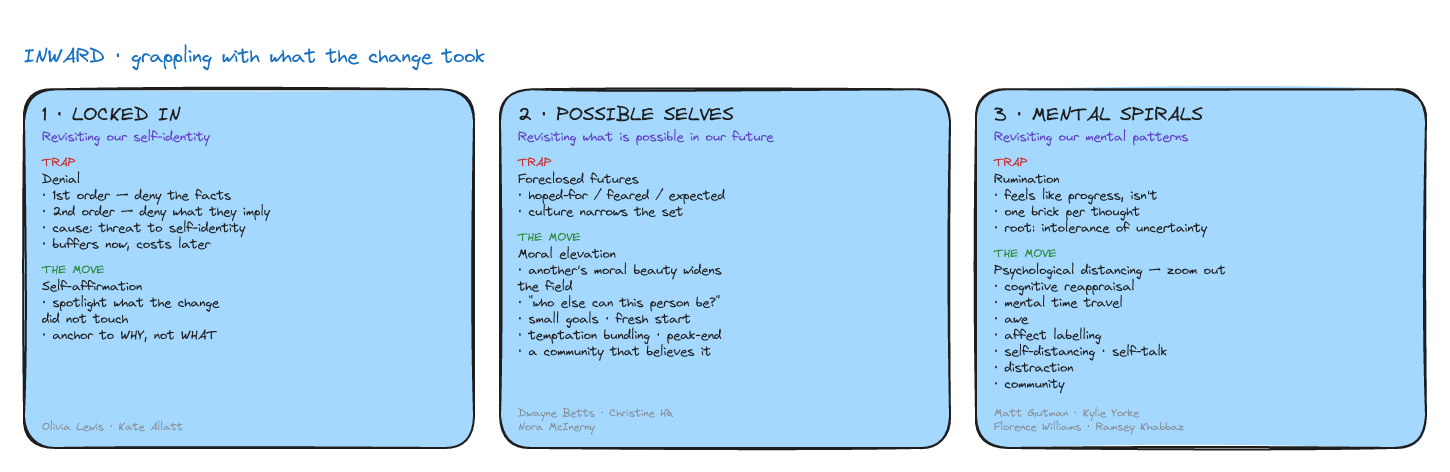
Inward — grappling with what the change took
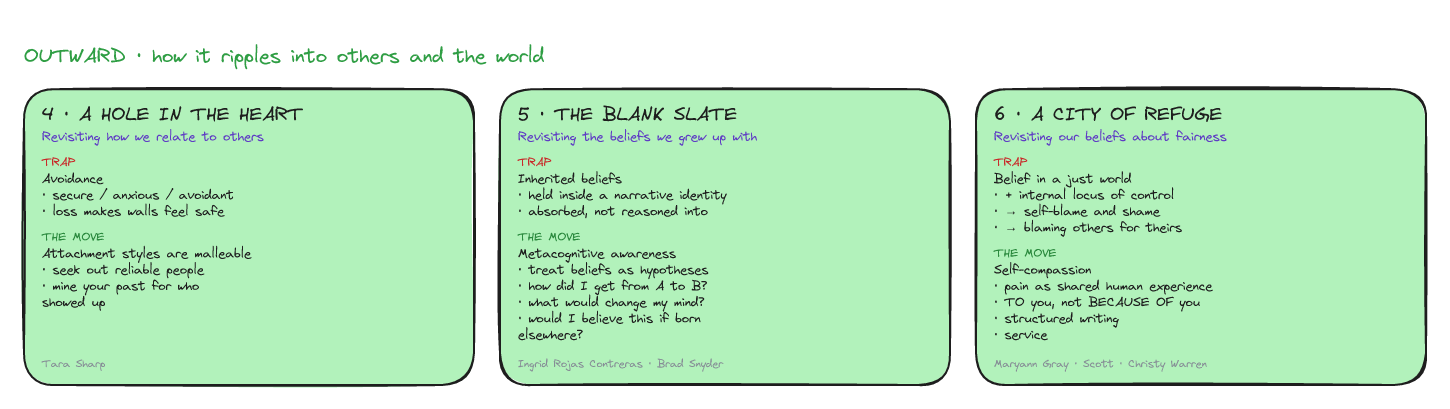
Outward — how it ripples into others and the world
The missing piece — becoming someone new
Takeaway
This book has given me a perspective to look at “change” through the lens of “traps” and “moves”. What might trap us when change hits us, which inevitably it will at multiple points in our lives? What might we do in such circumstances, when an unanticipated change occurs? By providing a vocabulary around the dimensions of change, I think it becomes easier to identify changes in one’s daily life, reflect on them, and act in such a way that the “change” reveals something about us for the better.