Mattering
Contents
This blogpost is about the book “Mattering: The Secret to Building a Life of Deep Connection and Purpose” written by Jennifer Breheny Wallace.

Jennifer Breheny Wallace
Structure: an introduction that names the five pillars, then eight chapters, each built around one or two real people whose story carries the principle.
The Mattering Core
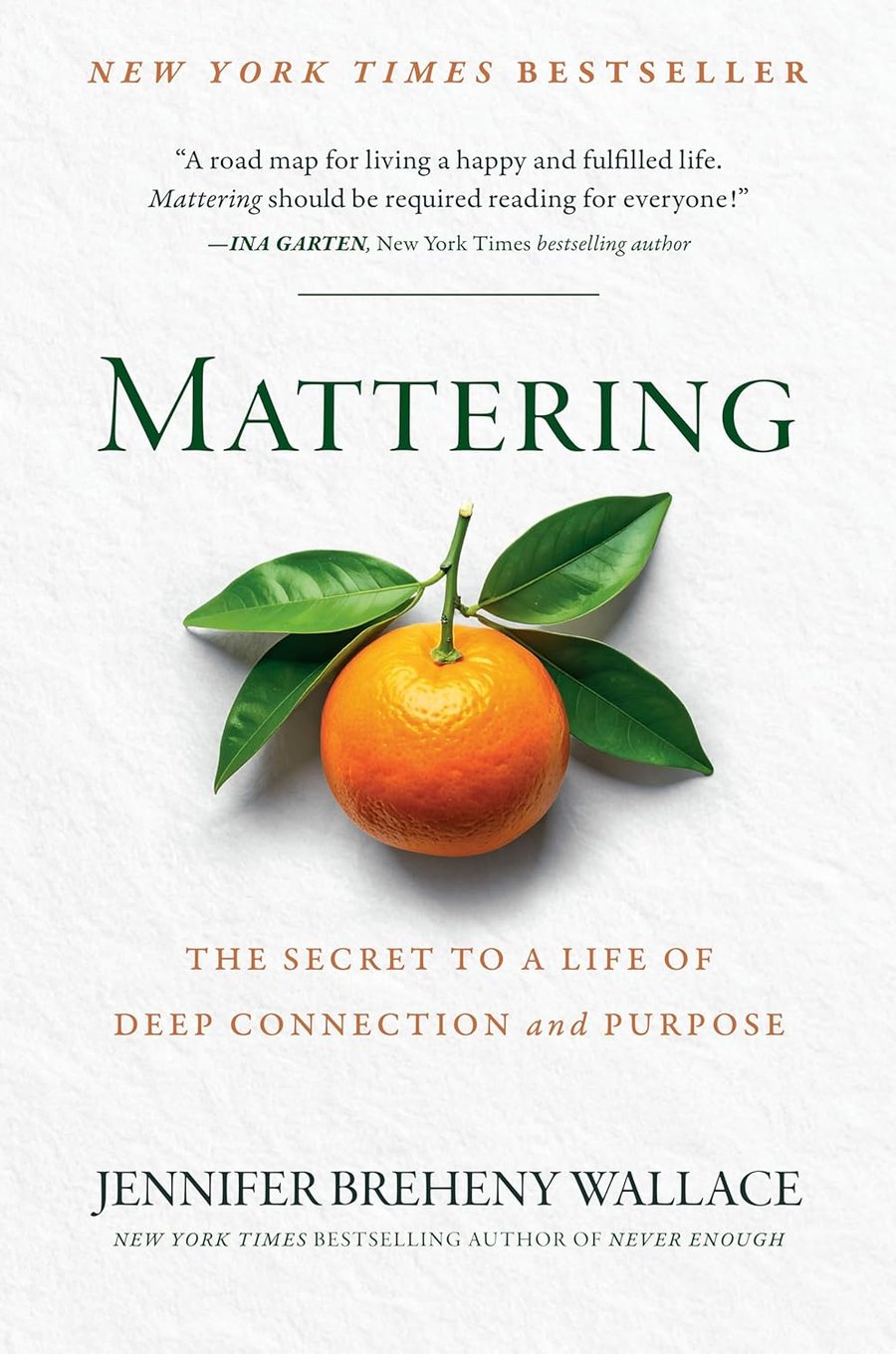
The author explains the reason for putting a “clementine” on the book cover. An interesting story to illustrate the basic human need in almost all of us: “Do you see me? Do you hear me? Do I matter?”.
The five pillars of mattering are stated right away:
- Recognition: You and your actions are valued, and your absence will be felt
- Reliance: You feel needed because others depend on you
- Importance: You feel significant because you are prioritized
- Ego Extension: You feel cared for because others are invested in your well-being
- Attunement: You feel deeply understood and meaningfully responded to
Connect to Your Impact (Importance)

Greg Bulanow
Principle illustrated
The author introduces a very interesting aspect relating to a group of firefighters who happen to have very low morale. One might assume that firefighters who put their lives at risk to save others will find their work very fulfilling. But the reality for this group was that most of the firefighters didn’t get to see what happened to their rescue acts as ER personnel immediately take over, after firefighters pull victims out of the accident. Because of the need for privacy, the firefighters never know what happened to their victims. This lack of seeing closure of their actions leads to demotivation and low morale. Greg, the group leader, realizes this and puts in relevant actions to address the issue.
Through this story, the author highlights everyone’s need to see the impact of their actions. For those who are struggling to see one’s impact, the author recommends having an “impact file” to log all the little ways in which one has contributed to others. By revisiting the “impact file” at regular intervals, especially in times when one is feeling low, one can regain the sense of mattering. This is different from a “gratitude journal” where one thanks all the people, things, events that one is grateful for, in life.
Resonance
I can relate to the situation mentioned in the chapter in the context of the pre-sales demos that I have created in the last 10 years or so. Most of these demos would have resulted in the sale of some offering. But I really do not get to see the impact of my work, more so in the last 4 to 5 years. Spending an enormous amount of time in creating a demo and not knowing whether it has resulted in a sale is an example of “lack of closure” that I can immediately relate to. The issue is not that I am seeking some sense of praise from others but the utter lack of a feedback loop makes it difficult to iterate and create something better.
When I read this chapter weeks ago, the first thing that I could think of was all the work that I do on a daily basis that has no chance of receiving feedback. It was a bit sad to realize that I am in this position out of my own volition and I need to do something about it else I will keep thirsting for feedback and impact for all the years that I stay put in this position.
The Good Kind of Weight (Reliance)

Julie Plaut Mahoney
Principle illustrated
The author narrates the story of Julie Plaut Mahoney, whose life was interrupted with the news of her mother’s cancer. She radically changed her lifestyle and took care of her mother until her last days. Once her mother passed away, Julie had a tough time reconciling to reality. She then realized that one of the ways to connect back to the world was to start a non-profit. She started “Welcome Home” to redistribute her mother’s belongings, turning personal loss into a community infrastructure.
The author uses this story to emphasize the importance of reliance. The author’s key message is that meaningful responsibility is far better than freedom without responsibilities. In a personal or work setting, this can be related to the idea of “skin in the game”. If you have a “skin in the game” approach, your contributions and behavior will be far more impactful and people will rely on you for work.
To add value = Find a need in a world + Apply your strengths
The worst thing that could possibly happen to anybody would be not to be used for anything for anybody
The purpose of life is not to be happy - but to matter, to be productive, to be useful, to have it make some difference that you lived at all.
Mattering Too Much (Importance)

Danna Thomas
Principle illustrated
The author tells the story of Danna Thomas, a kindergarten teacher who is super stressed at work because of a lack of any downtime. The story illustrates the importance of having mini-breaks in a day so that you are centered enough to get effective output.
The same teacher who realizes that she is not paying enough attention to downtime creates a community where teachers can join, connect and develop strategies for self-care.
Resonance
Again this is something that many working professionals can relate to in today’s hectic lives. Ideally one is forced to attend to one task after another, be it in either personal or professional life. This in turn leads to a situation where one has no “downtime”. The “mattering” principle highlighted in this chapter is that of “importance” - insisting on your own priority. In a way self-care is other-focused because one cannot pour out from an empty cup.
The content in this chapter did not resonate with me too much as in my current line of work, I manage to get enough downtime for various activities that I consider important. But I do agree with the overall principle espoused in the chapter.
Everyone Needs (to Be) a Cornerman

Rehan Staton
Principle illustrated
The author starts off by focusing on cornermen in boxing. Before reading this chapter, I never knew about cornermen. The author connects the analogy of cornermen in the boxing arena to the broader need for us to be cornermen in others’ lives and the importance of others to be cornermen in our lives.
To drive home this point, the author narrates the story of Rehan Staton, a sanitation worker who goes on to graduate from Harvard Law School and has a successful career. Reading carefully his story, one realizes that Rehan had many cornermen throughout various points in his life. He also served as a cornerman for others’ lives. I happened to watch an Oprah Winfrey interview with the mattering author, in which there is a video conversation with Rehan. Loved the way Rehan attributes most of his success to cornermen. The entire one-hour video from Oprah Winfrey is amazing and well worth the time.
The term used by the author to describe such behavior is “ego-extension”. By looking at and relishing others’ success, one is extending one’s ego to others. This enables one to look upon others’ success not with envy but with a feeling of happiness.
Resonance
I read this chapter while doing my morning walk. I regularly read-walk as it gives me a chance to silently reflect on the contents of any book. The first feeling after reading this chapter was that I have not been the cornerman for anyone, especially in the last few years or so. I have not genuinely looked at someone and cherished their success as mine. Why is it so? The chapter made me reflect on the way I was spending my everyday hours: it was probably not conducive to opening up chances to be a cornerman in others’ lives? Or am I fooling myself and there are enough ways to contribute to others in a way that their success can feel like mine? Don’t know. Will explore this feeling as I go along in my life. However, I should thank the author for explaining this part well that at least I am able to realize that this is something that is lacking in me.
Tuning In (Attunement)

Peggy Winckowski
Principle illustrated
The author talks about the “Still Face” experiment: A mother who’s normally responsive suddenly goes emotionally blank, and the baby, sensing that disconnect, quickly becomes distressed and starts to shut down. That’s misattunement in its rawest form.
The author uses the example of Grandma Peggy, who hosts a weekly breakfast club for high schoolers even after the death of her grandson. A fantastic story that gives the reader a different venue to come to grips with a change. Instead of an inward journey, tuning in to the specific needs of outside people, one might find solace and strength to deal with unanticipated changes.
Resonance
Given the nature of my work and the lifestyle I have chosen voluntarily, I have noticed that I am more or less not actively choosing to get into this state of attunement. There could be a few reasons why one might find it difficult to find attunement in life:
- Attunement asks you to slow down and actually notice, and modern life is built to keep us reacting, notifications, back-to-back tasks, always half-present. It is hard to tune into someone, or yourself, when your attention is already fragmented.
- Real attunement means sitting with feelings, yours or someone else’s, that you might rather avoid. It’s easier to fix, advise, or distract than to just be present with what’s actually there.
- Self-focus: When we are stressed or depleted, we default inward in a defensive way that leaves no room for anyone else.
When the Rug Gets Pulled

Nancy K. Schlossberg
Principle illustrated
This chapter has a lot of content common to the themes mentioned in the book, The Other Side of Change . Some of the common themes are:
- “Me-Search”: Looking for people who have undergone similar changes, bonding with them and doing something productive about it.
- “Fly on the wall”: Separate yourself from the change, distance yourself and start analyzing your situation. This can open fresh ways to deal with the imposed change.
When change hits, here are two steps you can take:
- First, invite others in. Let them see and tend to the pain. Seek out stories of others with similar experiences. Read memoirs. Listen to podcasts. Look for meetups with people who are in the midst of the same transition.
- Second, look outward. To get out of your own head, go find a need in the world. Remind someone else why they matter in small ways—thank the cashier, call your mother, carry a neighbor’s groceries, or donate books to a local school. Small acts help rebuild our sense of worth.
Resonance
In one of the podcast interviews, the author says that “accepting invites” and “sending invites” are great ways to get out of the rut of constant rumination. Whenever unexpected change hits us, the classic tendency is to obsessively ruminate. To get out of the rut, maybe it makes sense to rejoin a different group and explore the possibility of opening up to a different set of individuals.
Rest of the Chapters
The last two chapters focus on looking at the “mattering” principles in the context of the “workplace” and in the context of “community spaces”. Found the content in both the chapters very interesting.

Pietro Mangione

Lorenzo Lewis
Takeaway
Two weeks ago when I bought this, I never thought the content of the book would resonate with me as much as it did. From the title, I thought “mattering” principles would center around some random ideas about how mattering is important. However, I devoured the book on a few morning walks. There is no doubt that I am going to apply some of the principles in my personal life. I am glad I found the time and inclination to read this book.