The Courage to Be Disliked
Contents
This note contains some of my learnings from the book “The Courage to be Disliked”.

Figure 1: The authors, Ichiro Kishimi and Fumitake Koga
Context
Why did I purchase this book? It so happened that I visited a book store along with my daughter. She was browsing the children’s section while I was looking at the non-fiction section. For some reason, she ran to me and started questioning me about the books I intended to buy. I blabbered something which I don’t remember now. Impulsively she picked up a book from a rack that she could reach and urged me to buy the book titled “The Courage to Be Ordinary”. I resisted it for a bit as I was not sure what I was going to get out of a book that says one must be ordinary. Who wants to be ordinary? Everyone wants to be special in some way, even though biologically speaking, everyone is indeed unique. In any case, I ended up buying the book. On one of my read walks, I started reading a few pages and realized that it was better to read the two books that preceded the publication of the book. That’s when I did an impulse purchase of the book, “The Courage to be Disliked”. In hindsight, the impulse purchase turned out to be one of the best decisions that I have made. I read the book cover to cover in a few days and really loved every moment of it.
Coming back to the book itself, this book was first published in Japanese in December 2013 and the English translation was published in May 2017. The US edition came out in May 2017. I am not sure why I have never come across this title before. I am glad that I got to read it at least now. Some of the principles in the book are very useful mental constructs that resonated with me.
The book is an exploration of Adlerian psychology in the form of a conversation between two characters represented as “philosopher” and “youth”. All the principles are explained via dialogue between the two. The youth’s tone is brash, impatient and quick to jump to conclusions. The philosopher’s tone is more zen-like as he tries to explain the important principles of Adlerian philosophy in a way that anyone can at least get a gist of it. The book covers the following principles that might seem controversial when taken literally. However, the authors unpack the principles in the book in a way that I could easily understand and start applying in my daily life.
Adlerian Principles
Teleology vs. Etiology
Most of Freud’s and Jung’s philosophy emphasizes causality. Our current situation is a result of a long chain of cause and effect. If one looks back on one’s life, it is a convenient narrative that might confirm the view that our current way of behavior, thinking, perspective towards life, and life situation are all the result of a massive chain of causes and effects. The technical word for this kind of thinking is etiology. Adlerian philosophy takes a different stance and says that our current goals are what drive us.
Etiology asks “why did this happen?” Teleology asks “what is this for?”
Same behaviour, two different questions. Your friend won’t leave the house.
- Etiology (Freud): Because something happened to them. They were bullied at fourteen; that trauma caused the fear; the fear keeps them inside. The past pushes.
- Teleology (Adler): In order to not leave the house, they produce the fear. The goal comes first — staying in — and the anxiety is manufactured to serve it. The future pulls.
The Greek roots make it stick: aitia = cause, telos = goal or end.
Why Adler cares. If the cause is in the past, you’re finished — nobody can un-happen a childhood. If the fear exists for a purpose you’re currently choosing, you can choose differently. That’s the whole engine of the book: trauma doesn’t determine you, and the philosopher’s opening claim that “people can change” depends entirely on this swap.
The book’s sharpest version is the shouting waiter. Etiology: he spilled wine on you, you got angry, you shouted. Teleology: you wanted to dominate him, so you manufactured anger as the tool to do it. Evidence — if the phone rings mid-shout, you answer politely, then resume shouting. The anger was never in control of you. You kept it on a leash.
I have never thought about it this way before. All the tendencies that I am exhibiting right now are manufactured to meet a certain goal. A related book was mentioned by Ali Abdaal - How emotions are made? that talks about a similar point. Hope to read this book someday.
Denial of Trauma
This principle states that we use trauma and give meaning to it based on our goals. Seen this way, it means that no trauma is in itself a cause of success or failure.
We do not suffer from the shock of our experiences—the so-called trauma—but instead we make out of them whatever suits our purposes. We are not determined by our experiences, but the meaning we give them is self-determining.
Whatever horrible incidents may have happened in the past, you could look at them and choose to give them a meaning that suits your goals. In one way, this means that you could choose your current goal independent of the past and then choose to give meaning to all the events in the past to suit your goal. This is different from someone espousing that the past does not matter and all that matters is the present. Adler is not denying the existence of the past but is saying that the past does not determine the meaning that we often attribute to it. We could change the meaning by changing the goal we want to pursue.
If you believe in this principle, every day is a fresh start and life is a Markov process.
Anger is fabricated
We often use anger as a tool to meet our goal. Unconsciously, in all the situations where we respond in anger, we often have a goal in our mind and we reach out to anger as a tool to achieve it. If we view our interpersonal interactions from this perspective, then instead of thinking “I got angry at someone” or “I am angry at something”, one can zoom out and start thinking about the goal that one chooses in the first place. That zooming might give an opportunity to reframe the situation and change the goal itself.
The book uses a few examples that we all can relate to, to drive home this point. Personally I think this is a big shift in the way I see “anger”. Given so many variables in my life, I have been angry in many situations that have brought unhappiness in my life as well as the lives around me. Now I think of “anger” as a tool that I am using to attain my goal.
Anger is a form of communication — a loud shortcut for “listen to me,” used when you don’t trust the slow tool to work. The cure isn’t restraint, it’s having a better instrument: language. Suppression leaves the hammer in your hand and asks you to strain against it. Adler wants you to notice you were never obliged to pick it up.
Choosing to be unhappy
This principle says that humans are unhappy because they choose to be so. Out of the umpteen ways that we can live and enjoy the life moment by moment, some of us choose the life of unhappiness because that is the state we have deliberately chosen to be in.
If one internalizes this principle, then one can easily flip and choose the goal to be happy. If one realizes that we are consciously choosing unhappiness to satisfy our own goal, why would one stick to it in the first place?
After reflecting on this principle a bit, I have realized that I am unhappy because it is serving me in some sense - maybe in terms of the security it gives, maybe in terms of the safe environment that one gets to be in.
I am running a world view whose payoff I want and whose cost is being unhappy - and I keep paying.
The Greek word for “good” (agathon) does not have a moral meaning. It just means “beneficial.” … At some stage in your life, you chose “being unhappy.” … It’s that you judged “being unhappy” to be good for you. So the claim is not “you enjoy suffering” or “you want to be miserable.” It’s “at some point this was serviceable to you.” A worldview that keeps you small also keeps you safe, keeps an excuse in reach, keeps you from being measured. That’s a benefit, even when it’s a bad trade. Read with the moral sense of “good” smuggled in, the principle is offensive and obviously false. Read with beneficial, it’s just an unflattering observation about incentives.
Choosing unhappiness is viewed from the point of view of incentives. We choose unhappiness because it buys us something.
The book’s own example of what the payoff looks like is the friend who wants to be a novelist and never finishes anything. Too busy with work, never enough time, so nothing ever gets submitted:
It’s actually that he wants to leave the possibility of “I can do it if I try” open, by not committing to anything… He wants to live inside that realm of possibilities. The unhappiness is real — he’s genuinely frustrated. But it’s the price of a much more valuable asset: an untested “I could have.” Submit the manuscript and that asset gets destroyed either way, by acceptance or rejection. Stay unhappy and it stays intact forever.
The philosopher’s follow-up is the sting — in five or ten years the excuse just changes to “I’m not young anymore” or “I’ve got a family now.” So “serviceable” usually cashes out as one of: an excuse that stays intact, a risk never taken, an identity never tested, or a reason to be owed something.
Subjectivity and the Subjective World
A version of this principle is the popular saying that
We don’t see the world as it is, we see it as we are
The authors use the example of well water, which is always at a constant temperature; however, we feel it as cool or warm based on when we drink it. In summer, the same water feels cold while in winter the same water feels warm. Through this simple analogy, one can see that we hold a subjective view of the world. The world one sees is unique to one’s own perspective.
The way to interpret this signal is that we can define the meaning of our experiences, we can define the goals, we can change the subjective view of the world to suit our purpose. Instead of thinking of each difficult situation as something that is beyond control, we can change our subjective view of the situation and work towards creating a world where we can start taking action.
Lifestyle
This word has a special meaning in Adlerian philosophy. It means that we have a choice to view the world. It is your “worldview” - your tendencies of thought and action. Here is a parable that I came across in a different place that resonates with the “Lifestyle” principle.
A traveler comes to the gate of a village and finds an old man sitting there. “What are the people like here?” he asks.
The old man answers with a question of his own. “What were they like in the place you came from?”
“Terrible. Petty, cold, dishonest. That is why I left.”
“You will find them much the same here.”
Later a second traveler arrives and asks the same question, and the old man asks his own again. “Wonderful — warm, generous. I was sorry to leave.”
“You will find them much the same here.”
Someone who overheard both exchanges asks how one question could deserve two opposite answers. The old man says: people find what they bring with them.
Interpersonal relationships
This is one of the most debatable principles. It states that all problems are interpersonal relationship problems. The book goes to great lengths to unpack this statement by introducing various other principles.
The life-lie
One shifts one’s responsibility for the situation one is currently in to someone else. One is running away from one’s life tasks by saying that everything is the fault of other people, or the fault of one’s environment. One lies to oneself, and one lies to the people around one, too.
This is not a lie you tell others. It is a lie you believe, which is what makes it work. The book gives three flavors of this lie:
- The ordinary one: you imagine faults in other people so that you don’t have to have relationships with them
- Workaholism: You are too absorbed in your work and your excuse is that you don’t have time for anything else. This is filed under a failure for harmony of life. Every aspect of the work, such as time pressure and demands, might be real, but we often use it as an excuse to avoid life’s other tasks
- Greatest life-lie: Postponing life itself. You set objectives for the distant future, and think of now as your preparatory period. You think, I really want to do this, and I’ll do it when the time comes. This is a way of living that postpones life. As long as we postpone life, we can never go anywhere.
Separation of Tasks
In simple language, this says that there are “my tasks” and “other people’s tasks” and I need to pay attention to only “my tasks”. A variant of this is something I am sure many of us have come across. “Focus on what you can do” and leave out the rest. However, the principle espoused here is a little different. Here the principle says that it is often harmful to even think about or try to do someone else’s task. This is all the more relevant in the context of a parent-child relationship, a boss-employee relationship or for that matter any relationship where we might act as a superior. This “separation of tasks” says that it is in the best interests of the community if everyone is focused on one’s own tasks.
Feelings of Inferiority vs The Inferiority Complex
In the former, one might feel inferior and work toward improving oneself in various ways. The latter is a dead-end as one often uses that as an excuse to do nothing. The book goes on to say that the feelings of inferiority are subjective assumptions that can be changed.
Life is not a competition
My understanding of this principle is that you need to look at yourself and try to reach for a better you each day, rather than comparing with others. Seeing others perform better should motivate you to up your own skills with respect to your ideal self. In a way, even this statement of using an external person as a yardstick also brings in a competitive element in some way. I think it is far better to have your own motive in doing something: you wanted to move, and separately someone happens to be ahead.
Everyone is different. Don’t mix up that difference with good and bad, and superior and inferior. Whatever differences we may have, we are all equal. Human beings are all equal, but not the same.
Denying the desire for recognition
This principle states that performing actions with the desire for recognition is doomed as there are many failure modes:
- what if someone else or society fails to recognize you? Will you stop doing that activity?
- what if you choose whatever means to do the action for the sake of recognition, which might include cheating and manipulation?
- what if the activity itself does not give pleasure whatsoever but you are doing it for the sake of recognition?
In one sense, you will start living based on others’ expectations, essentially living their lives.
Horizontal vs. Vertical relationships
This is another interesting term to think about whenever you are interacting with others. Are you approaching the interaction based on a “horizontal relationship” or a “vertical relationship”? The former means that you treat others as comrades, treat them with gratitude and respect and do not display any superiority over them. The latter means naturally that you think you are superior to them in some way and that colors the way we tend to behave with others. This is all the more relevant in the context of a parent-child relationship where the Adlerian principle says that it is important to treat the child in a horizontal relationship.
Three Pillars of Community Feeling
- Self-acceptance: Accepting one’s “incapable self” and focusing on what can be changed, rather than self-affirmation
- Confidence in others: placing unconditional belief in others without requiring set conditions or security
- Contribution to others: acting on the community to feel “I am of use to someone”, which provides a sense of worth
Energeia: life as dancing, not as a journey
Visualizing life as a series of dots is a great analogy for the way to live our lives: from moment to moment. We might think that our lives have followed a linear or non-linear structure where we ascribe the current situation to a series of events that have happened in the past. We can also use the same extrapolation and imagine our lives to be a series of events connected into possible futures. However, this type of feeling prevents us from enjoying the present.
Giving meaning to a life that has none
This part might appear similar to Sadhguru, who says that there is no purpose in life. In that sense, it takes the burden off any person who is not doing anything because he/she has not found his/her purpose in life, or has not found any meaning in life. There is a subtle difference though. In Adlerian philosophy, the meaning is assigned by the individual. It is not as if the book is saying, “life has no meaning, so let me just not do anything, or let me just do anything”. That is not the view espoused. The way to interpret it is that it is our lifestyle that attributes meaning to life, and one of the ways to guide that meaning is to have a compass that points to “contributing to others”. This automatically removes all kinds of behaviors such as not doing anything, doing harm to others, or waiting for others to do something before you start doing something.
By being able to assign meaning to our lives with the above compass in hand, maybe it becomes easy to live life as a series of dots, i.e., to live life in moments. Maybe there is beauty in such a pattern of dots, if you think about it. Also if one thinks about one’s life as contribution to others, life becomes very easy to live without considering the baggage of the past and anxiety of the future. The concept of lifestyle ties in here: if you follow this guiding star “contribution to others”, one starts maintaining a lifestyle “people are my comrades” and that acts as a powerful glue to many other principles mentioned in the book.
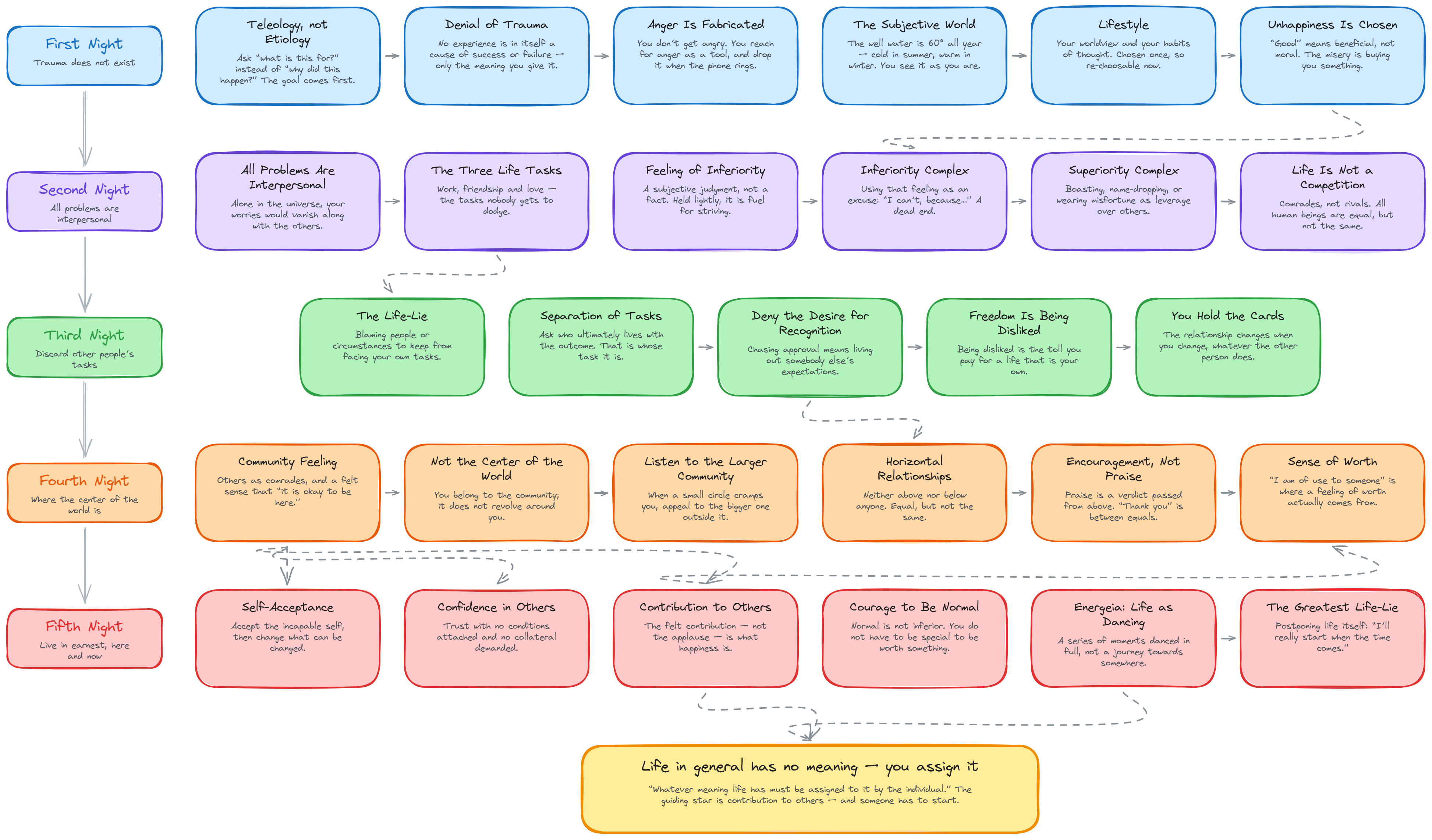
Principles - Map
The following is a one page map of all the Adlerian principles covered in the book. It is a large image - click on it to open the full size version.
Takeaway
The essential principle that ties all the content in this book is to seek to attain real freedom that is unconcerned by others’ judgments. Being disliked is proof that you are living by your own principles. Reading this book has been a wonderful opportunity to look at everyday actions from the perspective of Adlerian principles. My guess is that I will internalize some of the principles from the book that deeply resonate with me. The very fact that I have started reading the next book in the series says that this book has a special place in my library and in my life.