The Courage to Be Happy
Contents
This note contains some of my learnings from the book “The Courage to be Happy”.


Figure 1: The authors, Ichiro Kishimi and Fumitake Koga
Context
Thanks to my chance encounter with the book The Courage to be Disliked , I started reading this book over the last week whenever I could find some time away from work. This book has a more practical bent, as it starts off with the youth from the first book returning after three years with a disillusionment that all the principles learned in the first book could not be put to practical use in his new role as a teacher in a school. The book is a back-and-forth dialogue between youth and philosopher, focusing on ways to apply the Adlerian principles to specific real-life scenarios. In that sense, this book is a much-needed sequel to the first book that introduces Adlerian principles.
There is much more of a surprise factor in the first book simply because of the novelty of the whole range of principles that one gets to read at one go. For every 20 pages or so, you will pause and start thinking about the principle and its application to your life. This book is a bit different, where one pauses to connect the principle to the situation being described and then reevaluates it in the light of the difficulties faced by the youth in putting the principles into practice.
Having said that, the book specifically talks about using the principles in two specific settings: a classroom environment where the focus is on teacher-student behavior and a family environment where the focus is on parent-child behavior. The philosopher’s framing is that education is not intervention but assistance towards self-reliance, and that the educator is really a counsellor. Once you accept that framing, the rest of the book is an argument about what follows from it.
Adlerian Principles in Practice
Start from respect
Unconditional respect towards students or children means that you need to see the person as they are, without imposing your agenda on them. The book borrows Erich Fromm’s definition, which is far more demanding than the way the word is normally used.
Respect denotes the ability to see a person as he is; to be aware of his unique individuality. Respect means the concern that the other person should grow and unfold as he is.
The consequence is that respect cannot be forced. No amount of authority can make somebody respect you, which means the only move available is to go first and offer it unconditionally, without any guarantee that it will come back. The concrete first step the book recommends is to have concern for other people’s concerns - take an interest in what the other person is actually interested in, however trivial it looks from where you stand, instead of confiscating it and handing them something more worthwhile.
True empathy is a skill
True empathy is a skill, and that means it is not the same as feeling sorry for someone. Agreeing with another person’s opinion and sharing their feelings is sympathy. Empathy is asking “What if I had the same heart and the same life as this person?” and then working out what you would probably do in their place.
Seeing with the eyes of another, listening with the ears of another and feeling with the heart of another.
The important part of this principle is the claim that empathy is a skill rather than a temperament. If it is a skill, it can be practised and it can be improved, which is a far more actionable position than treating it as something one either has or does not have.
The triangular column
This is the most portable idea in the book. In counselling, the philosopher puts a paper triangular column on the table. From where the other person sits, only two of the three faces are visible, and almost every complaint any of us makes is written on one of those two faces.
One side says “That bad person”. The other says “Poor me”. The trick is to turn it and read the third side, which says “What should I do from now on?”
The point is not that the first two faces are false. It is that talking about them changes nothing, and whatever comfort they buy is temporary. Any conversation worth having - with a colleague, a child, or oneself - is on the third face. It also works as a check on one’s own complaints: if what you are saying fits on face one or face two, nothing is being solved.
Negating praise and rebuke
Both praising and rebuking qualify as manipulation, and the book spends a large part of its length defending this. Rebuking fails because it is a cheap form of communication - it forces submission without the slow work of arriving at consensus, and the child reads it, correctly, as immaturity on the adult’s part. Adler’s line is that anger is an emotion that pulls people apart.
Praising fails for a different reason. It is a verdict passed from above by someone able on someone deemed unable, and its goal is to get more of the behavior that suits the person handing out the verdict. The book’s test for this is the sentence “it has changed my opinion of you”, which sounds generous and is really the sound of a judgment being delivered.
Renounce the standpoint of the judge. You have not been granted the privilege of passing down judgements. Maintaining law and order is not your job.
There is also a neat empirical argument tucked in here. If rebuking worked as an educational method, it would only need to be done once. The teachers who are always shouting are the proof that it does not.
From competition to comrades
Stop thinking about competition in your fields and think of others as comrades. Reward and punishment are what create the competitive climate in the first place: when praise is the currency, other people become rivals, and rivals become enemies. The book’s diagnosis is that the problem child in a classroom is a symptom, and that the whole classroom is what is sick.
The alternative is not to abolish rivals but to abolish competing with them. Life is compared to a marathon in which the runners alongside you are a stimulus, right up to the moment you decide to defeat one of them, at which point the goal quietly changes from finishing the race to beating a person. Use games to get better than your previous self. It is the same as the application of separation of tasks in the context of games - how well somebody else runs is their task, and my own improvement is mine.
The five stages of misbehavior
This is the most practically useful classification in the book. Problem behavior, in children and adults alike, escalates through five stages, and each one has a different mental state behind it.
- Demand for admiration - playing the good child so as to be praised. Looks like model behavior, but the goal is the praise, not the deed.
- Attention drawing - if the praise does not come, standing out will do instead. The principle here is standing out, not being bad.
- Power struggle - provocation and open defiance, to make a show of one’s own might. The advice is to get off their court the moment you notice it, because returning the ball starts the rally.
- Revenge - having lost the power struggle, connecting through being hated instead of being loved. Stalking, self-harm and withdrawal are put in this bucket.
- Proof of incompetence - despairing and demonstrating helplessness so that nobody expects anything any more.
All five are bids for a sense of belonging - a place where it is okay to be. The reassuring part is that most problem behavior stops at the third stage, which is exactly where an ordinary parent or teacher can still do something about it.
Self-reliance, comradeship, contribution and the architecture of “we”
The chain that the book builds is self-reliance to comradeship to contribution to others to the architecture of “we” via love. The surprising move is the definition of self-reliance. It is not economic, and it is not about living apart from one’s parents.
Self-reliance is breaking away from self-centredness.
Every infant rules the household through its own weakness, and that is a survival strategy rather than a character flaw. Growing up means leaving that position at the centre of the world. What actually accomplishes it, according to Adler, is love, because love switches the subject of life from “me” to “us” - not my happiness, not your happiness, but the happiness of two people who cannot be separated. That “us” then keeps widening until it becomes what Adler calls community feeling.
The three life tasks
Life tasks come in three areas: work, friendship and love. They are not three activities so much as three distances of interpersonal relationship, and the book separates them with a clarifying distinction - trust versus confidence.
- Work runs on trust. It is conditional, like a bank asking for collateral. We divide labour because we are too weak to survive alone, so we have no choice but to believe in each other, whether or not we like each other.
- Friendship runs on confidence. There is no collateral, and no reason to befriend the person other than that you do. You believe in the person rather than in the conditions attached to the person.
- Love is the task accomplished by two people. We are educated for the tasks we do alone and for the tasks we do with twenty others, and never for this one, which is why it stays the hardest of the three.
The claim that follows is that respect and confidence are the same thing seen from two sides, so a teacher who relates to students purely as work can never quite respect them. Adler treated even his most difficult patients as friends rather than as cases.
Strike the Match
As one can see, most of the principles are meant to reinforce the ideas introduced in the earlier book. Focusing on two areas, teacher-student and parent-child relationships, this book is more grounded. Also, there is no point in reading these books if one does not test at least a few ideas in one’s life. Both the books, The Courage to be Disliked and this one, have given me enough ammunition to iterate on a few ideas and experiment in my life. One of the key ideas in both the books relating to Adlerian principles is “strike the match”:
We often wait for the world to change first. We say, I will respect them when they respect me. I will love when I am loved. Adler says: No, you must start.
The book’s own image for this is a torch on a night road. Your torch lights only a few metres around you, but it is visible to somebody hundreds of metres away, and eventually there are dozens of lights instead of one. Adler’s answer to whether that is realistic was simply that somebody has to start, and that whether other people are cooperative is not connected to you.
Principles - Map
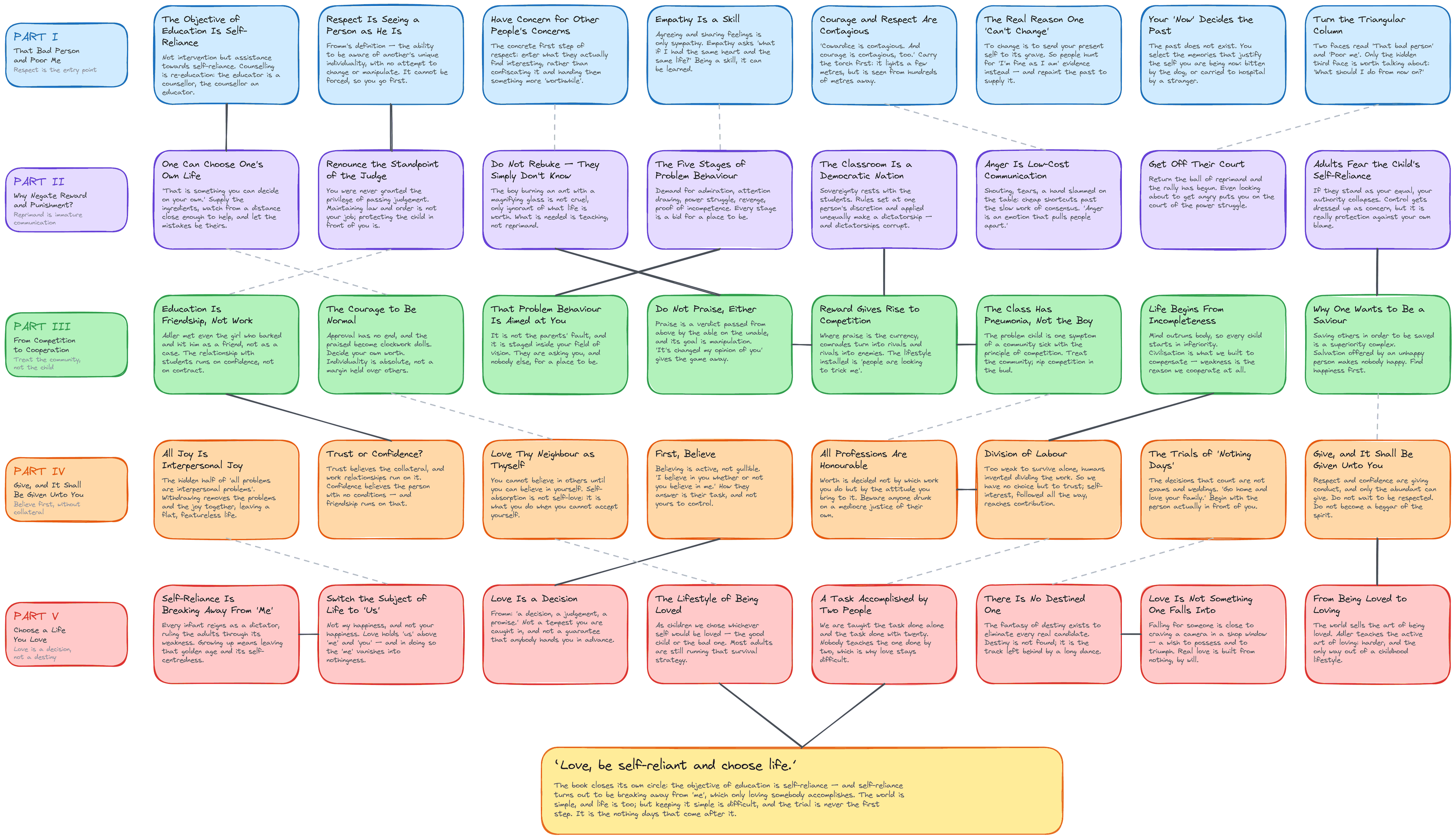
The following is a one page map of all the principles covered in the book, laid out as the five parts of the dialogue. A solid line means one principle rests on another - pull one out and the other falls over. A dashed line means the two belong to the same family of idea and explain each other. It is a large image - click on it to open the full size version.
Takeaway
Have enjoyed this book and the previous one, The Courage to be Disliked . With these kinds of books, I think the proof is actually in internalizing and applying them in my life; that is what decides whether they are worth my time and effort. I have a feeling that in the days/weeks/years to come, I will benefit from the Adlerian principles described in both the books.
If the first book is the map, this one is the compass. The first book tells you that the principles exist and shakes up your value system in the process. This one puts them in a classroom with an exasperated teacher and asks what you do on Monday morning. The philosopher’s parting advice is a single line - love, be self-reliant and choose life - and the sting in the tail is that the first step is never the hard part. What is really being tested is the courage to keep walking on the ordinary days that come after it.