The Courage to Be Ordinary
Contents
This note contains some of my learnings from the book “The Courage to be Ordinary” by Ichiro Kishimi.

Figure 1: The author, Ichiro Kishimi
Threads carried over from the earlier two books
This is the third book in the series, after The Courage to be Disliked and The Courage to be Happy . Very little of the doctrine here is new. The book takes a handful of principles already laid out in the earlier two and turns all of them on a single question: why do I believe I have to be special? The threads it picks up:
- Life is not a competition, and denying the desire for recognition - together these become the whole of “Why do I believe I have to be special”
- Feelings of inferiority vs. the inferiority complex - restated here as the fragile superiority of people who need to be extraordinary
- Horizontal vs. vertical relationships - returns as the image of everyone walking on the same horizontal plane
- Separation of tasks - why comparison and competition are treated as working on someone else’s task
- Self-reliance leading to contribution to others - the loop that makes “ordinary” mean free rather than mediocre
- Getting better than your previous self - the replacement yardstick, once other people stop being the benchmark
- Worth on the level of being - the car accident passage, which comes back here as “being alive itself is a contribution”
Why do I believe I have to be special
- It is pointless to compare your work with someone else’s. You do the work, and if someone else’s work is better than yours, you improve yours - not to gain recognition, not in the spirit of competition, not in the spirit of seeking other people’s approval. You improve your work for the sole purpose of making the output better for its own sake. This is life is not a competition from the first book, pointed at the work rather than at the person.
- You don’t have to strive to be special. The word “special” automatically means that you are comparing yourself with others. The mere thought of wanting to be special means that you are inevitably comparing yourself with others. Why is there a need to be special? You are different from every other being biologically, intellectually, emotionally and in god knows how many other ways. Each one of us is different, but that does not mean each one of us is special.
- Birth order sometimes shapes beliefs, which in turn lead to specific lifestyle choices.
- Parental approval or disapproval affects a child’s personality at a young age. A child can develop a lifestyle based on how their parents behave and on the influence the parents exert.
Fragile Superiority of those who need to be special
- Habitually tense people are those who believe they have to be extraordinary. We often see people who aced their exams, or did really well in the early part of life or in some part of it, feel that they are somehow extraordinary; the need to feel extraordinary then keeps them forever in a state of anxiety.
- A superiority complex is nothing but feeling inferior deep inside and wanting to make an impression on others. In one sense, both of these - the inferiority complex and the superiority complex - stem from our misguided assumption that we ought to be special in this world, that we ought to be doing something extraordinary in life. Once this assumption settles in, for whatever reason, it gives rise to so many ancillary feelings and actions that we might unknowingly be following a path that leads to habitual tension.
What it means to be ordinary
The book does not equate ordinary with mediocrity, even though one might tend to interpret it that way. Adler says that being ordinary means being free from other people’s expectations. There are a whole lot of related concepts discussed in The Courage to be Disliked and The Courage to be Happy that feed into this idea. If you consider the idea of separation of tasks , and of self-reliance and using your skills to be useful to others , then I think it naturally follows that you stop considering yourself special and you focus your attention on being you and nothing else.
Once you think of yourself as ordinary, I think the whole anxiety of living up to some standard falls away and you start focusing only on the work at hand. Only whether the work lives up to the standard set by you becomes important. This mindset might bring out the best in you, as you tend to iterate - not because someone is expecting it, not because you want to impress others, and not because of the many other external factors you have no control over. Instead the focus is on the task at hand, and more importantly on the question “what can I do with my skill sets in the given conditions?”
This section is useful to clear up the notion of what the author means by ordinary. In Adlerian terms, ordinary means being yourself - not because you have to, and not because you have some ulterior motive, but because that is the only way to become self-reliant and contribute back to the community.
Overcoming the feelings of inferiority
Feelings of inferiority also arise from comparing some attribute of others with ours, or some outcome others obtained with our current state of affairs. As long as we are fixated on comparison and competition, we will inevitably face the feeling of inferiority. This feeling is natural in many of us and it might encourage us to do things in a better way. It might motivate us to examine our performance and get better at the task with the sole purpose of improving ourselves. As long as our behaviour is focused on improving self-reliance and on improving the skill to do a task, there is no harm in it. However, we do not always behave that way. Adler talks of the inferiority complex , a state of mind in which we abandon the activity altogether, telling ourselves that we are not fit for it or that we do not have the skill sets to do it. One could also get hyper-aggressive and get better at the task with the sole intention of becoming better than someone else - here again the focus is the other person, and that inevitably leads to us getting habitually tense. Why? Once we are better than the person we were comparing ourselves with, there will always be someone better who comes along, and the cycle continues. Adler instead says that we should hold a view in which we are all walking on a horizontal plane ; not high, not low, not up, not down, but a world where everyone is walking toward some destination. Some might walk slower than you, some might walk faster than you, some might be ahead of you, some might be behind you. It does not matter. All you should care about is that we are all walking on a horizontal plane, each trying to be better than their previous self , each trying to be self-reliant and to contribute to the community.
Approaching your life with Confidence
- There is a part of me that sometimes makes me avoid taking action because I fear or worry about disappointing results. However, this self-made anxiety and fear are not needed to get a task done. If you need to take action, you do it with your full focus and attention. If the outcome is not as expected, you take corrective action. That’s all there is to it.
- Thinking about competition while working or studying has damaging consequences, as you are forever thinking about something else rather than focusing on the task or on improving the way you do it. Instead of doing the task for the sake of it, you are influenced by things that are probably other people’s tasks , or by events that are outside your influence
- Comparing yourself with others has many painful consequences
- You probably put a cap on your own potential
- Instead of focusing on the task, your subconscious objective is now someone else, some external benchmark. An external benchmark is good as far as it inspires you to do a good job. But beyond that it is pointless; it becomes performative
- Comparing yourself with others might also give you the false impression that the other person is doing it effortlessly. We often fail to see the struggles that person had to endure to arrive at the finished product we see, and so we become envious or dejected. It is absolutely fruitless to have such a tendency, as it is self-defeating and cannot take you along the path of self-reliance
- Fantastic take on the hare and the tortoise story: the tortoise accepted the race despite knowing that it could only walk slower than the hare. Instead of leaving it at that point, it chose to enter the competition to prove a point. That, in the Adlerian sense, is pointless. We need to have the wisdom to see that we are different, and to forget about feelings of superiority or inferiority, as they serve no use.
- Measuring your worth solely by wins and losses is a profound misconception
- All failure teaches, and it is better to take a moment and reflect on the failures of everyday life. I would even say that everyone should maintain a failure log and revisit it regularly, to be happy about everything they have learned so far.
- If you do nothing because you’re afraid you won’t get good results, or that you’ll expose your failure, you will go through life without learning the things that truly matter. In reality, you may get better results than you expected, or find that what you’ve already learned helps you pick up new lessons and skills more easily than you thought.
- Our work is evaluated, and these evaluations aren’t always accurate. What matters is doing good work, not working in order to be evaluated or praised.
- Evaluation doesn’t determine value. Of course we need some sort of evaluation to get feedback on our work and iterate. Recognition doesn’t determine value either. This is slightly different from the messaging of Mattering , where the author gives multiple examples of people getting demotivated when they see their work not being valued by others, or when they feel that their work lacks external connection or impact. One can argue that Adler is focused on making people more self-reliant in that sense. However, having read the previous two books, I feel that self-reliance is not, after all, an isolated goal that one pursues in relation to nothing. The loop between self-reliance and community feeling is mentioned repeatedly, in many chapters of both books, The Courage to be Disliked and The Courage to be Happy . One must not get so hung up on evaluations that they become a stumbling block for self-reliance
- Originality does not arise from nothing. It’s like how a bird can’t fly in a vacuum: it needs the resistance provided by the air to stay aloft. Research is the same
- Only work you take on willingly, guided not by mere obligation but by an inner prompting, deserves to be called a vocation.
- Differentiate between “I must” and “I have”
Some of the points made in this part of the book resonate closely with the theme of the book How Emotions Are Made , which I am yet to read.
What’s desirable is to first do work that you yourself find fulfilling, and only then have that work contribute to others.
Plants don’t strive for more once they’ve borne fruit. People may harvest the fruit or admire the flowers, but that isn’t something the plant or flowers concerns itself with
Ambition is anxiety. Vocation is expectation. Ambition is fear. Vocation is joy. Ambition calculates and fails. And success is the most dazzling of all its failures. Vocation abandons itself to nature, and everything is given to it.
Starting from who you are
- It is better to face who you are head on, rather than view yourself through the lens of fear or anxiety - this is what the first book calls self-acceptance . If you are able to decipher what your skill sets are, what you need to develop further and what you need to work on, it becomes easier to take stock of the situation and work towards improving them. On the other hand, if for whatever reason - fear, or over-confidence - you do not see yourself as you are, then it is likely that you run the risk of never getting better at something, and of placing an obstacle in your own path to self-reliance
- Enjoy the process of learning. In order to do that, you need to actually experience the joy of discovering what you didn’t know.
- Value the process, not the outcome
Living your own life
- Valuing yourself is a prerequisite to a healthy relationship
- Step out of competition mode and seek cooperation, treating others as comrades : these are the two keys to happiness
- Being alive itself is a contribution . So whatever state of mind you are in, you should never consider yourself worthless
- The important thing to remember is that your value is not determined by your ability to contribute through work, and it is not defined by other people’s opinions. To see that, you have to focus not on the work, but on the contribution
- When people are driven by vanity, work becomes painful. Most become habitually tense because they don’t experience the true joy of work. Work becomes a derivative of something else they are after.
- Giving something without any expectation of getting something back is the way to live, rather than considering every interaction from the perspective of give and take. This is the strike the match idea from the second book: you must start, without waiting for the other person to go first.
This part of the book reinforces two ideas that might seem to be opposing ideas:
- Respect your uniqueness, your individual traits and your rough edges; do not be bowed down by other people’s expectations, and do not succumb to your own fears
- You need to contribute to the community. Winning for yourself is pointless, or meaningless
The thread that ties these two together is Adler’s idea that you need to be self-reliant - you need to consider yourself worthy of something before you can use your skills to do something for the community.
Principles - Map
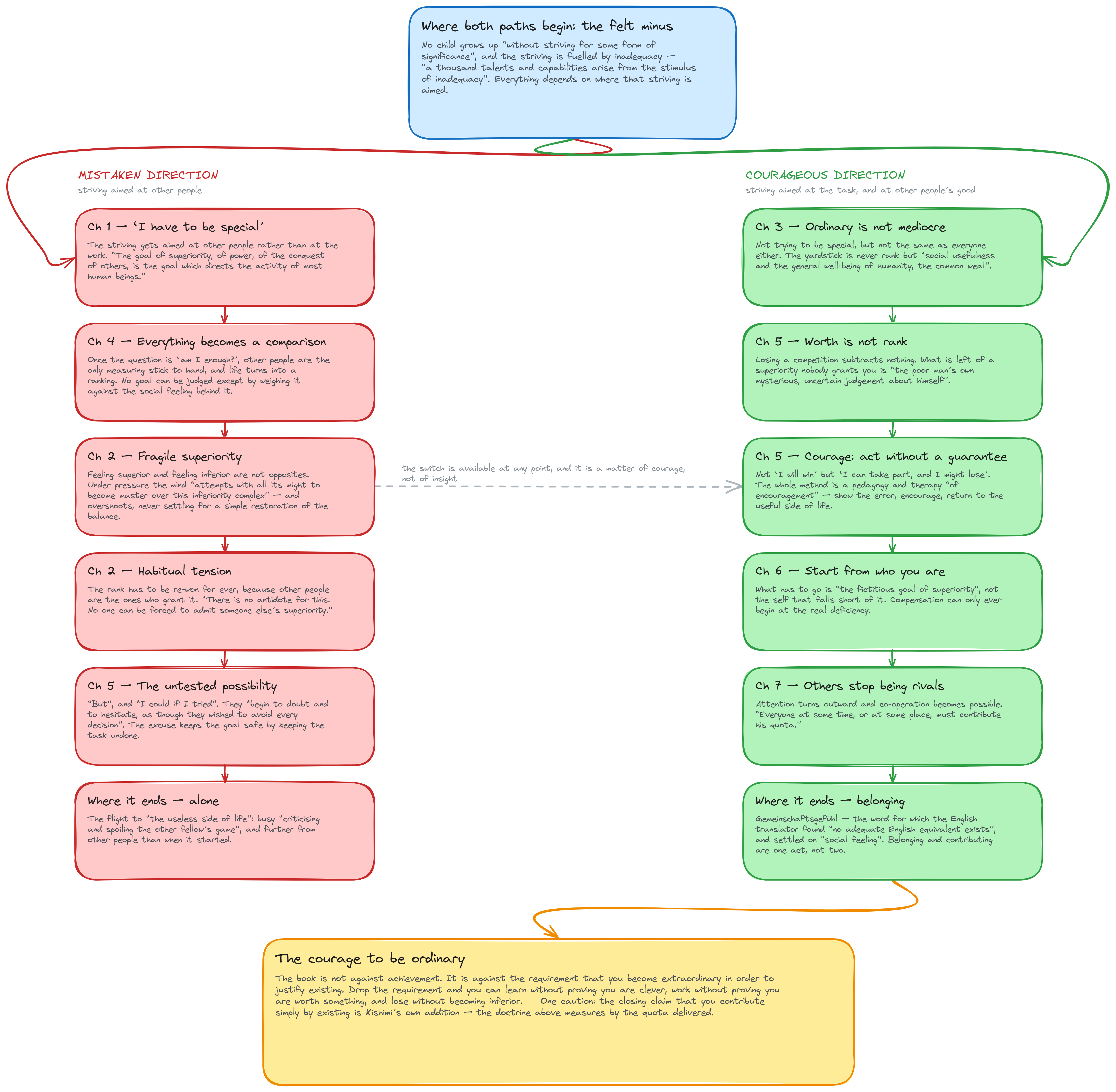
Adler’s starting point is that every one of us begins from a felt minus - a sense of inadequacy that is universal, and that is the fuel for every capability we ever develop. What decides how a life goes is not whether you feel it, but where you aim the striving that comes out of it. That is the fork the whole diagram hangs on.
Aimed at other people, the striving produces the left-hand column. I have to be special, so everything becomes a comparison, so superiority turns into something other people have to keep granting me, so I am permanently tense - and eventually I stop attempting anything that could be judged at all. The column ends further away from other people than it started.
Aimed at the work, and at what is useful to others, the same striving produces the right-hand column. Ordinary is not mediocre, worth is not rank, so I can act without a guarantee, so I can start from who I actually am, so other people stop being rivals. That column ends in belonging.
The dashed line across the middle is the part worth remembering. The switch from one column to the other is available at any point. It is not a matter of finally understanding something; it is a matter of courage.
The following is a large image - click on it to open the full size version.
Takeaway
I have read three books by the author in the span of 15 days, which goes to show how much I have enjoyed the Adlerian principles explained in them. As with all such books, it is only when I put some of these ideas into practice that the time and investment will have been worth it. Hopefully I am able to do so. Or maybe I should be saying: hopefully I have the courage to do so.