Let Your Life Speak
Contents
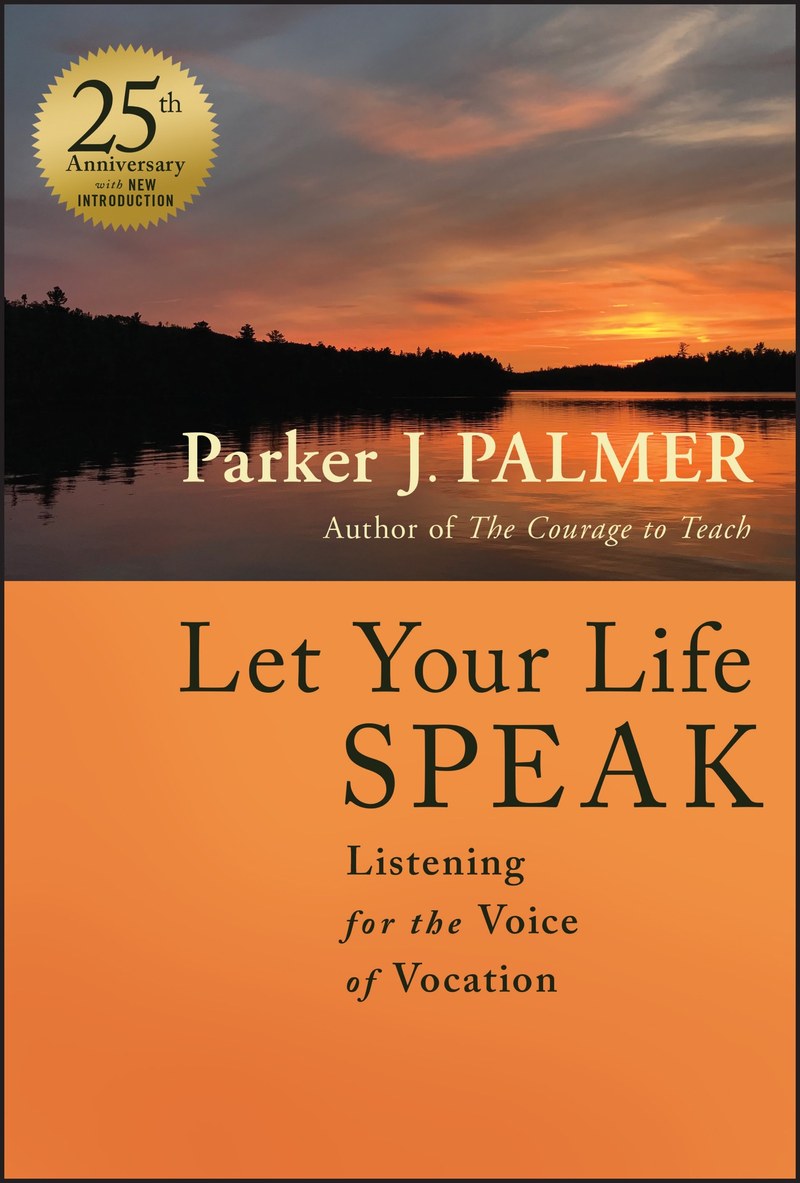
This note summarizes some of the ideas from the 25th anniversary edition of “Let Your Life Speak” by Parker J. Palmer.
Introduction to the 25th Anniversary Edition
The author reflects on turning eighty-five as the book enters its twenty-fifth year. He looks back on the quarter century that has passed since he wrote it and says he would not change a word of the original. He also tells the reader what to expect: stories from his own life, gory details included. Why? Because those experiences turned out to be a goldmine for him — they were how he worked out his identity and his integrity, the two constructs you need if you are going to live the life you were meant to live.
I started reading this book because there are similarities between Palmer’s philosophy and Adler’s — self-reliance and contribution to the community. Having been immersed in Ichiro Kishimi’s books for the last fifteen days, I thought I would take a detour into Palmer, who touches on something important: letting our lives speak to us, rather than our steering in whatever direction we please on the strength of other people’s expectations, false assumptions, or whatever notions we happen to be carrying.
Listening to Your Life
The first chapter opens with William Stafford’s poem “ASK ME”. The poem uses a river flowing beneath frozen ice as a metaphor for the life that waits in all of us to be lived. Instead of listening to it, we often live to fulfill someone else’s expectations, or according to our own notion of what will bring fame, recognition, money, or whatever else the external world hands back for a certain kind of work. This is particularly visible in families where children are pushed into STEM education, on the assumption that a parent’s idea of what a child ought to do with a life is better than anything the child would arrive at alone. Granted, a child is not mature enough to weigh all the possibilities — but forcing someone into a specific career is something many parents are guilty of, and all that effort goes to waste anyway when the child does not turn out the way they wanted. More importantly, even when the child grows up and does fulfill those expectations, the adult may still question their real vocation or calling and realize that they have lived someone else’s life.
The soul speaks its truth only under quiet, inviting, and trustworthy conditions.
The soul is like a wild animal—tough, resilient, savvy, self-sufficient, and yet exceedingly shy. If we want to see a wild animal, the last thing we should do is to go crashing through the woods, shouting for the creature to come out. But if we are willing to walk quietly into the woods and sit silently for an hour or two at the base of a tree, the creature we are waiting for may well emerge, and out of the corner of an eye we will catch a glimpse of the precious wildness we seek.
Now I Become Myself
A clue to finding true self and vocation: we must withdraw the negative projections we make on people and situations—projections that serve mainly to mask our fears about ourselves—and acknowledge and embrace our own liabilities and limits.
In this chapter the author gives a quick narrative of the events from his childhood onward — Carleton College, Union Theological Seminary, Berkeley, Washington, D.C., Georgetown University, Pendle Hill. Throughout, he reflects on coming to terms with his fears. In some of those moves, he says, his old self justified the decision by blaming external conditions or external people; in the end it was the journey into periods of darkness that led him to see who he really was. That in turn helped him make peace with the world. Ironically, once we accept the mind-made projections we cast on the world as something outside our control, we become far more focused on what we can actually do with our lives.
There are many Adlerian principles that come to mind when I read the author’s narration:
- Separation of tasks : this gives us the freedom to focus on what we can achieve
- Self-reliance
- Being useful to others depends on valuing your own self-worth
- Habitual tension , once you are wearing other people’s faces and not your own
- Lifestyle : how we have the freedom to choose our own
- Feelings of inferiority and feelings of superiority are equally pointless
- Self-acceptance
- The triangular column tool: Poor Me / That Bad Person / What should I do from now on?
The pilgrimage toward true self will take “time, many years and places.” The world needs people with the patience and the passion to make that pilgrimage not only for their own sake but also as a social and political act
- Parker J. Palmer, on May Sarton’s line
When Way Closes
The author argues that life leaves us clues about our limits and about our possibilities. Behind every closed door in our lives is a hidden clue: perhaps we were trying to go beyond our limits, and perhaps moving away from that door is exactly what lets us see the other doors and possibilities life is opening.
Our culture has it ingrained in us that we should keep trying until we succeed. If something is to be achieved, we ought to keep at it; if we fail, we analyze why we failed and try again. But there is a subtler point the author is making. When we are doing something we truly do not want to do — doing it for the derivative benefits of fame or money, or to meet someone else’s expectations — we need to pay attention to the failures. The idea is not to go at it again but to really listen to what life is telling us. Perhaps the failure is saying that we are better tuned to contribute somewhere else, in some other way, or to some other community. It is not always easy to tell whether our quitting comes from lethargy or from a lack of the required skill, OR whether the true self is genuinely trying to tell us something about our identity. That is a tough question to answer, I think.
If we are to live our lives fully and well, we must learn to embrace the opposites, to live in a creative tension between our limits and our potentials. We must honor our limitations in ways that do not distort our nature, and we must trust and use our gifts in ways that fulfill the potentials God gave us. We must take the no of the way that closes and find the guidance it has to offer — and take the yes of the way that opens and respond with the yes of our lives.
All the Way Down
In this chapter the author gives all the details of the period in his life when he went into severe depression. For a very long time he kept it private, but he did find the courage to write about it — in a journal issue on the theme of the “wounded healer”, in memory of Henri Nouwen, who was his mentor and friend.
Among all the people who came to help him, the one who really helped was a friend who mostly listened and offered no advice. Mattering echoes the same idea: if we are to be attuned to someone, we must stop ourselves from being preachy, stop ourselves from offering suggestions based on what we would do, and so on. Listening to what the other person is saying, and acknowledging that the situation has no easy answers, is the best way to provide comfort.
The author’s story reveals the powerful transformation that going deep into depression can bring about. It can help us understand what we are — the depression behaving like a voice trying to say something we have avoided for a long time. Only by befriending that voice, and understanding how it grounds us in our true inner self, can we begin to see the sequence of events that may have led to the depressed state. That inner voice was always there and has always been trying to talk to us, but our constant neglect leaves it no option except to throw us into the throes of depression.
Set against the book’s overall theme of learning to know your true self, this chapter fits right in. Whether it is depression or ecstasy, we need to pay attention to the feelings, the thoughts and the way we react, and then try to uncover the true self in all the clues that come along.
Leading from Within
The author says that whatever work we do, we lead others in our own way.
If we, as leaders, are to cast less shadow and more light, we need to ride certain monsters all the way down, explore the shadows they create, and experience the transformation that can come as we “get into” our own spiritual lives.
Elaborating on this, the author names five monsters:
- Insecurity about identity and worth
- The belief that the universe is a battleground, hostile to human interests
- Functional atheism: the belief that ultimate responsibility for everything rests with us
- Fear, especially the fear of the natural chaos of life
- Denial of death
There Is a Season
I went for a nice long walk while reading this book. I am so glad that life gave me the opportunity to be in silence and solitude for this wonderful chapter. The author uses the seasons as a metaphor to help the reader discover their identity and integrity. The earlier chapters use the “seed” metaphor for the true self that is planted in the world at our birth; this chapter encourages the reader to see life as a cycle of seasons.
- Autumn:
- Symbolizes death and, at the same time, the possibility of change
- Interplay of living and dying
- Winter:
- Symbolizes the soul gone underground to renew and refresh itself
- The only way to deal with winter is to learn to get out into it: the same inward journey that is alluded to throughout the book
- Spring:
- The pre-spring muck we see all around is essential for growth
- Muddiness and chaos are what give rise to possibilities
- Summer:
- Symbolizes abundance
- We often embrace the scarcity assumption, and so invite scarcity into our lives
- Community doesn’t create abundance — community is abundance
Connection to Adlerian Principles
On a first read, it appears that Palmer and Adler are taking opposing stances. Adler, with his teleological view, says that we grant importance to causes only in order to serve a goal. Palmer, on the other hand, says there are clues — causes behind various things in life — that leave some doors closed and others open. On a bit of reflection, though, I think Palmer is saying that one has to listen to the inner self to understand one’s own limits and strengths. He is not advocating getting trapped by them at all. Adler, meanwhile, is talking about a behavior where we tend to justify our causes and end up crippled by them.
Palmer says: Listen to the current underneath your life.
Adler says: Be careful about turning your past, your feelings, or your supposed inner nature into causes that dictate your future.
A useful synthesis would be:
Palmer helps you listen; Adler helps you question what you hear.
Palmer might say: Don’t dismiss that experience. Examine what your life is telling you.
Adler might then ask: But what purpose does the belief “I am not a good finisher” serve? Are you using it to avoid responsibility, rejection, or failure?
Put together, they produce a much stronger inquiry than either taken simplistically:
Notice the recurring pattern -> don’t immediately explain it causally -> examine the purpose of your interpretation -> choose how you want to live.
That is probably the most productive way to read Palmer after Kishimi . Palmer gives much more weight to inner listening and vocation, while Adler gives much more weight to choice, purpose and freedom from deterministic stories.
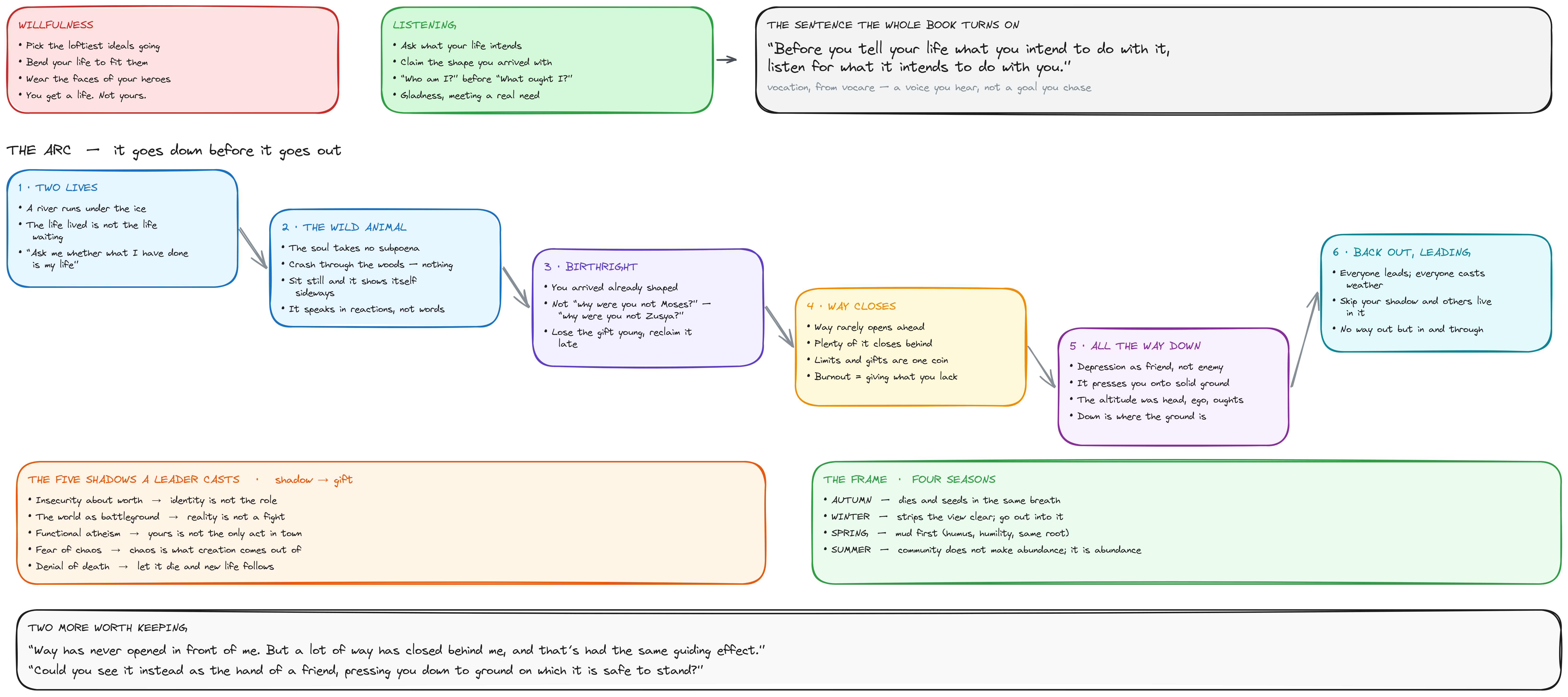
Principles Map
Here is a map of all the principles mentioned in the book.
The following is a large image - click on it to open the full size version.
Takeaway
Loved the book. It reminds me of “The Gift from the Sea ”, which I read almost fifteen years ago. Maybe it is the way the author writes — unhurried, revealing all his vulnerabilities, his fears and the dark corners of his life — that makes this book all the more appealing. It is not preachy, and at the same time it gives enough food for thought to reflect on one’s life and re-examine whether one is really living the life that wants to be lived, or someone else’s script. An alternate title to the book could have been “Listen to Your Life”, but the title taken from Quaker philosophy is probably more sticky.