The Happiness of Pursuit
Contents
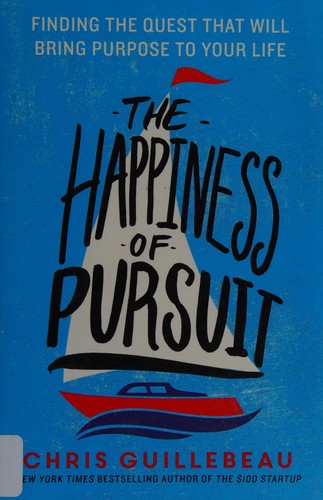
This note summarizes some of the main points from Chris Guillebeau’s book, along with my own reflections on them.
Context
I am not sure why I picked this up now. I bought this book way back in Feb 2017, almost a decade ago, and it has been sitting on my bookshelf waiting to be read. After the recent detour into books by Ichiro, Jennifer Wallace, Eric Zimmer and Palmer, maybe my mind was looking for something more modern and a lighter read - something that would have interested me back when I bought the book.
I picked it up this month and managed to read it over a series of walks. The author has traveled to every country in the world and wrote this book to share his experiences of everything related to that quest. The book would have been boring if it were only about his own quest. Instead, he interviews a bunch of people who have undertaken some form of quest in their lives and found the experience fulfilling in many ways.
Quest
Firstly, what is a quest? Does any hobby you work on over the weekend qualify as a quest? The author defines a quest using the following parameters:
- has a clear goal and a specific end point
- has a clear challenge
- requires sacrifice of some kind
- is often driven by a sense of calling
- requires a series of small steps and incremental progress toward the goal
He used these criteria to filter the many stories and interviews he had collected for the book.
Sometimes I do wonder why I am reading about quests that other people have undertaken. Maybe some part of me feels that I am not doing justice to my skill sets. The most vivid memory I have of a quest is an intellectual one I took up back in the 2010s, when I really did not have a clue about modern probability theory. Instead of reading about it from a 10,000 ft view, I delved deep into measure theory, the essentials of stochastic calculus, ruin problems, and the historical developments around the Lebesgue measure. In a span of three years, I read about 30 probability books and finally managed to read Rosenthal’s book on probability theory . After multiple attempts and misadventures, I reached the goal I had set for that quest. Since then, I do not vividly recall undertaking any quest in my life. Yes, Sitar has given me a daily challenge to work through in the last few years, but mostly it has made me realize that I have not been practicing Meend well. Gamak and Meend are two components of Sitar that I have neglected for many years, and I have decided to go on a quest to master them by
- I have four more years to go, and I think I am progressing steadily on
that journey. There are many side quests I have undertaken, mostly learning on the job whatever was needed to get the work done and meet the demands of my work. But if I step back and ask whether I have really done any specific thing for an extended period of time, I must say that I have not, and maybe that is what pulled me to this book. Shouldn’t one have a singular determination to do some really challenging task that is joyful as well as useful to society? Currently I am at a juncture where I feel a bit lost in life and not sure where I am going. In any case, back to the book.
Why a quest?
The author says that his interviews with many people who undertake quests surfaced a few patterns, or threads, on why people take on arduous tasks:
- Self-discovery
- Reclaiming
- Response to external events
- Desire for ownership and empowerment
- Taking a stand for something
In my case, I am pulled towards setting a challenging goal and going after it mainly because I want to use my potential in ways that I can measure and improve. The fact that my work is disappearing into a big void with no feedback is troubling me. A quest might give me the feedback I need to get better at something and create something useful before I die.
Most people seem to go on a quest when they combine three elements:
Dissatisfaction + Big Idea + Willingness to take action = New Adventure
Once you’re near the end, there’s no time for bullshit. But what if you decided there’s no time for bullshit—or regrets—far in advance of the end? What if you vow to live life the way you want right now, regardless of what stage of life you’re in?
Journey
What does it take to undertake a journey? What elements should one think about? Of course, the cost of the journey and the risks it poses come first. Maybe one also thinks about the skills, resources and time needed to work on the quest. Then come the objections one might have before taking it up: one might not be able to walk away from one’s responsibilities, and there are other people’s expectations, the fear of failure, the fear of losing everything that life has given so far, and the fear of looking like a fool.
“If I didn’t do it, I would always wonder about what could have been,” was repeated over and over and in many different ways by the people I talked with. I understood it well, because it’s exactly how I felt when I first began to ponder the goal of traveling to every country. I had to do it! It was such a ridiculous idea that I knew I’d always wonder about it if I didn’t try.
I guess the above feeling triumphs over all the reservations we have about undertaking a journey. I am writing these words sitting in a coffee shop in Singapore, wondering what would happen if I really paid attention to the above quote and started doing something about it. Sometimes I feel I am a coward and do not have the courage to step up and do something about the gnawing feeling that is eating at me every day - why am I not putting enough effort into producing something that is valuable to others? Why am I focusing on producing artifacts that do not yield direct feedback?
The author talks about an interesting concept, the life list - a list of things one maintains as projects to do. The list itself could be a combination of things, some of which serve as quests.
The chapter on “Love of the craft” is the one that resonated with me the most. Firstly, it mentions Seth Godin, whose blog I read almost every day a decade ago. I have always tried to incorporate some of the advice he gives everyone on many aspects of life, and that extends to the daily rituals I follow. The fact that I manage to do certain activities come what may is straight from Seth’s advice of doing something consistently even when you feel you cannot or don’t want to. I have been writing daily for over 800 days, rain or shine. Even when I fall sick, I somehow get my energy levels up just enough to get my writing ritual done. The discipline of doing something consistently has of course helped me in other parts of life, where I am seeing the utility of compounding - small actions done consistently over a long period of time give fantastic results. I can definitely attest to this in many areas - not so much in my professional life, but in other life skills in general.
It’s better to be at the bottom of the ladder you want to climb than the top of one you don’t
- Stephen Kellogg
Effort can be its own reward if you let it
Other Quotes or Ideas from the book
- Be a warrior of the mind rather than a librarian of the mind. It is no use merely taking in information but one needs to make use of those skills and knowledge that you gather
- Quest is a great learning tool but takes you out of comfort zone
- What we are learning should connect to something real. It is useless if you can’t connect
- Quest asks you to grow in ability, belief and commitment
- When discontentment leads to excitement, pay attention
- Fall in love with the process not the end result
Reflections
The book is not saying anything dramatic. The ideas are not ones you would argue with or find difficult to digest. They are all sensible ideas that egg someone on to go on a quest, stay the course, and ultimately reach the goal they set for themselves.
If I look at what I have been doing in the last few weeks and think hard about whether I really want to do those things, I am reasonably certain that I am doing the best I can at the relevant tasks at work. But do these tasks excite me? I know I am not slacking in any way; I am giving my best to the work and producing the output the job needs. But am I climbing the wrong ladder, instead of stepping down and looking for the ladder that resonates with my skill sets and my interests?
Using my math skills, programming skills and the bouquet of other skills I have built over time to create something useful for others has always been my goal. But somewhere along the way, I have faltered. I realize that I am still trying to satisfy my craving intellectually by reading about other people’s quests instead of actually going on a quest myself. Maybe I should start being courageous and do something worthwhile with my life.