You Can Just Do Things
Contents
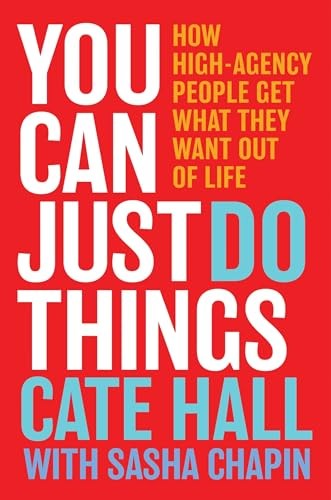
This note summarizes some of the main points from Cate Hall’s book “You Can Just Do Things”, along with my own reflections on them.

Introduction
The author says that the single most important attribute that decides our fate is personal agency.
It is the capacity to both see and act on degrees of freedom that other people overlook. It is being able to see choices where others only see constraints - the hidden doors in the walls of life.
The book is organized into five sections, each with a handful of short chapters. I have kept the same structure below.
Wake up and Move
Staring into the abyss
The author says that it takes courage to stare into the abyss that one is facing, and that good things come out of it. It is easier to run away from the abyss and do the next convenient thing that one likes to do. However, there are umpteen situations in which, by staring into all the dark corners of the abyss, we tend to develop tremendous self-knowledge about the way we process information.
The idea is similar to one in Parker Palmer’s work, which I wrote about in Heart Speak . In it, he says that it is often when we look into the dark areas of our life that we get a far richer understanding of our own predilections.
Sometimes I wonder why I am not looking into the abyss that I am facing. Isn’t it abundantly obvious that things are not going as per my expectations? There are so many issues that I am struggling with that it would take several pages to write them here. Maybe I should look at the abyss that I am facing right now and take a bit more courageous steps. There are many aspects of my life that I need to correct. Maybe what is stopping me is a lack of courage to do things that make sense for the skill sets that I have? There is something that has been troubling me, and in a way I am running away from the abyss.
The precious state of mind that results is high-conviction but also high-curiosity and low-ego. When you are a master at staring into the abyss, you allow yourself to make bold bets, but also allow yourself to reverse course when you find that your previous assumptions were incorrect.
Becoming a Crisis Manager
I have learned a new term, thanks to this book. A crisis manager is someone who has selective amnesia about your life. A crisis manager is someone who shows up in your life and starts attacking the problems with no previous baggage and no previous assumptions about what can and cannot be done. It is more of a thought-experiment hack. If you are facing problems that seem intractable, invoking this kind of mindset helps you see the problems in a different light.
In a way, if I had to put a math spin on this statement, I would say: live life like a Markov process, where the conditional distribution of the random variable at time \(t+1\) depends only on the state at time \(t\) and nothing before it. Even though modelling real-life processes as Markov processes is a mathematical convenience, if you start thinking about it seriously and start applying it to 1) work, 2) relationships and 3) self-relationships, several problems disappear.
Quit living in Movie Logic
The chapter addresses the fear that most of us have about dealing with situations directly. By naming the problem and dealing with it directly, we get a very good grasp of the problem.
Seek Real feedback
If there is one chapter that resonates with the problem that I am currently facing in my professional life, it is this. I do not get external validation for the work I am doing. The real feedback is so far removed from my efforts that I think they are pointless. I have known about this problem for a few years. The other issue that I can clearly see is that even when I get feedback from external entities, it is often about something that doesn’t really excite me.
The way I would describe my current situation is this: whenever there is work, irrespective of its nature, I tend to give it 100 percent. Out of a sample of 10 tasks, I tend to get feedback on one. The problem is that I don’t seem to value the feedback even on the one task in ten that comes back. I think this points to a deeper problem at hand. I need to be doing something for which the feedback is something I care about, learn from, and ultimately use to improve my craft. The more I think about it, the more I realize that I am being a coward and not doing the right thing in my life.
Be Willing to Look Stupid
The second section of the book urges readers to take risks and have the courage to look stupid. That is probably one of the ways to put yourself in uncomfortable situations that stretch you, and learning follows.
Learn to love the moat of low status
This is one of the most common behavioral biases that we carry. We put effort into getting something and then we are afraid to risk it to pursue something else, even though the current situation might be unpleasant or unrewarding. This happens in many scenarios that we can relate to across our lives. You put x number of years into a company and suddenly you are doing tasks on autopilot, unless you challenge yourself and reinvent your role regularly. You follow a certain way of doing things, and those habits dictate what you can learn and deliver. You communicate in a certain way, and over a period of time, if you don’t reflect on other ways to say the same thing, you become predictable in what you say, i.e. there might not be an element of spontaneity or zing in what you deliver. So what stops us from pursuing alternative paths is the fear of losing something that we have already obtained. In behavioral science, this is called “loss aversion”.
The other reason why people refuse to undertake actions that might move them to low status is their fixation on “what other people will think about the failure”.
I think there is a massive advantage in remaining anonymous. You become free to experiment with various things in life. The fact that you are in a low-status job frees you from having to always think about a certain standard or external benchmark that you have to hit. Low status automatically puts you in a high-play, low-risk game. You can keep playing, iterating and correcting many times until you get good at it. I have seen this in people who get good at certain instruments, art, comedy and many other fields. They toil anonymously for years, even decades, until the world realizes their work is outstanding. The most immediate example that comes to my mind is Charlie Mackesy, the author of “The Boy, the Mole, the Fox and the Horse” . For many years, he toiled in his own world, trying to create art. An outsider would have written him off as a “loser”. But if you look at the way he managed to churn out a series of bestsellers using the same skill he had built over the years, it is remarkable what staying in low status can do.
One of the hacks the author mentions for developing a moat of low status is:
Imagine the edge you will have over all the people who let the fear of shame stop them from even trying
The key idea from this chapter is that we fear being seen as low-status, and that this fear stops us from living richer lives to an unbelievable degree.
I think if one has the mindset of learning and effectively applying what one learns to solve problems, then one does not even think about this low-status or high-status stuff. In my own life, I have seen that if I want to learn something and feel excited about it, I don’t care where I start, for I know it is only a matter of time before I reach a reasonable skill level to get things done. Of course, that confidence did not come to me in a day. I have deliberately been attempting several things that are different from one another, to get over the fear of learning something new. Nowadays I do not consider any action low-status. Maybe others do, but I get a sense of joy from doing anything, as I can always bring all my attention to getting the task done. In doing so, a whole universe opens up, and there is a ton of learning in doing any seemingly simple task. Also, the detours I end up taking because of immersion in a seemingly meaningless task have sometimes led to really important insights about other related subjects or skills.
Court Rejection
How many times have I avoided rejection? Many times, I guess. I have always been an introvert and have always been shy about talking to people. I go to extreme lengths to avoid social contact. I am not sure how I am surviving in my current job, which requires me to constantly interact with clients and companies. Most of the time I try to do the job remotely, as I am so very comfortable with remote interactions. By some fortuitous turn of events, I have managed to stay away from constant interaction and at the same time somehow get paid for the work that I am doing. I am not sure how long this state will last.
I am not sure why I am afraid of going out and interacting with people or maintaining social relations. Am I afraid of some sort of rejection? I am not sure. Why am I writing this in the context of this chapter? Maybe because that is something that I have always stayed away from, and it may have cost me a lot: I may have missed out on a tremendous amount of learning and the rich social life that one can probably have by maintaining a set of close family and friends.
The author stresses the importance of seeking rejection as a healthy avenue for learning about ourselves and learning about the world. Without this affinity for courting rejection, humans might naturally veer away from scenarios where there could be possible rejections. When we shy away from such scenarios, the cost is often not known immediately but plays out in the long term.
The author states five reasons for making unreasonable requests:
- If you habitually avoid rejection, you are not going to be well-calibrated about what’s reasonable - which might be more than you expect
- When you train yourself to be less afraid of rejection, you will find your requests are granted more often, because you will make them with greater confidence
- Unreasonable requests can open the door to reasonable requests
- Unreasonable requests can be a filtering mechanism
- Unreasonable requests can lead to productive conversations
Recognize failure as a cost of doing business
I would argue against the very title of this chapter, which sets up failure as a cost. In the grand scheme of things, failure could just as well be reframed as a necessary fee that one must pay to learn stuff. Nobody seems to frame the education that we get from school, from training or from work as a cost. That is because all these situations teach us to be better at what we do, even if they make us uncomfortable in the short run. Hence my idea of failure is that it is like any fee one has to pay to learn from the real world. Yes, you can probably do a lot of training and iteration in simulator cockpits until you get good at it. However, simulator cockpits can only take you so far. One has to ultimately get into the real world, start experimenting and start learning from the situations.
The author says that failures are like sacrificial offerings at the altar of learning. It is only by going through multiple failures that one tends to learn. In that sense, failure should be actively sought and welcomed so that you know what doesn’t work.
It is ruthless experimentation and a willingness to learn from trials—not consistent success out of the gate—that ultimately lead to victory.
The author reiterates that the world is not as harsh as you might think in terms of judging your failures. If you have that perspective, you will try to churn out far more prototypes and see what works and what doesn’t.
Get Out Of Your Lane
Learn to see Traits as Skills
Do I need to read a book to understand this point? Not really. I understand this point as I have developed several traits that would have been unthinkable a decade ago. I developed all these traits using the principles I learned from the book “Make It Stick” , which I have read and reread over the last decade. I have always believed that everything is learnable. If that is the case, why am I hesitating to do the thing that I have always wanted to do?
Whatever you want to cultivate as a trait, break it down into parts and start working on those micro traits via a simple plan. You will be amazed at how far this will take you.
- We often mistake learnable behaviours for permanent personality traits.
- Saying “That’s just who I am” can prevent personal growth.
- Our existing strengths can sometimes stop us from developing other valuable abilities.
- We can improve traits such as charisma, empathy, curiosity and reliability by observing others and practising small behaviours.
- The purpose of personal growth is not perfection, but greater freedom to become the person we want to be.
Don’t learn fake lessons
This is an interesting title for a chapter that urges readers to reassess what we learn from events. In the world of ML, there is a concept called overfitting, which means that we look at data points and try to forcefully fit them to a complex model, making the trained model look absolutely wonderful. In the real world, though, such models tend to perform badly, as an overfitted model exhibits massive variance in performance on real-world data.
The concept of overfitting can also be applied to our lives, where we fit sparsely available data points (in this case, our finite set of experiences) to a mental model that might not be useful to us or might limit us. These limiting beliefs can be traced to fake lessons we have learned. The term “fake lessons” can be thought of as equivalent to fake models that drive the decisions in our life. More often than not, these decisions stop us from taking necessary action and stop us from pursuing what might eventually be good in the long term:
- One entrepreneurial blow-up might stop you from trying again.
- A failed relationship might stop you from exploring a fresh relationship with someone else.
- A failed presentation might make you shun public speaking at events.
- A failed trading strategy might make you falsely believe that you are no good at trading.
All of these instances are classic examples of extrapolating more than needed from a finite set of events.
Why do we learn these fake lessons? My guess is that it is convenient to attribute our outcomes to these fake assumptions rather than put in the effort to understand the causes and then try once again. Our minds might trick us into following a convenient route that does not challenge us.
The chapter mentions fake lessons from positive as well as negative emotions. The former make us brash and overconfident; the latter make us diffident, shy and under-confident. There are many reasons why one tries to fit wrong mental models from either positive or negative emotions. But I guess the real lesson is to start noticing all such models: the ones we have fit in the past, the ones we carry in the present, and the ones we might be falling into the trap of fitting in everyday life.
Cross the Cringe Minefield
At a deep level, we all shy away from things that make us uncomfortable, even though they might be rewarding in the long term. The author urges readers to see the minefield in the first place and then make an effort to cross it. The ideas from this book closely relate to Adler’s philosophy as described in The Courage to be Disliked , The Courage to be Happy and The Courage to be Ordinary . It takes courage to understand our fears. It also pays to dissect the causes of such fears and address them head on.
Cringe minefields are where our biggest self-improvement gains are likely to come from, because they point to parts of ourselves we haven’t allowed to develop - there’s only so much you can continue to squeeze out of your core strengths, but you can get “noob gains”, as gym bros would say, from focusing on your core fears. This means that where you feel the cringe is actually a strong signal pointing you to where you can make the most progress quickly.
Imagine two people working on improving themselves.
- Person A
- Already an excellent public speaker. They spend another 100 hours improving their presentation skills. They might improve from 90% to 95%.
- Person B
- Terrified of speaking publicly. They practise speaking for just 10 hours. They might improve from 10% to 50%.
Person B experiences much greater improvement because they started from a much lower level. This is what the author calls “noob gains.” In gym terminology, beginners often build muscle relatively quickly when they first start training. Experienced athletes usually progress more slowly. The author is applying the same principle to personal development.
Growth may come less from polishing what you already do well and more from exploring what you have avoided.
Walk through Walls
Don’t assume it will be hard
Most of the time, we look at a problem and think that it might take a very long time to get things working. Almost always, once you take the first steps, you get a feeling that the task is much easier than you thought in the initial phase.
The chapter makes a case for accelerated learning instead of regular, regimented, hierarchical learning. In today’s world, with LLM-based interactions, learning is significantly accelerated. In that context, the following are some of the features of a high-growth learning environment:
- Rapid trusted feedback
- An expert teacher gives you information as fast as you can handle it, with frequent quick tests
- Direct learning
- You learn by doing. To learn how to speak French, bumble through conversations with a native speaker
- Open-ended sessions
- Sessions are as long or short as needed to maximize learning
- Source of motivation
- You have some skin in the game and are rewarded for pushing your upper limit, not just making the grade
The chapter makes a fantastic case for reverse impostor syndrome: you understand that most people are basically impostors, and it doesn’t stop anyone else, so why should it stop you?
Take Shortcuts
This is one area where I have always been at fault. Whenever I see a problem, I tend to take the approach of looking at the entire problem and working from scratch. For example, when I realized my DSA skills were weak, I took an incremental approach of solving problems on a daily basis and ensuring that I understood the approach properly. I did improve quite a bit, but was it the right way to get good at DSA? Maybe I was following a very long route that I could have compressed.
The chapter talks about position vs. interest:
- Position
- The method you have chosen.
- Interest
- The result you genuinely want.
Don’t confuse the two. The author wants you to become less attached to your preferred method and more committed to your actual goal.
The author argues that high achievers aren’t necessarily people who work the longest hours. They are often people who ask: “What is the simplest possible way to achieve the result I actually care about?” For example, if your goal is to influence public opinion, you might not need to write a 400-page book. A concise, persuasive essay may have a greater impact. The author isn’t saying that hard work is bad. She’s saying that unnecessary work is not automatically valuable.
In the case of DSA, I put the emphasis on the process (my position) and thus put in enormous hours. Instead, I should have focused on the goal (my interest), and I could have taken shortcuts and accomplished the same.
Increase your surface area for Luck
There are a few points that resonated a lot with me, maybe because I am already following some of the points mentioned in the chapter. There are also a lot of them that I am not following, and maybe that is something to note and work on. The key idea of the chapter is to do a lot of iterations that can help you get feedback on your work, and also to ensure that the work gets used by others. By constantly iterating and getting feedback from the people who use the product, you are very likely to find success. As they say, the more shots you take at goal, the higher your probability of scoring.
I believe in quantity over quality in almost all the things I care about. In sitar, for example, it is only by practicing kan swar again and again, and stumbling while practicing notes, that one can become better. In the world of programming, there is a massive difference in the skill level of a person who builds 100 prototypes vs one who builds 10. The same is the case for building companies, I guess, though the painful memory of my startup folding has left such a massive scar in my mind that I am forever afraid of starting a second venture. Having said that, the skills I developed during the startup have helped me every day. In that sense, one definitely needs to stretch oneself to do stuff on a daily basis and go beyond one’s comfort zone.
So the surest path to getting stuck is:
- Don’t attempt a lot
- Seek a very long feedback loop
- Keep your work from the eyes of scrutiny
Look around you: I think about 8 out of 10 people might be following the above behavior. Why? I think it all comes down to various subconscious fears that might be stopping one from stretching oneself and having the high-curiosity, low-status feeling while delving into anything new.
One interesting statement that stuck with me from the chapter is:
Assume you are auditioning for a bigger stage
I am sure everyone in Phuket, or in Thailand, knows about Nene Royal, the 16-year-old girl who won AGT 2026. Years before she even played at local competitions, she chose to play at the local market in front of nonchalant crowds to get feedback and to learn the art of engaging an uninterested audience. My guess is that she was subconsciously preparing for a bigger stage in every performance that she did at the local market. This mindset is really precious. Whether you are called upon to do a simple presentation, a simple project, a quick-and-dirty piece of work or a very mundane deliverable, you can put in all your effort and turn it into kick-ass work. Why? The skills you will learn in the process of delivering that work will be priceless, and you will use them as you go along, when you start preparing for other projects.
The author puts it very nicely:
Imagine that you were a chef at a Michelin-starred restaurant and, for some reason, you were assigned a shift as a regular brunch cook. You would probably perform unusually well, beyond the level that could be expected of an ordinary cook. Maybe there wouldn’t be anything categorically different from what an average brunch cook would do—there would just be an increase in caring, because to perform anything less than excellently would be embarrassing. You’d pay consistent attention to the sauces, the garnish, the cook on every egg.
The winning move here is to start behaving like that chef when you’re just a cook. To assume that you’re aiming for a future that will hold you to a much higher standard, even if you’re not currently held to that standard. People who behave like this—who perform as if they are already an admired success in their field—have a funny way of ending up there.
Meanwhile, when you half-ass everything in your life because you’re waiting for a great opportunity to showcase your genius, pretty much nobody thinks, “There goes a latent genius.” Instead, they think, “Ah, there’s a person who likes to half-ass it.”
It’s not that every excess outlay of effort pays dividends immediately; it’s that people really notice when you show up despite it not being a matter of duty or obviously in your self-interest. And people remember it.
Find a way
The author introduces a character named “Melvin” to symbolize the part of us that is afraid of risks and chooses to play it safe.
Melvin wants to avoid embarrassment, criticism, and blame more than he wants to achieve the best possible outcome.
Am I behaving like Melvin in some part of my life? I think I am. As someone who was once so deeply immersed in quant and high-frequency math, I have stepped away from all the fantastic ways to live life. I have become more of a generalist, helping my company sell data and feeds. Why have I turned out this way? Maybe, deep inside, I am afraid of embarrassing myself.
The author describes a conflict between two versions of ourselves.
- The aspirational self
- Wants success, growth, achievement, and a meaningful life. Willing to take risks.
- The timid self (Melvin)
- Wants comfort, predictability, approval, and protection from embarrassment.
The author suggests that we often attempt to satisfy both selves simultaneously. We want the rewards of ambition without the vulnerability that ambition requires. And that can lead to half-hearted efforts.
I think one of the best takeaways from this chapter is to assume that there is a way. It is not the foolish mindset of just being optimistic. It means rapidly exploring the various options that can get you to the solution you want. If you treat constraints as puzzles, you realize that things progress far more quickly, and you reach a miniature version of your goal far sooner than you might have imagined.
| Idea | Central Message |
|---|---|
| 1. Melvin | We sometimes prioritize avoiding criticism over achieving results. |
| 2. Playing another game | Hidden goals can conflict with what we say we want. |
| 3. Afraid to really want | We avoid committing because failure could hurt. |
| 4. Discouragement | We mistake a failed strategy for personal inadequacy. |
| 5. Assume you’ll find a way | Treat obstacles as puzzles rather than permanent barriers. |
| 6. Test what’s reasonable | Explore unconventional approaches instead of restricting yourself to familiar ones. |
Find Your Limits
Tie yourself to the mast
The main idea of this chapter is that we must have forcing functions, a nice term for rituals and a disciplined schedule, in order to do things efficiently over a long period of time. If it is a one-off project that one has to do, one can dive in and get it done. But the things that we intend to master usually take prolonged practice at regular intervals.
Take the example of mastering the sitar, an instrument that I have been practicing for the last 15 years. In order to get even reasonably good at it, one cannot pick it up at random times in a week or month, play something and put it aside. It requires dedicated daily practice, and it also involves reflecting on what has gone right and on the areas of improvement that one must focus on. Of course, in mastering a skill like the sitar, one needs a guru who can listen to you and give guided feedback. Having said that, a guru can only be helpful to a certain extent. The majority of the work needs to be done by the disciple, and having rituals and forcing functions that compel you to pick up the instrument and practice every day is essential.
Broadening the scope to all the professional work that we do at a company, one can see the same approach paying dividends. If one takes the constraints as given and works around them, one sees that one can deliver a considerable amount of work in any setting. The phrase “tie yourself to the mast” comes from Homer’s Odyssey, where Odysseus was tied to the mast so that he wouldn’t be lured by the dangerous Sirens. In our lives too, by adopting constraints and forcing functions, we tend to get far more done than otherwise.
This needs a bit of reflection from everyone, as one has to investigate the activities that one gets done in a day, a week or a year and see whether there are forcing functions in place. Otherwise, most of the time our output is driven by external forces, i.e. we don’t have agency in the way we live out our time at work or in our lives. Not having agency is probably one of the single biggest reasons for burnout, where we do one task after another without being able to control the time, effort or outcome that comes out of it. I totally agree with the key message of this chapter: having agency in the kind of work that you do is wonderful, as it ironically frees you to do more stuff.
Aim for Hypercompetence
A one-line summary of this chapter: are you asking the question “Is there a better way to do this?” in whatever you are pursuing? Usually one does many things in life that involve work, relationships and self-relationships. We could ask this question in any sub-component of life, and we would be surprised at how good we get at improving ourselves.
Do it Yourself
The key idea, as is obvious from the title of the chapter, is to do it yourself and not wait for some authority to show up and give you directions. Being curious and taking action is the quickest way to accomplish a ton of stuff.
The Gods will offer you chances
In the last chapter of the book, the author talks about the phrase she has tattooed on her forearm as a constant reminder that we need to get through the discomfort, disappointments and hardships in our lives to get better chances at living a good life. In that context, she invokes the idea that the gods, i.e. the mysterious force that seems to be driving the universe, will grant us enough chances. Statements like these are not uncommon. We have heard them in a gazillion forms - fortune favors the brave, luck is when preparation meets opportunity, and many more that anyone can rattle off.
Having said that, the author is genuine in talking about her addiction, her vulnerabilities and how she came out of them using agency. In that sense, this is not a book written by a self-help guru. It is a book written by a former poker champion and drug addict who went on to become a successful business executive and a wonderful author. So I think it is a fitting message to close all the ideas in the book.
Reflections
The word “agency” is something that tech founders have been using quite a lot. In simple words, it is the ability to look at all the dimensions of life, along with its constraints and possibilities, and then take action to produce something useful for oneself or others. In that sense, these are the same ideas expressed in Adler’s books and some of the other books that I have read in the last few months. So, is there anything new in this book? Well, maybe it gives a modern account drawn from a real-life story, which makes this book worth reading once.