The StatQuest Illustrated Guide to Machine Learning
This note summarizes my impressions of Josh Starmer’s book “The StatQuest Illustrated Guide to Machine Learning”, along with a takeaway of my own.
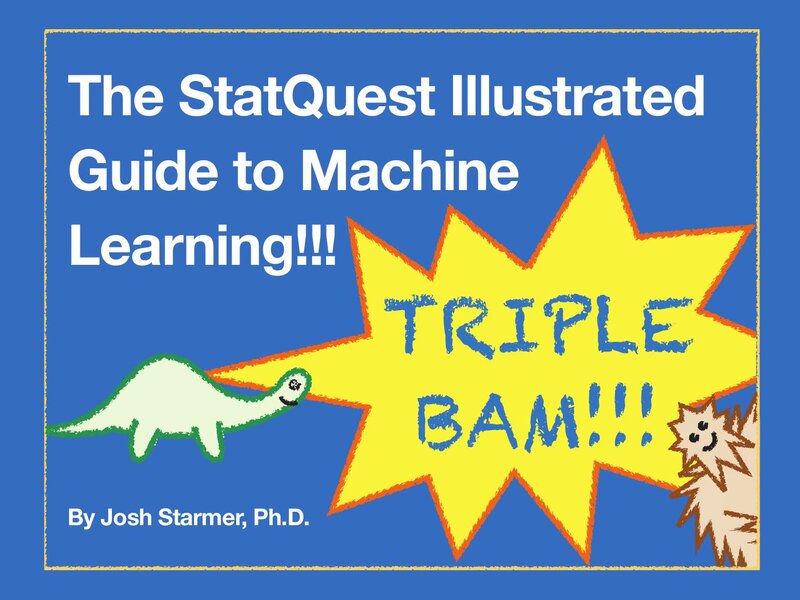

Summary
I stumbled onto Josh Starmer’s books randomly, out of nowhere, and have been binge reading them. I read through The StatQuest Illustrated Guide to Statistics , which I loved. I then started on this book on ML and managed to read it in a few days between work tasks. Like his book on statistics, this book gives a fantastic overview of classic machine learning concepts using visuals.
The book covers the following ML methods:
- Regression
- Logistic Regression
- Naive Bayes
- Classification Trees
- Regression Trees
- Support Vector Machines
- Neural Networks
Here are some of the points that I had never paused to reflect on before. They are all the more reinforcing because of the nice visuals used:
- A probability distribution is a type of model that approximates a histogram with an infinite amount of data
- A small p-value does not imply a large effect size
- Gradient descent, stochastic gradient descent and mini-batch stochastic gradient descent: what’s the connection, and when does SGD win over GD?
- A limitation of logistic regression is that it assumes it can fit an s-shaped squiggle to the data
- Multinomial Naive Bayes vs Gaussian Naive Bayes
- A bunch of confusion matrices can be summarized by a ROC curve
- Models can be compared based on the area under the ROC curve
- ROC curves vs precision-recall curves: which is better, and when?
- Lasso regularization shrinks parameters all the way to 0, whereas ridge regularization shrinks them only asymptotically close to 0
- How do you explain SVMs visually?
- Why does one use a kernel function, and the polynomial kernel, in SVMs?
- What is so special about neural networks that they can fit any kind of complex pattern in the data?
- How do you explain backpropagation using visuals?
Takeaway
This can be a good first book to build intuition for how various classic ML models work and how one goes about fitting parameters to those models. Since most of the book is visuals, it is perfect for anyone who wants to understand or revisit classic ML concepts. Definitely worth reading once.