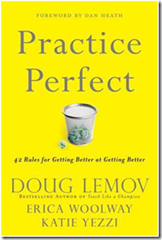
Practice Perfect : Review
 [
[ [
[
The authors of this book run “Uncommon Schools ”, a network of 32 charter public schools across Massachusetts, New Jersey, and New York. The first author, Doug Lemov , is also known for his earlier book, “Teach Like A Champion ” that is exclusively geared towards teachers to improve their effectiveness. This book is also, in a way, aimed at teachers, educators, etc. though the authors suggest that some of the techniques are more general in nature that can be be applicable to any field.
Quote for the day
Quote for the day
Every time I read a good novel (currently Anna Karenina), it astonishes me to see to what extent getting wrapped up in fictional characters seems to lend a purpose to life. There are some pleasures that can come from many sources, but in my life the pleasure of feeling part of a group — which is what makes life seem to have a meaning — comes from exactly two: close friends, and good books. In the absence of the former, the latter is an alarmingly good substitute.
Delhi incident
Sadhguru on the Delhi incident :
Mumbai Local & Waiting Times
“Waiting time” results are often paradoxical and counter intuitive. To illustrate using a simple example, here is the advertised schedule of train departures from of a Mumbai Local from Churchgate to Borivalli over a a 24 hour timeframe.
The average inter-departure time between the trains appears to be ~ 6min from the graph on the right. However since it is a discrete distribution, one can easily compute the exact value by taking a weighted average. In this case, it is 5.6 min.
Pitfalls of Backtesting
Ernie Chan on backtesting :
PostSecret

In Nov 2004, Frank Warren printed 3000 postcards inviting people to share their secret.

He handed over these postcards at subway stations, art galleries, slipped them in between pages of library books. As the word spread, people were making up their own postcards and mailing them to Frank . As of today he has over half a million postcards from strangers all over the world.This book is an assorted collection of secrets from his vast database. Each postcard has a untold story behind it. The post cards evoke a gamut of feelings : sad, shock, dismay, thought-provoking, disgusting at times, funny ….
Superb!
Quote for the day
Well, another box is suggested by the maxim better to fail quickly than to fail slowly which I’m attributing to venture capitalists but also applies in everyday life. Better to have a marriage fail after 7 months rather than 7 years; better to decide you don’t really want to do a Ph.D. after 7 months rather than 7 years. Actions that turn slow-failure outcomes into fast-failure outcomes may be better; you can stop what you’re doing and try something completely different, outside the context of the model.
Snakes & Ladders revisited
Snakes & Ladders is one of the popular board games. Just for fun, I have tried revisiting this game from a math perspective.
There are many variations of the game where each variation differs from the other in terms of the position of ladders and snakes. I picked this specific version from this wiki

Blurb from Wikipedia
Snakes and Ladders (or Chutes and Ladders) is an ancient Indian board game regarded today as a worldwide classic. It is played between two or more players on a game board having numbered, gridded squares. A number of “ladders” and “snakes” (or “chutes”) are pictured on the board, each connecting two specific board squares. The object of the game is to navigate one’s game piece from the start (bottom square) to the finish (top square), helped or hindered by ladders and snakes, respectively. The historic version had root in morality lessons, where a player’s progression up the board represented a life journey complicated by virtues (ladders) and vices (snakes).
Glowing Review
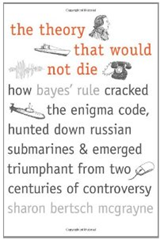
A glowing review of the book, “The Theory That Would Not Die ”, by Christian Robert in current issue of Chance :
A few days ago, prior to reading her book and writing this review, I had lunch with the author of The Theory That Would Not Die, Sharon McGrayne, in a Parisian café. We had a wonderful chat about why she wrote the book and about the people she met during its completion. Among others, she mentioned the considerable support provided by Dennis Lindley, Persi Diaconis, and Bernard Bru. This conversation also acted as an introduction to the interview on Page 24. (I had not fully read the book before because of delays in the delivery, presumably linked to Yale University Press not correctly forecasting the phenomenal success of the book and scaling the reprints accordingly.)
Surplus educated
“A little educated man has done this for the society , What will you surplus educated people do for the society?” , asks an Indian Innovator.
Staying in the NOW
The classic wisdom of “Staying in the NOW” is verified by an iPhone App.
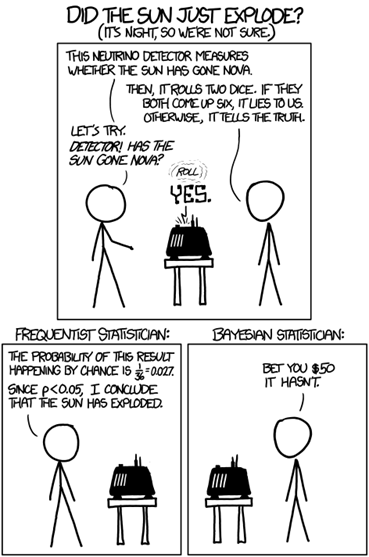
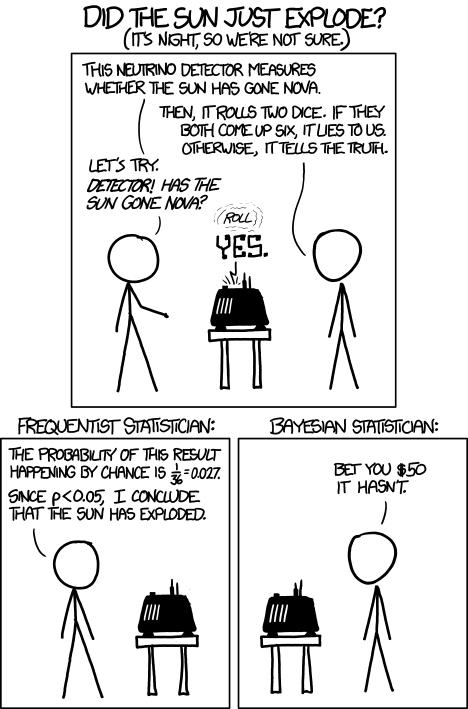
Frequentists vs. Bayesians
Via xkcd :
Taleb on Antifragility
Introduction to WinBUGS for Ecologists : Review
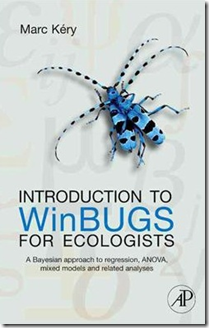
WinBUGS ( Windows Version of Bayesian analysis Using Gibbs Sampling) is a software that was developed less than a decade ago, in 2003, by Spiegelhalter. Today it is widely used by statisticians, researchers in various fields. Its popularity is also directly related to increasing acceptance of Bayesian statistics. What’s the purpose of WinBUGS ?
WinBUGS lets one specify almost arbitrarily complex statistical models using a fairly simple model definition language that describes the stochastic and deterministic “local" relationships among all observable and unobservable quantities in a fully specified statistical model.
Choosing Industry over Academia
A Professor leaves a cushy job in academics for a job @ Google.
Here’s Why ?
Quote for the day
Analyzing data is a little like fixing a motorbike but in reverse: it consists of breaking a data set into its parts e.g., covariate effects and variances), whereas fixing a bike means putting all the parts of a bike into the right place. One way to convince yourself that you really understand how a bike works is to first dismantle and then reassemble it again to a functioning vehicle. Similarly, for data analysis, by first assembling a data set and then breaking it apart into recognizable parts by analyzing it, you can prove to yourself that you really understand the analysis.
The Joy of X : Review
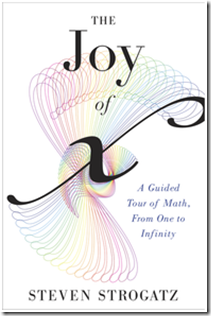
This book is indeed a joy to read. There were many “aha” moments, some of which are :
Google’s Page rank explained using a simple Markov chain example. Demonstrates the power of linear algebra.
Thinking about conditional probability in terms of frequencies is more intuitive and less confusing than the usual Bayes formula.
Power Law is the new Normal Distribution of the world.They are everywhere.
Log scale verbalized brilliantly :Markings on the axis differ by the same factor than same absolute number.
So Good They Can’t Ignore You : Review

Cal Newport wants to find out an answer to a nagging question in his mind, “Why do some people end up loving what they do, while so many others fail at this goal ?”. Researching on this question leads him on to a path where he finds rather unconventional answers. Through this book , he shares his findings.
Most of us have equate “passion” as intense love affair with one’s work. There is a also a belief that “passion” is a necessary condition in finding THE RIGHT work. In the first part of the book, the author debunks Passion Hypothesis. What is Passion Hypothesis ? The key to occupational happiness is to first figure out what you’re passionate about and then find a job that matches this passion.
Nutrition

The month of September vanished from my life as my erratic eating habits and my work schedule took a toll on my health. Having recovered now, one of the biggest changes I have made to my life is, my diet. Thanks to a colleague of mine, Gautam, who suggested this book, I have started changing a few things in my daily schedule.
Usually I don’t even cast a glance on books with such titles.But this one, I took some time out to go over it. To my surprise, the content was refreshing. The author dispels a lot of myths about nutrition, diet and weight loss. Here are a few points that I will keep in mind:
Principles of Data Mining : Review
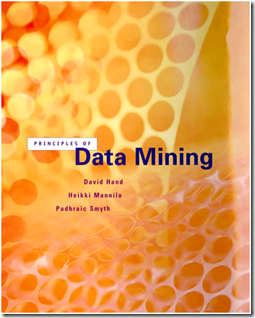
One of the reasons for going over this book is, to shuttle between the macro and micro world of modeling. One can immerse in specific type of techniques/algos in stats, forever. But I can’t. I typically tend to take a break and go over macro aspects of modeling from time to time. Books like these give an intuitive sense of “What are the types of models that one builds? I like such books as they make me aware of inductive uncertainty associated with building models. Let me summarize the main points in the book.
Sadhguru @ IIT- M
The Little Book of Talent : Review
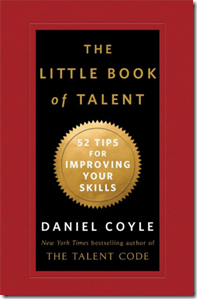
I liked Daniel Coyle’s “Talent Code ” that talks about the importance of “deep practice” in achieving mastery in any field. Not for the message of deep practice as it was already repeated in many books/articles, but for the varied examples in the book.
Here comes another book on the same lines by the same author. This book is a collection of thoughts and ideas from author’s field work, packaged as “TIPS” to improve one’s skillset. These tips are categorized in to three categories, “Getting Started”, “Improving Skills”, and “Sustaining Progress”.
In All Likelihood : Review
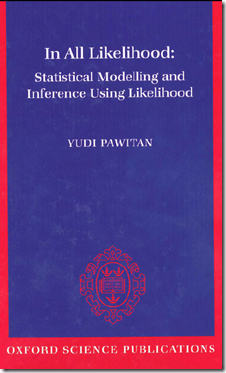
Likelihood function is a very useful mathematical object in statistics. With it, you can perform the two main tasks in statistics,i.e. estimation and inference. If you can get the distribution right or the overall structural equation right, you can do all types of stats; univariate stats, multivariate stats , linear models, generalized linear model, mixture modeling, mixed effects model and even non parametric statistics to an extent. All of this can be done from scratch with one math object, “Likelihood function” + pen & paper + a plain vanilla optimization routine.
The Zen of Steve Jobs

This graphic novel talks about Steve Jobs and Zen Buddhist priest Kobun, who acted as Jobs’ spiritual guru. Hard core Apple fans might like to know the kind of conversations that Jobs had with Kobun . However I felt the book was pointless. I think it is merely trying to cash in on two aspects, 1) Increasing popularity of graphic novels among adults and 2) Steve Jobs death in Oct 2011.
Bayesian and Likelihood Principle
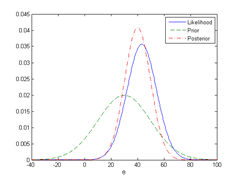
Stumbled on to an interesting paper that connects Bayesian ideas to Likelihood based inference. Both are related in the sense that Likelihood based Inference can be thought of a Bayesian Inference with uniform/vague prior. However when you get down to estimating and inferring from the data using these two philosophies, the math, the equations you use, the code you need to write are completely different.
This paper by Steel talks about whether a hard core Bayesian must accept Likelihood principle or not. It talks about two versions of Likelihood Principle(LP) that can be easily connected to the posterior-prior Bayes framework. The first version(LP1) is where you see different sets of data but they don’t change the likelihood function and the second version(LP2) is where you evaluate a competing hypotheses with the same dataset.
Document before Coding
[slideshare id=7249526&w=427&h=356&fb=0&mw=0&mh=0&style=border-bottom: #ccc 0px solid; border-left: #ccc 1px solid; margin-bottom: 5px; border-top: #ccc 1px solid; border-right: #ccc 1px solid&sc=no]
Ex Libris : Summary

The author Anne Fadiman considers herself a common reader. Who is a common reader ? In her words,
The common reader differs from the critic and the scholar. She is worse educated, and nature has not gifted her so generously. She reads for her own pleasures rather than to impart knowledge or correct the opinion of others. Above all, she is guided by an instinct to create for himself, out of whatever odds and ends she can come by , some kind of whole.
Wow!
Detecting Parkinson’s via a phone call !!
Your Brain at Work : Summary
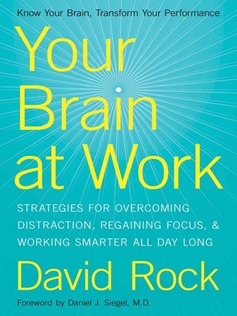
Was recovering from a brief illness. Tried reading this book just to recover from my drowsy and sullen mood.
I found the first part of this book interesting. Given the amount of information overload it often helps us to understand how our brain functions. “How do we use our brains for understanding, deciding, recalling, memorizing and inhibiting information ?” is an important question that we all need to answer, to function efficiently in our lives. I loved the initial part of the book because it uses the metaphor of stage and audience to explain the scientific aspects of our brain, more specifically the prefrontal cortex. Also the book is organized in such a way that it is presented as a play with various scenes(like a theater play). Each scene has two takes, first take is one where the actor has no clue on how the brain works and messes it up, and the second take is where the actor performs in full cognizance of the workings of the brain.
An Introduction to Generalized Linear Models
 [
[
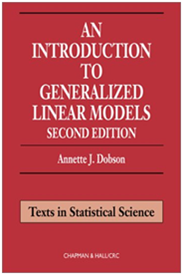
This book is written by Annette J. Dobson, a Biostatistics Professor at University of Queensland(Brisbane). I had come across this book way back in May 2010 and had worked through out the book. Here is what I wrote about it back then. While trying to understand local likelihood modeling, I realized that I had forgotten some basic principles relating to diagnostics and model evaluation for GLM. Sometimes I wonder what makes things stick. May be there is no magic bullet at all. One has to keep revisiting concepts to understand and remember them.
Knight Capital – Will it become extinct
Via LA Times :
The high-speed trading arms race being waged on Wall Street has finally claimed its first major casualty.
Knight Capital Group, a brokerage that handles nearly 11% of all stock trading in U.S. companies, is in danger of collapsing after a software glitch triggered millions of unintended orders. The New Jersey firm lost $440 million in less than an hour — nearly four times the company’s profit last year.
Teaching Kids to Read
At Harlem Village Academies (a network of public charter schools in US),
Every student (fifth graders) reads fifty books a year!
Isn’t it amazing ?
Quote for the day
Writing a novel is like driving a car at night. You can see only as far as your headlights, but you can make the whole trip that way.You don’t have to see where you’re going, you don’t have to see your destination or everything you will pass along the way. You just have to see two or three feet ahead of you. This is right up there with the best advice on writing, or life, I have ever heard.
The Devotion of Suspect X

The book begins with a single mother murdering her ex-husband. To create the perfect alibi and lead every police investigation in to a dead-end, her neighbor, a quiet high school math teacher, offers to help her. The math teacher almost succeeds in doing so, and nobody figures out the real story behind the murder except, a physics professor, whom the detectives seek help from.
The most engrossing thing about this book is that you are given the murder, i.e. the complete picture at the very beginning of the book and you encounter various characters in the novel who try fit together the pieces of the jigsaw puzzle So you always kind of, follow the intuitions, deductions, inferences of various characters about the murder and ultimately you can’t help feeling lost too. You start wondering, whether it is possible to implicate the murderer at all? But then the physics professor cracks it and puts it all together. The final picture that emerges out of the jigsaw puzzle is something that is totally unexpected.
Spectral Analysis of Time-Series Data : Summary
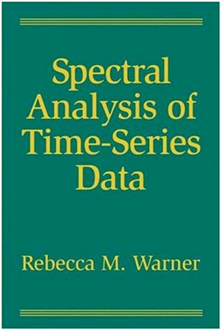
I stumbled on to this book way back in September 2010 and had been intending to work on frequency domain aspect of time series since then. I am embarrassed to admit that almost 2 years have passed since then and it was lying in my inventory crying to be picked up. Why did I put off reading this book for so long a time? May be, I am not managing my time properly. In any case, I finally decided to go over this book. In the recent few weeks I have spent some time understanding Fourier Transforms (Continuous and Discrete). I was thrilled to see so many connections between Fourier transform and Statistics. It was like getting a set of new eyes to view many aspects of Statistics from a Fourier Transform angle. Central Limit theorem appears “wonderful” from a convolution standpoint. Density estimation becomes so much more beautiful once you understand the way FFT is used to compute the kernel density, etc. The simple looking density function in any of the statistical software packages has one of the most powerful algorithms behind it, the “Fast Fourier Transformation”. I can go on and on listing many such aha moments. But let me stop and focus on summarizing this book. With Fourier math fresh in my mind, the book turned out to be easy sailing. In this post, I will attempt to summarize the main chapters of the book.
Future Babble : Summary
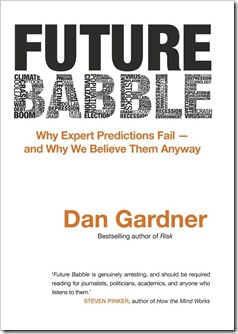
Introduction
The author begins the book with a slew of examples involving predictions that never materialized. These examples span a wide range of fields like economics, social sciences, finance, politics, etc. The author also sneaks in examples of his parents and grandparents lives to show how their lives panned out in ways that were completely unpredictable. Well, Do these examples prove anything ? You can quote volumes of predictions going wrong , but if you ask the people who predicted them, they always seem to have a defense. What are the common answers that experts give, when asked about the failed predictions
Dark Pools : Summary
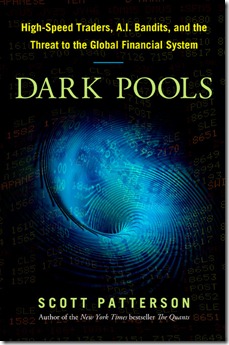
As early as 1997, the financial markets comprised blue chip stocks traded by specialists at NYSE , other stocks traded at NASDAQ by specialists and a small scale electronic system. Fast forward to 2012, the US market comprises 40 trading destinations. There are four public exchanges - NYSE, NASDAQ, Direct Edge and BATS. Inside each of these exchanges there are various destinations. NYSE has NYSE Arca, NYSE Amex, NYSE Euro next and NYSE Alternext, NASDAQ has three markets, BATS and Direct Edge have two market destinations with in themselves. There are toxic Dark pools.There are Internalizers - Citadels , Knight tradings of the world that execute trades with in their trading pools. The system, as you can see, has become extremely complex. Dark pools and internalizers accounted for 40 % of all trading volume in 2012. The pace of developments have been unbelievable. How did this all come about ? Why has the average holding time of a stock gone down from 8 month in 2000 to 2 months in 2008 and finally drop to 22 seconds in 2011 ? This book tries to answer some of the questions. This book is not so much about dark pools as it is about tracing the personalities behind some important firms in the modern high speed trading world.
Linear Models with R : Summary
 [
[
The book is written by Julian Faraway , a Statistics Professor at University of Bath. The book seems to be culmination of lecture notes that the professor might have used over the years for teaching linear models. Whatever be the case, the book is wonderfully organized. If you already know the math behind linear models, the book does exactly as it promises in the title,i.e, it equips the reader to do linear modeling in R.
Quote for the day
The love of theory is the root of all evil.
**
_--** William M. Briggs_
An Introduction to the Bootstrap : Summary
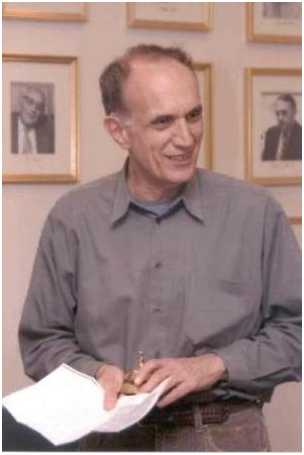 | 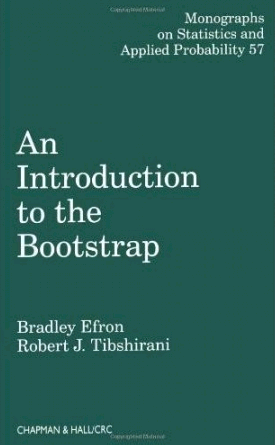 | 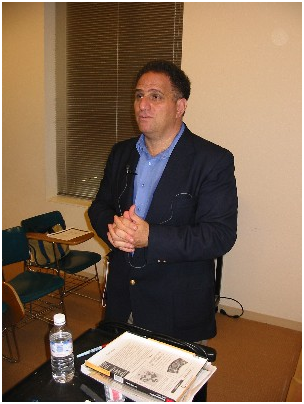 |
Bradley Efron | Robert J. Tibshirani |
When I first encountered “Bootstrap” algorithm and looked at its application , I was literally blown away. Here was a methodology that took the traditional statistics head-on. Armed with a computer and a basic algorithm for bootstrap, you can pretty much do any sort of analysis that you can find in traditional statistical world. Guess what, you hardly need to remember any complicated formulae. Somehow people who are used to traditional way of doing statistics do not like bootstrapping for various reasons. This is from my personal experience. I had developed a model that involved bootstrapping and it was a decent way to handle uncertainty. However in the recent times, the model went through a review and the reviewers were somehow averse to using bootstrapping. Well, I had to go with their decision, because sometimes it is better to get things done than to be in a perpetual state of debate. In any case, it was unlikely that I would have convinced them about the superiority of a bootstrapped approach. Having said that, my romance with bootstrapping is steady J. I love the way things can be done using basic bootstrapping algorithm. In fact these days whenever I end up solving something in a parametric way, I always double check whether bootstrap is giving similar results. If the results don’t match, I tend to cast a suspicious eye on the parametric method and trust the bootstrap method. There are very few books written on bootstrap, may be a handful even though the basic idea was introduced 30 years ago.
Self-efficacy
What is a p-value anyway : Summary

Statistics stands on two pillars, estimation and inference. Pretty much anything you work on stats, you end up either estimating something or inferring something. If you take a random sample of people who have taken a stats101 course at some point in their lives and ask them what was the course all about , a most likely answer would be, “It was something to do with p-values”. Statistics at it core is about comparing a set of numbers with each other , with theoretical models and with past experience. But most of the introductory textbooks contain scary formulae and distribution tables that need to be used by students. I think if you are a teacher introducing statistics to a new batch of students, it will do a world of good, if you dramatize a specific act : Walk in to the class and tear all the pages in the appendix that have these tables and arcane formulae that only scare people out of developing a statistical mindset. It will at least drive home the point that there is no formal textbook to interpret real life data. Why do you think textbooks make assumptions about the distributions of the data ? Pause for a few seconds and think about it. Well, one of the main reasons is that unless you have some assumptions, you cannot fill up the textbook with neat formulae. Yes, think about it. Unless you assume a certain distribution, you cannot put a neat formula for estimate. You cannot put a neat formula for confidence interval and so on and so forth. What’s the use of those formulae ? Not much.
Relevance of Stats
Via What Are the Odds That Stats Would Be This Popular?
“Most of my life I went to parties and heard a little groan when people heard what I did,” says Robert Tibshirani, a statistics professor at Stanford University. “Now they’re all excited to meet me.”
It’s not because of a new after-shave. Arcane statistical analysis, the business of making sense of our growing data mountains, has become high tech’s hottest calling. There are billions of bytes generated daily, not just from the Internet but also from sciences like genetics and astronomy. Companies like Google and Facebook, as well as product marketers, risk analysts, spies, natural philosophers and gamblers are all scouring the info, desperate to find a new angle on what makes us and the world tick. Computing has become cheap and available enough to process any number of formulas.
Elaborate encoding
Joshua Foer, the author of the book, “Moonwalking with Einstein ”, speaks at TED.
Silence
A beautiful poem via Jaisri :
Misunderstand me correctly…
Music begins where words cease.
When music ceases, silence!
When all arts aspire to
the condition of music;
What does music aspire to?
Silence.
The logic of music leads
eventually to silence!
Music must come from silence.
Come from it and return to it.
Perhaps everything will end in fire.
Fire, then silence.
That is how everything end, after all.
But, misunderstand me correctly.
Statistical Pragmatism
Via The Big Picture :
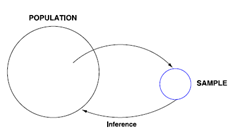
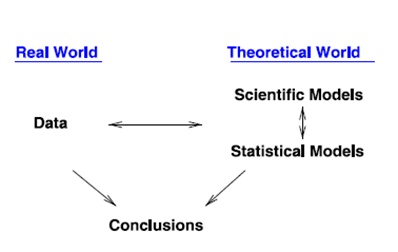
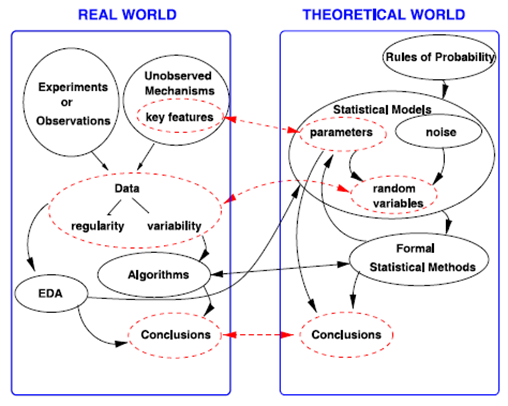
The note summarizes that one does not need to have a split personality to apply Bayesian or Frequentist thinking to stats. Separating Real World with Theoretical World from the perspective of data shows that both the schools of thought kind of have the same assumptions.
========================================================
Frequentist OR Bayesian Inference
========================================================
Frequentist AND Bayesian Inference
Statistical Pragmatism
Bayesian and Frequentist approach
Born Standing Up : Summary
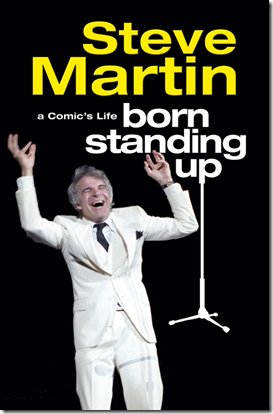
Getting good at any craft takes a long time, be it deal making or trading or mastering a game or programming. However books/articles,etc. out in the world are stufffed with “get rich quick”, “get smart quick”,“get skills quick” kind of messages. I can’t speak of other fields but programming books, that implicitly carry these messages, are always in majority, be it in the offline and online bookstores. ‘Learn XYZs language in 30 days’, ‘Become an ace coder in X weeks’ etc. For all such coders who believe such books and coding something for 30 days is going to transform you, make your venture the next instagram, this book has a lot to offer. Steve Martin gives a biographical account of his life where he claims his achievement is not a result of some sudden random event that got him to spotlight and has since then remained in spotlight. Far from it, its a story of sweat, tears, rejections and occasional acceptances, smiles and rewards . Steve starts off his book saying