Quote for the day

For some unknown reason we got in to a wrangle about – of all things! – best sellers. All aspiring writers say these things : “ I will not compromise and write a best seller! “ – as if they could!. There may be a few totally faked-up books that sell, but on the whole I believe every writer writes as well as he can. It takes a good story teller to write a best seller, and a good craftsman. The professional will never brush the best seller aside as something he could do if he were willing to compromise. No, it is all a matter of kinds of perception, and of kinds of writing. Very great writers – Dickens, Joyce, Trollope, Hemingway – have been best sellers. And very great writers – Virginia Woolf, for example have not, or only by chance.

Quote for the day

It seems that two qualities are necessary if a great artist is to remain creative to the end of a long life; he must on the one hand retain an abnormally keen awareness of life, he must never grow complacent, never be content with life, must always demand the impossible, and when he cannot have it, must despair. The burden of the mystery must be with him day and night. He must be shaken by the naked truths that will not be comforted. This divine discontent, this disequilibrium, this state of inner tension is the source of creative energy. Many lesser poets have it only in their youth; some even of the greatest lose it in middle life. Wordsworth lost his courage to despair and with it his poetic power. But more often, the dynamic tensions are so powerful that they destroy the man before he reaches maturity.

A Writer's Ten Commandments

Via Truth&Lies in Literature


TEN COMMANDMENTS


**1. THOU SHALT NOT DRINK, SMOKE OR TAKE DRUGS
**To be a writer you need all the brains you’ve got.

**2. THOU SHALT NOT HAVE EXPENSIVE HABITS
**A writer is born from talent and time – time to observe, to study, to think. So you can’t afford to waste a single hour earning money for non-essentials. Unless you were lucky enough to he born rich, you had better be prepared to live without too many worldly goods. True, Balzac got special inspiration from running up huge debts and buying things, but most people who have expensive habits tend to fail as writers.

Do the Work – Summary

clip_image002

This is a free Kindle book that I stumbled upon. This book is basically designed to coach you through a piece of work be it writing a book / developing a software / creating a model / new venture / new product/ new service etc. This book is not so much about “what you should do”, but more about “how you should you do it”. In any creative endeavor, most of us would agree that the biggest obstacle is “internal”. You can name the internal struggle in umpteen ways, here the author chooses to call it “Resistance”. He starts off saying that three big forces against us doing creative work are Resistance (i.e., fear, self-doubt, procrastination, addiction, distraction, timidity, ego and narcissism, self-loathing, perfectionism, etc.), Rational thought , Friends and family. Out of the above three mentioned forces, the author dwells upon the beast (Resistance) in us which we do not recognize sometimes. The beast has the following characteristics :

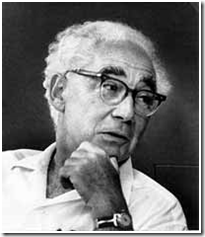
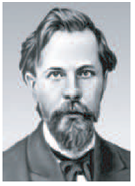
Andrei Andreevich Markov(1856 –1922 )

image

It is profoundly important to read around the area that you are working on; more so in mathematics. Theorems that you see in the texts are usually a result of ardous efforts / long drawn fights between mathematicians / result of being in extreme hysteria(Cantor for example)/ family duels(Bernoulli)/ Open air competitions(Solution to cubic & quartic polynomial ).

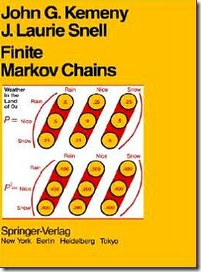
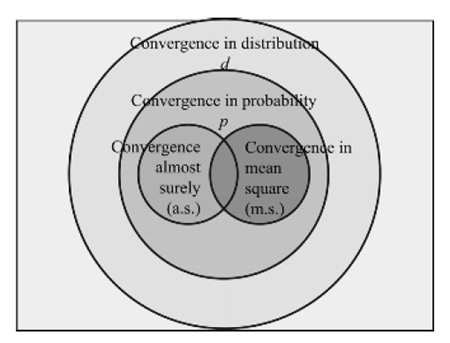
It is important for any person building stochastic models to have a thorough understanding of Markov chains as they typically lead to random walks and Brownian motion concepts .Typically one comes across some form of limit theorem in elementary courses on probability or statistics. In a crude form, one has an intuitive understanding that “You take a large collection of numbers and you take an average, it converges to some number.” It is tucked away in most books under some title which has the words,” law of large numbers” in it. However you miss the entire action if you miss the historical development to this concept and more importantly, the application of this law to dependent variables. Almost all the forms of weak law that one usually comes across has “independent and identically distributed” statement in it. This is where Markov’s work becomes important. Almost 100 years back he generalized the weak law to dependent variables. Sometimes historical developments such as these are not highlighted in math books and one needs to resort to reading around the material to get an idea of the immense contributions of the mathematicians.

Poke the Box : Summary

image

It has been a really long time since I have read any of the Seth Godin books , so picked up his latest book – “Poke the Box”. Books from Seth are usually filled with nuggets of wisdom culled out from marketers / entrepreneurs/purple cows that he comes across. To me, I love the way he writes; Straight to the point, no bullshitting, no nonsense and blends his message with anecdotes and interesting insights.

Quote for the day

If we are to speak well, our words must pass three gates.
At the first gate we ask: Are these words true?
At the second: Are they necessary?
At the third: Are they kind?

- A Sufi Saying

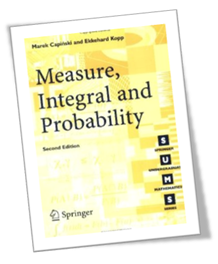
Measure, Integral and Probability : Summary

image I have found this book very challenging to go over a few years ago. This was one subject that I found it very difficult to understand. The main reason being I was never exposed to any real analysis course back then. Needless to say, my understanding was shallow. The offshoot of this limited understanding has come to plague me now when my task is to develop a model that is completely based on general measures. The model that I am trying to customize is heavily based on general measures. The model’s creator has given a few guidelines and that’s about it. The guidelines point to heavy usage of martingale theory. I realized that my understanding of general measures and martingales was pathetic and I decided to go over this book, being well aware of the fact that the book would be very challenging.
The Music Room : Summary

image

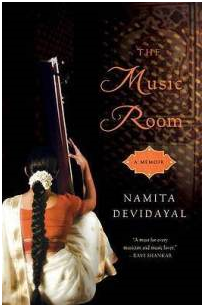
The book is a memoir from Namita Devidayal. Belonging to a cosmopolitan family in Mumbai,  Namita narrates a parallel universe that she lives in, i.e the world of Hindustani Classical, which is vastly different from her home environment. This parallel universe is given a metaphorical name,”The Music Room”. Namita is dragged in to the world of music at a young age by her mother to improve her marriage prospects. Namita reluctantly starts taking music lessons from Dhondutai Kulkarni, a musician from Jaipur gharana. This book’s central character is Dhondutai(Yes, the name sounds little odd. Infact the book somewhere mentions that Dhondutai was the only surviving child of a family from Kolhapur and the elders in the family decided to name the child , Dhondu, literally meaning “Stone” in order to cast off evil spirits.)

The Lebesgue-Stieltjes Integral : Summary

image

Firstly, something on the pronunciation –:).Lebesgue Stieltjes is pronounced as Le-BECK Steel-ye. The former being a French mathematician and the latter being a Dutch mathematician and the integral being named after their outstanding contribution to the field of analysis. I came across Stieltjes integral for the first time in Marek Capinski’s book on Probability. It was introduced in relation to measure decomposition theorems. The treatment in Marek Capinski’s book is very concise and hence I really did not understand the significance of Lebesgue Stieltjes integral. Also I came across this reference to this integral while I was studying Ito’s integral a few years back. Back then, I had no clue about Lebesgue Stieltjes integral and had never bothered to check its limitations in describing Brownian Motion. All I cared that it was somehow useless for describing Brownian motion. My limited understanding became a handicap in understanding  measure decompositions. So, finally I had to get out of limbo and slog through to understand the integral. I picked up this book which looked like an accessible introduction to the integral, which in the hindsight appears the perfect choice. Let me try to summarize the contents of the book.

Probability Essentials : Summary

image

I was going through this book after a gap of 3 years, reason being, I had conveniently forgotten some important stuff relating to martingale theory.  Now that my work demanded a thorough application of this theory, I had to go over it again.  In order to refresh my memory, I thought I should go over this book by Jacod & Protter where I had read about Martingales for the first time.

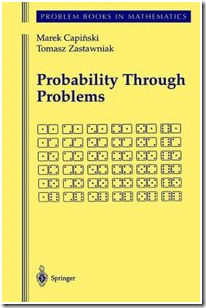
Probability Through Problems

image

This book has a nice collection of problems related to Modern Probability. Unlike the classical problems which are related to discrete variables, the problems in the book are related to variables whose measure is a combination of discrete , absolute continuous and singular measures.

My motivation in going through this book was Chapter 10 which is on Conditional Expectation. Martingales are very important mathematical objects , as far as math-fin stuff is concerned. They appear everywhere, be it option pricing/ hedging/ stat arb etc.They also play an important part in stochastic portfolio theory. Martingales are Conditional Expectation variables.

Quote for the day

Every one of us is touched in some way or the other by the problems of mathematical communication. Every one of us can make some contribution, great or small, with in his own proper sphere of activity. And every contribution is needed if mathematics is to grow healthily and usefully and beautifully.

- E.J.McShane

Quote for the day

“ What science can there be more noble, more excellent , more useful for men, more admirably high and demonstrative than this of mathematics ? ”

- Benjamin Franklin

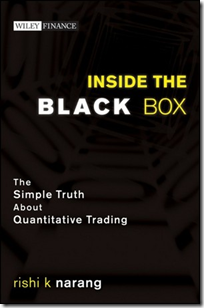
Inside the Black Box : Summary

image

The book is divided in to three parts. The first part of the book gives a basic primer to the Quant world which includes some description about the benefits of quant trading and intro to the structure of a basic quantitative trading system. The second part of the book deals with the key elements of the black box and the third part of the book is relevant to investors / managers who would want to evaluate various quant trading strategies.

Quote for the day

“ People focus on role models;
It is more effective to find antimodels – people you don’t want to resemble when you grow up.”

- Taleb

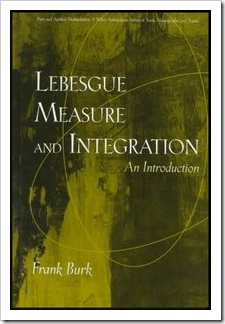
Lebesgue Measure & Integration - Frank Burk : Summary

image

Lebesgue Integration is usually introduced in either one of the two ways , in most of the books. Either using measure theory OR  skipping measure theory altogether and using approximating functions like step functions, monotone functions etc. The second approach is usually taken so that one can actually understand all the concepts of Lebesgue integral with out going through measure theory. However that approach would make it difficult for a reader to connect Lebesgue Integral and concepts relating to stochastic processes. This is one of rare books which combines both the approaches. It introduces measure theory as well as approximations in the book and uses them in various proofs, wherever the introduction makes the proof easier to follow. Let me attempt to summarize this book.

Avoid News!

Via Rolf Dobelli

  • News misleads us systematically
  • News is irrelevant
  • News limits understanding
  • News is toxic to your body
  • News massively increases cognitive errors
  • News inhibits thinking
  • News changes the structure of your brain
  • News is costly
  • News sunders the relationship between reputation and achievement
  • News is produced by journalists
  • Reported facts are sometimes wrong, forecasts always
  • News is manipulative
  • News makes us passive
  • News gives us the illusion of caring
  • News kills creativity

Rise of picosecond Trading

Via efinancialnews.com

But in recent weeks trading geeks have started to talk about picoseconds in what is a truly mind-boggling concept: a picosecond is one trillionth of a second. Put another way, a picosecond is to one second what one second is to 31,700 years.

Why on Earth (which spins at a rate of 460 meters a second) is it necessary to trade so fast?

The answer is simple. Firms that trade super fast effectively put themselves at the front of the trading queue and have priority over other orders. This position gives them better information on the trading behaviour of other investors and allows them to react faster.

Quote for the day

“Always produce” is  a heuristic for finding the work you love. If you subject yourself to that constraint, it will automatically push you away from things you think you’re supposed to work on, towards things you actually like. “Always produce” will discover your life’s work the way water, with the aid of gravity, finds the hole in your roof.

- Paul Graham

Quote for the day

It is worth emphasizing that quantitative measures of risk, until further notice, should not be viewed as a strictly cardinal (absolute) expression of risk, but rather as an ordinal measure; my VaR is more than it was a week ago, less than it was three weeks ago, but what “it” is, is not truly knowable.

- Andrew B. Weisman

Computing power isn’t good enough

Via Paul Erdos:

We have all these powerful computers
but they are not good enough to answer this question,

“Find the minimum number of guests that must be invited so that
at least 5 will know each other OR at least 5 will not know each other ? ”

Quote for the day

Our need for consistency is stronger than just about any other intrinsic need we have. People will behave in a manner that is consistent with their previously existing self-concept, even when this behaviour is unrewarding to them otherwise.

- Prescott Leaky

Quote for the day

A Japanese artist was commissioned by an American to do a paining. The completed work had, in a lower corner, the branch of a cherry tree with a few blossoms and a bird perched upon it. The entire upper half of the painting was white. Unhappily, the American asked the artist to put something else in the painting because it looked, well, so bare. The Japanese refused the request. When pressed for an explanation, the artist said if he did fill up the painting, there would be no space for the bird to fly.

Nature Vs Nurture

Via “ How to be genius ?“ New Scientist ,15 September 2006 - David Dobbs

My mother, rest her merry, brainy soul, convinced me early on that I was - as she liked to put it, quoting the cartoon character Yogi Bear - “SMARRR-ter than the average bear!” I happily assumed that my Yogi-like intelligence would ensure great things. My sense of entitlement grew when I easily won good marks in school, then grew some more when three different college professors told me I had a talent for writing. Rising to the top, I gathered, was a matter of natural buoyancy.

Rise

      Such is the way of the world
      You can never know
      Just where to put all your faith
      And how will it grow

      Gonna rise up
      Burning back holes in dark memories
      Gonna rise up
      Turning mistakes into gold

      Such is the passage of time
      Too fast to fold
      And suddenly swallowed by signs
      Lo and behold

      Gonna rise up
      Find my direction magnetically
      Gonna rise up
      Throw down my ace in the hole

The Cauchy – Schwarz Master Class : Summary

image

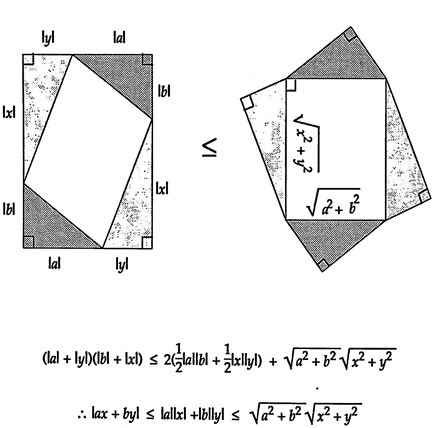
You see inequalities in any discipline. In math-fin area specifically, most of the times, the inequalities are derived from a basic set of inequalities such as Cauchy’s, AM-GM, Jensen’s,Holder’s, Minkowski’s Inequalities. One typically comes across inequalities in some math course where one is asked to prove a specific inequality. Typically one solves them just like one learns the grammar and syntax of a language. Sadly ,the principles behind them are conveniently forgotten as one does not actually use then in some practical context. So, the GAP between the time one is working on basic inequalities in a course work and the time where one needs to apply them to solve a practical problem, sometimes runs in to years/ decades. Sadly , all one can do is to go back and refer some books on inequalities that most often than not , appear consisting of  pages with a laundry list of inequalities. You start to wonder, “ Are there any principles behind solving inequalities?”, “Are there any common strategies to work with inequalities ?” , “Is there a connection between a specific strategy / inequality to problems in various scientific disciplines ?”. The book provides these answers in a delightful way. Math books written in conversational style are few and this is one of them.

Quote for the day

          There is a pleasure in the pathless woods;
          There is a rapture on the lonely shore;
          There is society, where none intrudes,
          By the deep sea, and music in its roar:
          I love not man the less, but Nature more…

                                                       - Lord Byron

Quote for the day

To solve a problem is a very human undertaking, and more than a little mystery remains about how we best guide ourselves to the discovery of original solutions. Still, as George Pólya and others have taught us, there are principles of problem solving. With practice and good coaching we can all improve our skills. Just like singers, actors, or pianists, we have a path toward a deeper mastery of our craft.