Quote for the day

Free flight is one of the most common subjects of sweet dreams; just as falling is the frequent stuff of nightmares. And yes, we learned to fly; we achieved the dream and it has proved dust and ashes. Ironically enough, everything about human flying is the antithesis of what we dream of. Aeroplanes are noisy, cramped, polluting – they scratch the surface of the blue ceiling and break up the silence of the night. Strapped in like children, herded about like animals, deafened not just by engine noise but also by overcrowded airports and a general atmosphere of pandemonium, and bound by sets of regulations that would be condemned in an ordinary prison, you further have the privilege of doing the maximum possible amount of environmental damage and running the risk of deep-vein thrombosis

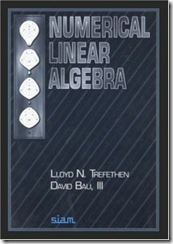
Numerical Linear Algebra : Summary

image image] Prof.Trefethen image David Bau

Prof Lloyd N.Trefethen and his student, David Bau have neatly organized all aspects of numerical linear algebra in to a set of 40 lectures. Each lecture revolves around one specific idea. I will try to summarize the key points of these lectures.

Every person who has solved any real life math fin problem knows that the classic numerical algebra is dead. Iterative methods are almost always used for finite difference methods, solving pde’s, optimization. Books such as these , which explain things clearly and  give the intuition + math behind iterative methods should be considered as a treasure. To appreciate the iterative methods, it is important to know the classic algos. In that sense 31 lectures out of 40 lectures in the book revolve around the classic way of solving stuff. If you have the patience to slog through the 31 lectures, then you will definitely see the iterative methods in a different perspective altogether.

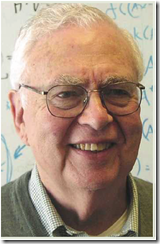
Gene Golub (1932 – 2007 )

Gene Golub’s Obituary written by Professor Lloyd N. Trefethen( Oxford) :

image A century ago, matrices and the techniques for their manipulation — linear algebra — were a backwater of mathematics. Today, they are the foundation not just of the mathematical field of numerical analysis,but also of computational science and engineering, and have become indispensable for anyone who wants to get numerical results from a computer. The pre-eminent figure in matrix computations over the past 50 years, Gene Golub, died on 16 November,2007.

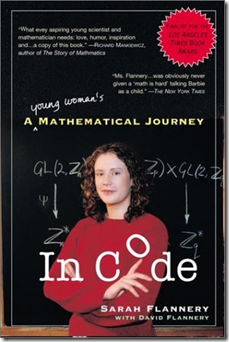
In Code : Summary

 image

Sarah Flannery became famous at a young age of 16 when her algorithm for cryptography was speculated to be a far better alternative to the widely adopted RSA algorithm. She presented an algorithm at the Young Scientist Competition with no fan fare and she won the competition. This book would not have been written but for one reason , the competition result got picked up by “London Times “  and an article appeared on the front page with a nerdy picture and a catchy title , ”Sarah Flannery, 16 , who baffled the judges with her grasp of cryptography”. Subsequently “Reuters” published the story , which put Sarah, her family, her life till then, under public eyes. She was inundated with calls from journalists, TV shows, firms offering her employment , VCs wanting to give seed capital , universities asking her to give a talk to their students etc.

Image Compression & SVD

Image compression is a billion dollar industry. An optimal way to store and retrieve image data storage is the key. Though there are multiple algorithms that are usually used , one such algorithm that has found wide spread popularity is SVD( Singular Value Decomposition).

To explain SVD in simple words, let’s take an image

image 

For illustration purpose, I have deliberately chosen two colors.  Now let’s say you want to store this data. One way is to store in a matrix. Lets say that the above image can be fit in a 15 by 40 matrix with each cell carrying either a white or a black colour. Now if you were to store the above data in a matrix , it will be a whole lot of 0’s to represent black color and sparse 1’s to represent white color. Most of the images that we come across are of the same pattern. If you represent them in a data matrix , it will turn out to be a sparse matrix, meaning a matrix with whole lot of 0’s as its elements. Now if you want to store the above data, you will be storing 15*40 = 600 numbers.  It might not sound a lot but if you pick up an image from the real world, the image might have 512 pixels in each row and 256 pixels in each column, thus having massive amount of data (2 power 17 entries). The example that I have chosen is for mere illustration purpose but the principle is applicable to any massive image data matrix too.

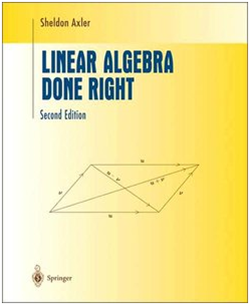
Linear Algebra Done Right : Summary

image

There is a need to visualize higher dimensional spaces in various applied math problems, though one cannot give any physical meaning to such higher dimensional spaces. Our inability to see anything more than 3 dimensions does not mean we cannot visualize and understand multidimensional space. For a superb account of ways to visualize higher dimensional space, one can read “Flatland”, the classic book of a 2 dimensional world, which describes the experiences of a 2 dimensional square trying to come to terms with a 3 dimensional world. After reading “Flatland”, one becomes more open to understanding multi-dimensional spaces. Developing abstract thinking is the key for doing math/modeling and linear algebra being the study of multi-dimensional world becomes very important to enhance abstract thinking.

Optimize Travel Search

Via LANYRD

In this brief video, Jonathan Seidman and Ramesh Venkataramiah discuss the use of Hadoob, Hive for doing analytics on 500 GB /day data that gets generated via Orbitz.

A website like Orbitz generates millions of searches each day. Storing and processing the ever-growing volumes of data generated by all of those searches becomes prohibitive though traditional systems such as relational databases. This presentation details how Orbitz is using new tools such as Hadoop and Hive to meet these challenges. We’ll discuss how Hadoop and Hive are being used to analyze search data in order to optimize the products shown to users and detect trends in search keywords. This includes such tasks as using Hadoop to extract and transform data, and using Hive to perform statistical analysis on that data.

ColorBrewer

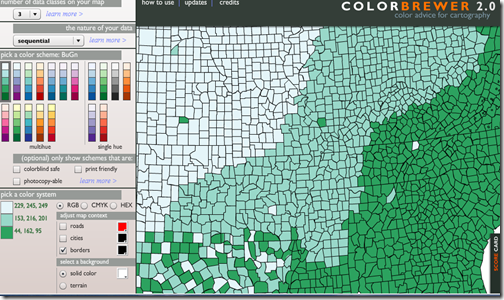
Visualization of data is one of the key components of analysis. The better the visual, the better the insight in to the data patterns. “Color” in a graphic is one of the key elements and in this aspect, Cartography provides valuable lessons.

Via Colorbrewer :
image
                   Different Schemes of colouring can be used based on the data requirements :

  1. Sequential schemes are suited to ordered data that progress from low to high. Lightness steps dominate the look of these schemes, with light colors for low data values to dark colors for high data values.

Solitude

Sent by Geeta Ma’am:

           Solitude ( Alexander Pope)

Happy the man, whose wish and care
A few paternal acres bound,
Content to breathe his native air
In his own ground.

Whose herds with milk, whose fields with bread,
Whose flocks supply him with attire;
Whose trees in summer yield shade,
In winter, fire.

Blest, who can unconcern’dly find
Hours, days, and years, slide soft away
In health of body, peace of mind,
Quiet by day.

College Education

Via good.is

Shamus Khan ( Sociology Professor at Columbia University ) says :

I am a college professor. And as I look at such data, I cannot help but think that I am part of a great credentialing mill. Colleges are increasingly places for the rich. It’s too simplistic, but this is pretty much the story. Colleges admit already advantaged Americans. They don’t ask them to do much or learn much. At the end of four years, we give them a certificate. That certificate entitles them to higher earnings. Schools help obscure the aristocratic quality to American life. They do so by converting birthrights (which we all think are unfair) into credentials (which have the appearance of merit).

Quote for the day

There is a tide in the affairs of men,

Which, taken at the flood, leads on to fortune ;

Omitted , all the voyage of their life

Is bound in shallows and in miseries.

On such a full sea are we now afloat ;

And we must take the current when it serves,

Or lose our ventures

- Shakespeare, Julius Caesar

Quote for the day

The sea does not belong to despots. On its surface iniquitous rights can still be exercised, men can fight there, devour each other there, and transport all terrestrial horrors there. **But at thirty feet below its level their power ceases,  their influence dies out, their might disappears.
**
Ah, sir, live in the bosom of the waters! There alone is independence.There I recognize no masters! There I am free. “                                              - Jules Verne. 2000 Leagues Under The Sea.

The Shallows : Summary

image

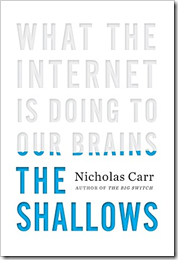
What is common between Michael Lewis, Malcolm Gladwell, Paul Graham , Clay Shirky ? If you have read any of the articles in the media written by the above authors, their articles are distinct. They are long, hyperlink free, engage our minds for a long period of time using arguments / interesting examples , make us a bit contemplative . In short we can DEEP READ their articles. They have the power to change our thought process too. However the other 99.9999999 % of the stuff that we come across on the net are basically short articles heavily laden with  hyperlink , video links, multimedia etc. Exposure to such media is doing something to our brains and Nicholas Carr discusses the issue thread-bare in his new book , “ The Shallows”.

Quote for the day

As the drill will not penetrate the granite unless kept to the work hour after hour, so the mind will not penetrate the secrets of mathematics unless held long and vigorously at work. As the sun’s rays burn only when concentrated, so the mind achieves mastery in mathematics, and indeed in every branch of knowledge, only when its possessor hurls all his forces upon it. Mathematics, like all the other sciences, opens its doors to those only who knock long and hard.

Quote for the day

Good Design is HARD.
If you look at the people who’ve done great work, one thing they all seem to have in common is they worked very hard. If you’re not working hard, you are probably wasting your time.

- Paul Graham in Hackers & Painters

A Radical Approach to Lebesgue’s Theory of Integration : Summary

image

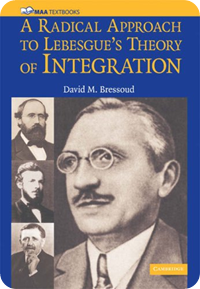
This book is the sequel to the book A Radical Approach to Real Analysis, a book that I found to be the best historical narrative of Real Analysis. This book too in the same league, though applied to Lebesgue theory. Let me attempt to summarize this fascinating book. The book comprises 8 chapters structured in such a way that it takes the reader from Riemann integral to Lebesgue integral and finally answering  a simple but revolutionary question in analysis, “ When does a function have a Fourier Series expansion that converges to that function? ”

Mathematics – A Very Short Introduction : Summary

image

A nice workout typically jolts you out of bad day and makes you alive. For me,a good book does the same when I have no energy to step out of home. Last few days I have not been keeping well and this book has kept my mind active despite the dullness around.

In this delightful little book, Timothy Gowers delves in to the philosophical differences between people who are happy with the notions of infinity, curved spaces, square-root of –1, N dimensional spaces, etc, from those who find them disturbingly paradoxical. There are many amongst us who question the very purpose for thinking about quantities that do not exist in their experience. Why bother about to think about infinity? It’s just a mathematician’s symbol for something that is not finite. Why bother about anything beyond the 3 dimensional experience objects? Can you show me a 4 dimensional object? If not,  why should I spend my time understanding a four dimensional geometry ?, goes the usual stance. They say, god created integers and rest of the math is basically human mind’s construct. So why bother developing a mathematical approach to our daily life situations, if it’s just a theoretical construct , a ghost of our imagination ? The book’s underlying theme is that math is a happy ghost which will only help you in understanding stuff better.

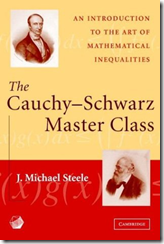
An Introduction to Inequalities : Summary

image

Inequalities are a boon to various derivative valuation problems that arise in real life. One can use inequalities to get around problems for which closed form solutions are difficult. The other day I was struggling with an inequality . So, took my friend’s help who worked on it in a jiffy and produced a bound. He also happened to suggest this book to me so that , I can quickly refresh basic inequalities and probably stop bothering him with trivial questions –:) . This book is a remarkable little gem that quickly got me up to speed .

Metric Spaces - Iteration and Application : Summary

image

Instead of approaching “Metric spaces” from a real analysis perspective, this book tries to use an application to motivate the reader. The application is based on “contraction mapping theorem” which is used in solving a single equation / simultaneous equations. In its most simple form, let’s say there is an equation of the type x = f(x) which needs to be solved. One of the ways to solve this type of equation is as follows:

Quote for the day

Vital lives are about action.
You can’t feel warmth unless you create it,
can’t feel delight until you play,
can’t know serendipity unless you risk.

— Joan Erikson

The Calculus Gallery : Summary

image

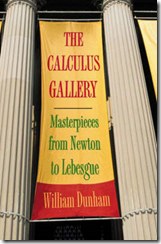
Off late, I have developed a lot of interest in Lebesgue Measure, thanks to the math- fin exposure over the last few years. Being a practitioner instead of a theorist/academician has its own advantage. You don’t get wedded to one concept or one theory. You take a random sample of all the techniques which have been applied to solve a problem and based on the context, you can choose one  from the random sample OR create a customized method from that random sample of methods. Sometimes it also helps to see how various problems have been approached by the pioneers in any field. The Calculus Gallery is one such book which gives the approach followed by pioneers in Calculus to solve various kinds of problems. 

A Radical Approach to Real Analysis : Summary

image image

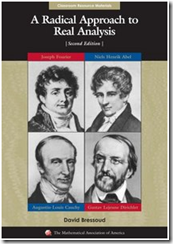
Any subject looked at from a historical perspective becomes interesting because the narrative becomes a story and the concepts become that much more meaningful. A subject like real analysis is a dry subject, whose importance though is seen in many branches of mathematics. When someone brings out a book on Real Analysis in a narrative format, I think it should not be missed. David Bressoud wrote the first edition of the book titled “A Radical Approach to Real Analysis” in 1994 and followed it up with a second edition in 2007. Obviously things have been structured/pruned/organized better in the second edition. But somehow I happen to read both the editions. So, I will attempt to summarize the content of both the editions as each has its own charm.

Quote for the day

They say that you get the face you’ve earned by the time you are forty – all those sorrowful, angry expressions, long hidden behind the makeup, become the naked truth. It mirrors who you are, who you’ve been , a kaleidoscope of endless patterns. Oh, well, for today at least I’m beginning to loosen up and like who I could be

- Joan Anderson ( A Year by the Sea)

Understanding Analysis : Summary

image What’s the connection between probability and real analysis theory ? Why does one need to know at least the basics of Real Analysis to understand probability.Well, that’s because axiomatic probability is built , ground up, using the concepts from real analysis. Though you can pick up any graduate level probability book and go through it by having an intuitive sense of real analysis, there is no substitute to seeing axiomatic probability through the eyes of person who understands real analysis well.
The Quants : Summary

image_thumb3

The book starts off with the story of Ed Thorp, the father of stat arb. Priceton / Newport partners is a fund that is well known in the quant world that has a great track record of beating the market for decades and the quant behind it is Ed Thorp. If you want to read the entire story with bells and whistles about Ed Thorp,  Fortune’s formula is a better book. This book though quickly summarizes the success story of Thorpe-Shannon combination and goes on to tell a nice story of four quants who strike it big in the hedge fund world.  The author traces the lives of  Peter Muller(Morgan Stanley PDT) , Ken Griffin( Citadel), Cliff Asness (AQR) and Boaz Weinstein(Saba) from their childhood, to their trading careers, their eccentricities, their hiring decisions , their winning and losing trades.  Besides these four quants, there are host of people / funds mentioned in the book

The Quants : Summary

image

The book starts off with the story of Ed Thorp, the father of stat arb. Priceton / Newport partners is a fund that is well known in the quant world that has a great track record of beating the market for decades and the quant behind it is Ed Thorp. If you want to read the entire story with bells and whistles about Ed Thorp,  Fortune’s formula is a better book. This book though quickly summarizes the success story of Thorpe-Shannon combination and goes on to tell a nice story of four quants who strike it big in the hedge fund world.  The author traces the lives of  Peter Muller(Morgan Stanley PDT) , Ken Griffin( Citadel), Cliff Asness (AQR) and Boaz Weinstein(Saba) from their childhood, to their trading careers, their eccentricities, their hiring decisions , their winning and losing trades.  Besides these four quants, there are host of people / funds mentioned in the book

Quote for the day

It often happens that a player carries out a deep and complicated calculation,

but fails to spot something elementary right at the first move

- Chess grandmaster Alexander Kotov

Trivia : Ironically, Amaranth hedge fund once sent chess sets as year-end gifts, inscribed with the above quotation.

Applied Multivariate Statistical Analysis : Summary- Part I

image

Last few weeks have been good , for most of the trades have gone right. When something works, I generally  attribute it to 90% luck + 10% logic. When something doesn’t work, I usually have the proportions reversed in my mind as it  helps in creating better logic/algo. It really doesn’t matter what one believes when something has already worked, but one’s attitude/belief system DOES matter when things don’t work . On this “feeling lucky” note, I thought I should write something about Multivariate Stats . 

Gift from the Sea : Summary

image

Anne Morrow Lindbergh decides to take a brief retreat from her life to spend some time on Florida’s Captiva Island and ponders over several aspects of life. This book is a compilation of those thoughts. First published in 1955, this book was a big hit and was translated in to 45 odd languages. More recently, there was a 50th anniversary edition of the book with a preface written by Lindbergh’s daughter Reeve Lindbergh  

Alex’s Adventures in Numberland : Summary

image” for Math. What does the book contain ? It contains 12 chapters on various aspects of math with history and examples blended in such a way that a reader will love the pace of the book.

0. Head for Numbers

The book starts off with questioning the concept of NUMBER itself. Is it a cultural artefact or Is it something that we have an innate ability to comprehend ? Alex cites an interesting piece of research which reaffirms our tendency to think in logarithmic scale. Innately, we compare numbers by ratios and not by their distance between them. So, the distance between 10 and 100 appears same as 100 and 1000, though our schooling in math says they are different.  The point made by the author is that we are innately kind of wired with log scale BUT we encounter the linear scale in our math education. So, the suggestion is to marry both scales somehow and lessen the math phobia amongst some of the kids at the school level. If understanding quantities approximately in terms of estimating ratios is a universal human intuition, then the question remains ,”Why should Kids learn about times tables , instead of sharpening their estimation skills ?” 

Superb Visual

Via Information is Beautiful :

A superb way to collate numbers. Absolute numbers are useless but become interesting when you see it in a context. Someday I would love to write a piece of code which does this automatically given some data points.

image

Finally!!!

image Have been waiting for this kind of plugin since ages. Finally I stumbled on to one today.

Readability : Cuts the crap while reading articles on the net. I think it is pretty useful if you don’t want to get distracted while reading stuff on the web.