Zen Shorts

image
I had never heard of Caldecott Honor & Medal books until yesterday when I came to know that such books contain a lot of ideas for teaching stuff to kids. 

Here is what the wiki says :

The Caldecott Medal is awarded annually by the Association for Library Service to Children (ALSC), a division of the American Library Association, to the artist of the most distinguished American picture book for children published that year. It was named in honor of nineteenth-century English illustrator Randolph Caldecott. Together with the Newbery Medal, it is the most prestigious American children’s book award

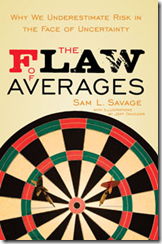
Flaw of Averages : Summary

image

Well, there have been enough books about Central Limit Theorem bashings, Gaussian bashings , as applied to finance, thanks to the books like Blackswan and its ilk.

I had put off reading this book for quite sometime for I was expecting the same message – average is really an average! :), there are better ways to dealing with data than merely looking at the average. So, reluctantly I quick read this book a few days back. This book is extremely light read and could easily be read in a couple of hours.To my surprise, there were some good points in the book.

Role of Stats

Via  NY Times ( For Today’s Graduate, Just One Word: Statistics)

“The key is to let computers do what they are good at, which is trawling these massive data sets for something that is mathematically odd,” said Daniel Gruhl, an I.B.M. researcher whose recent work includes mining medical data to improve treatment. “And that makes it easier for humans to do what they are good at — explain those anomalies.”

What is true about internet data is also to some extent valid for high frequency data where anomalies need to be traded and arbitraged away…With world around us becoming more uncertain than ever, the only thing that is worth explaining and worth trading might be at a high frequency scale!!

Physics Envy

Thanks to Sanjiv Sir’s forward,  this note on financial models is one of my best reads till date, on the crucial differences between a Physics based Model  and a Financial Model. Why should a financial modeler be extra cautious in whatever he/she does and not carried out away by math jazz is something that is well brought out by the paper by Andrew Lo.

_If Tycho, Kepler, Galileo and Newton had been confronted with such “quasi-periodic” data for the cyclical paths of the planets, it may have taken centuries, not years, of observational data for them to arrive at the same level of understanding of planetary motion that we have today.

US Economy – Is the story over

Look at some of the numbers … Its a scary picture!

  • Massive Option ARM resets in 2010
  • Extremely tight lending norms leads to lesser demand for housing and further home price fall
  • A total of 6,130,000 U.S. workers had been unemployed for 27 weeks or more in December 2009.  In fact, it is more than double the 2,612,000 U.S. workers who were unemployed for a similar length of time in December 2008.
  • In December, there were also 929,000 “discouraged” workers who are not counted as part of the labor force because they have “given up” looking for work.
  • The mayor of Detroit estimates that the real unemployment rate in his city is now close to 50%
  • An estimate of  22% to 29% of all current U.S. jobs will be outsourced in the coming few years
  • During the 2001 recession, the U.S. economy lost 2% of its jobs and it took four years to get them back. This time around the U.S. economy has lost more than 5% of its jobs and there is no sign that the bleeding of jobs is going to stop any time soon.
  • 25 state unemployment insurance funds have gone broke and the Department of Labor estimates that 15 more state unemployment funds will likely go broke within two years and will need massive loans from the federal government just to keep going.
  • 37 million Americans now receive food stamps, and the program is expanding at a pace of about 20,000 people a day.
  • The number of Americans who are going broke is staggering. 1.41 million Americans filed for personal bankruptcy in 2009 - a 32 percent increase over 2008.
  • Dollar power erosion
  • The recent economic downturn has left some localities totally bankrupt. For instance, Jefferson County, Alabama is on the brink of what would be the largest government bankruptcy in the history of the United States - surpassing the 1994 filing by Southern California’s Orange County.
  • The U.S. is facing a pension crisis of unprecedented magnitude
  • Social Security and Medicare expenses are wildly out of control.
  • The U.S. has allowed the total federal debt to balloon by 50% since 2006 to $12.3 trillion. 
  • Senate Democrats last week proposed allowing the federal government to borrow an additional $2 trillion to pay its bills, a record increase that would allow the U.S. national debt to reach approximately $14.3 trillion.
  • It is going to become even harder for the U.S. government to pay the bills now that tax receipts are falling through the floor.  U.S. corporate income tax receipts were down 55% in the year that ended on September 30th, 2009.
  • The Federal Reserve bought approximately 80 percent of all U.S. Treasury securities issued in 2009.  In other words, the U.S. government is now being financed by a massive Ponzi scheme.
  • The reckless expansion of the money supply by the U.S. government and the Federal Reserve is going to end up destroying the U.S. dollar and the value of the remaining collective net worth of all Americans.

Via : EconomicCollapse Blog

Pie Charts – Why

Most of the times you pick up any report / numbers based article from the media, you will frequently see this animal called “Pie Chart” .

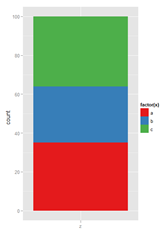
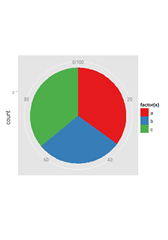
Actually if one thinks of it, Pie Chart is nothing but a polar transformation of a stacked bar chart.

image image

In that sense , a stacked bar chart gives much more visual information than pie chart. Its an empirical observation that most of us are not too comfortable with judging proportions based on the angles in a pie. Now if the angles subtended are huge, then we can discern the proportions, else it becomes difficult. Imagine a pie with 6 cuts and 4 of them are subtending 16, 14, 17 , 20 degrees. The pie chart then becomes completely useless.

Quote for the day

It is not the strongest of the species that survives , nor the most intelligent,

**but the one most responsive to change
**                
- Charles Darwin

Tears in Armenia

Via Kiran :

The main instrument in the piece that sounds like a wind instrument (like a flute) is a 3000 yr old Armenian instrument called Duduk (pronounced DUDHOOK). The song is called Tears in Armenia. It was composed to mark the 100 yrs of Genocide that Armenians had to face from the Turks in early 1900s. Duduk is made of  seasoned apricot stem and bones. It has 2 parts to it. This is the only instrument that sounds like a man’s husky voice

:59 Seconds

If you look around, you cannot miss the fact that people are living in a road runner culture, meaning , People want to do everything fast.

  • Speed publishing – Blogging , Twittering

  • Speed Talking -  IMs

  • Speed Dialing

  • Speed Dating

  • Speed Sex

  • Speed Walking

  • Speed Yoga

  • Yogaerobics - I saw this ad in Midtown NY and was  rather amused at the way yoga, an essentially slowing down activity  , is being marketed with aerobics tag

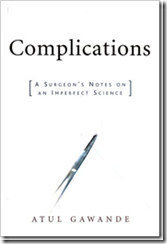
Complications : Summary

image

I stumbled on to “Better” at a crossword store in Mumbai. Picked it up immediately after spending a minute browsing through the book… The book turned out to a great read.

So, with that experience behind, I ordered the other two books written by the author Dr. Atul Gawande. His first book which is extremely popular is “Complications”. “Better” is his second book and recently he came out with a book titled “Checklist Manifesto” . With very high expectations, I began reading “Complications” and by the end of it , the book did not disappoint me.

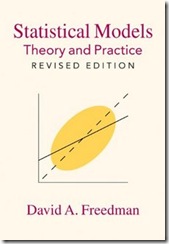
Statistical Models : Summary

Image-134

Had a dose of stats at work during this week and I am still struggling to find a way out the model that I am working on. To take a break from that mode of thinking and also thanks to this three day weekend , I am writing a rather elaborate summary of , what I consider to be one of the well written books in statistics for linear models. The point of this summary is  to motivate beginners - intermediate level stats oriented students to have a look at this book . I am certain that  there will something to take away from this book that is wonderfully written. Ok, now coming to the summary..

UNICEF clip

A young girl in India longs to be in school. She watches through the window and the gracious teacher calls her in. But when she sits down, the boys shift over to one side to be away from her. This is the premise of The Classroom, the winner of the UNICEF youth video contest marking the 20th anniversary of the Convention on the Rights of the Child (CRC). As the one-minute video progresses, more and more girls join the first girls side, until the classroom is full of both boy and girl students doing their lessons.

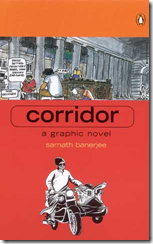
Corridor

image

This book was marketed as the first graphic novel in India. Written by Sarnath Banerjee, the book was a delight to me.  A beautiful amalgamation of text and graphics narrating the urban life of Delhi and Calcutta through varied characters.

It can be read in 1/2 hr time . However if you take the time to look at the graphics and the interplay of the minute details with the graphics, you will tend to appreciate a lot many things.

e: The Story of a Number

  • Who came up with this constant ?

  • Where did it first appear ?

  • Why is this number so important ?

  • Why should one make a function out of this constant ( exp(x) ) ?

  • What is its relation to complex numbers ?

  • What is its connection with hyperbola , as it appears in coshx , sinhx etc ?

This book is a collection of stories about various developments around e. However there is a common thread which runs across all the stories. Each of the story has in its essence, a development which lead to the world we are living in, where we take e for granted in most of the applications we deal with.

Quote for the day

Ever since I switched from economics to probability and statistics in my early student days, this area has continued to absorb my interests. The very idea that the seeming chaos of chance obeys mathematical laws is immensely attractive. It gives me great satisfaction to have made a few contributions to the understanding of this field.The successes I had did not come easy to me. They were the fruits of long hours of work which often led to dead ends. I am well aware that with advancing years my capacity to work has diminished. The lure of the subject persists.Whether I will contribute more to it, only time will tell.

Dabbawallas : Six Sigma on What

Image

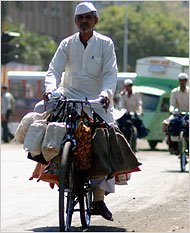
For my lunch @ work, I get it from VITAL foods, an agency which uses the famous dabbawalla network to deliver. Most of us are aware of the accurate service of dabbawalla’s in Mumbai. I think it is also a case study at HBS. Also, the publicity it gets in the local newspapers makes sure that most of the non-residents of mumbai also know about it.

However there was a letter from VITAL foods stating that they would discontinue the services of Dabbawalla as there have been too many complaints in the recent past. Being a customer of this system, I did find that to be true. Even though the system was accurate in the delivery , it was erratic in terms of the time of delivery.

Quote for the day

TAKE short views. If you shoot at a near mark, even if your hand shakes you will hit it.

If you shoot at a distant mark, and your hand vibrates slightly, you will miss it.

Trivia

Given the modern day computing capabilities, calculating Image is easy . Here X and Y stand for dependent and independent variable data, the resultant computation gives the estimates of a linear model .

Below is Brunsviga Arithmometer, a tool for adding , subtracting, multiply and dividing. Yule, the famous statistician is known to have used 2 slide rules and this machine below to calculate betas.

Now, how does one one calculate inverse of a matrix using slide rule and arithmometer ? Truly amazing :). Think about the various issues in matrix inversion and one is amazed at the ways in which statisticians used mechanical devices to compute stuff.

Quote for the day

The best way is always to stop when you are going good and when you know what will happen next. If you do that every day … you will never be stuck. Always stop while you are going good and don’t think about it or worry about it until you start to write the next day. That way your subconscious will work on it all the time. But if you think about it consciously or worry about it you will kill it and your brain will be tired before you start.
-- Ernest Hemingway ( On How to Keep the momentum going?)

Rational Strategy and Irrational Behavior

I believe that there are patterns in markets that can be studied to take arb positions. Some trades go wrong , Some trades go right. Overall as long as you are right in majority of the trades, you are safely home.

It was easy for me to accept this framework when a LOT of my trades went wrong. I was enthused about fixing the parameters of the strategy, getting a better time window, using a ton of diagnostic tests etc. It was fun to fix the problem.

On email

_
" Email is a wonderful thing for people whose role in life is to be on top of things. But not for me; my role is to be on the bottom of things. What I do takes long hours of studying and uninterruptible concentration. I try to learn certain areas of computer science exhaustively; then I try to digest that knowledge into a form that is accessible to people who don’t have time for such study."_

Quote for the day

If you wait until you see clearly, you will never act.

If you wait for a pure motive, you will never move.

- Dickson G Watts

Ten Commandments of Statistics

Via Niche Modeling
( Posting the content “as is”, for it serves as a good reminder to me whenever I go over old posts )

  1. **Get as large a sample as you can.
    **A. Large N provides for more stable measurement of variables, they are less likely to be affected by outliers.
    B. Large N also provides for distributions that are more normal, or better reflect the full range of scores in the population.
  2. **Run as few statistical tests as you can.
    **A. running several tests increase the risk of a Type 1 error
    B. focus your results as much as possible
  3. **Never report the same data twice.
    **A. all of the statistics you have learned are part of the same model, thus if one test is significant (e.g., correlation) then a different statistic will also be (e.g., regression).
    B. when doing tests of means following ANOVA, especially for analysis of interactions, include each mean in only 1 test (if possible).
  4. **When using multivariate tests, always get the most for the least.
    **A. in factor analysis, account for high percentage of variance with as few factors as possible.
    B. in multiple regression, get the highest R2 with the fewest predictors.
    C. in path analysis, specify as few paths as possible that account for most of the correlations
  5. **Use the most reliable measures possible.
    **A. always test for the reliability of scales or multi-item tests before computing a total score for the test.
    B. if a variable is unreliable, its correlations with other variables are almost always lower than they should be. Thus, you underestimate the true degree of correlation but you don’t know by how much.
  6. **Plan your analysis before collecting the data.
    **A. there are some studies whose data cannot be analyzed because the analyses were not planned in advance.
    B. control for potential problems when designing the study, not when analyzing the data.
  7. **Use statistics to support the written (verbal) argument, not to substitute for it.
    **A. also, do not write statistics that you don’t understand, it shows.
  8. **Never do multiple tests without controlling for Type 1 error.
    **A. never do several t-tests when ANOVA is appropriate
    B. never do several ANOVAs when MANOVA is appropriate
    C. never do post hoc t-tests or many correlations without adjusting alpha (or at least admitting to the risk of Type 1 error when writing them up)
  9. **Never try to prove the null hypothesis.
    **A. do not design a study to show “no difference” between means or “no correlation” between variables.
  10. **Others
    **A. Never trust a factor with less than three substantial loadings.
    B. Never interpret a correlation without looking at the scatterplot
    C. Look for outliers but never toss them out unless you know that the data are inaccurate

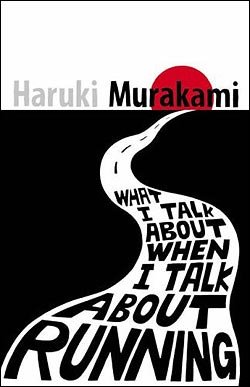
What I Talk About When I Talk About Running

Image

The author is so passionate about running that he says in the preface that

“Writing honestly about running and writing honestly about myself are one and the same thing. So I suppose its all right to read this as a kind of memoir centered on the act of running”

So, in that sense , this book is about a person who is deeply immersed in writing and running that he finds both the activities to be contemplative, meditative acts that ultimately reflects his life.Isn’t it true that whenever we do any activity over a long period of time, the process and the results reflect what we are.

Change

Image Vs Image

For a change , I had a workout in the morning time today, instead of my usual evening time. It was a pleasant experience to sweat early morning and the fact that the music wasn’t loud in the gym was even more pleasing. Some people say that you should only workout in the morning times and quote some scientific reason behind it. As for me, I can only say that my body allowed me to do far many crunches, far more pushups and other exercises as compared to working out after office when I am almost out of energy and my mind is occupied with something relating to work.

Forget about Forgetting

Via Wired ( an old article) :

Philosopher William James once wrote that mental life is controlled by noticing. Climbing out of the sea and onto the windy beach, my skin purple and my mind in a reverie provoked by shock, I find myself thinking of a checklist Wozniak wrote a few years ago describing how to become a genius. His advice was straightforward yet strangely terrible:

_You must clarify your goals, gain knowledge through spaced repetition, preserve health, work steadily, minimize stress, refuse interruption, and never resist sleep when tired. This should lead to radically improved intelligence and creativity. The only cost: turning your back on every convention of social life. It is a severe prescription.
_
And yet now, as I grin broadly and wave to the gawkers, it occurs to me that the cold rationality of his approach may be only a surface feature and that, when linked to genuine rewards, even the chilliest of systems can have a certain visceral appeal. By projecting the achievement of extreme memory back along the forgetting curve, by provably linking the distant future — when we will know so much — to the few minutes we devote to studying today, Wozniak has found a way to condition his temperament along with his memory. He is making the future noticeable. He is trying not just to learn many things but to warm the process of learning itself with a draft of utopian ecstasy.

The Unbearable Lightness of Being

Image

This is the first time I am struggling to write anything about the book I have read.This book explores themes in a very complex way. The author plays with opposites, heaviness and lightness, life and death , god and atheism, love and hate etc. These themes are explored from the lives of the characters in the novel , Tomas, Sabina, Teresa, Frez . Relationships with god, wife, mistress, country, animals are explored through out the novel in “opposites”.

Better : Summary

Image

Non-technical books by doctors are rare , and amongst them, “hard to put down” books , are extremely rare.

A view on performance by a doctor is always a nice read, for you would want to know, the variables that a doc attributes to the success. For whatever I have known about doctors, mainly anecdotal, I have the following impression :

  • Doctors need to have excellent PR to succeed , besides the skill sets which are kind of default in any doc
  • Its more touchy feely thing that makes you choose a specific doctor. You need not always judge a doc by the medicine he/she gives.
  • Doctors need to constantly update their knowledge about whatever domain they are working in.
  • Doctors make a ton of money, at least in US.They slog till early 30’s , establish a practice by late 30’s and early 40’s and then its heaven
  • Doctors in US have to deal with a truck load of insurance problems . One of my friend who is a doc in US thinks that insurance knowledge is sometimes the key between a successful and an ordinary doc
  • Doctors are usually health conscious , cleanliness focused people .

What’s this book about ? This book is by Dr. Atul Gawande, a endocrine tumor surgeon , who talks about performance. Well, to begin with, I imagined this book to fall in either of the following categories, A book which cribs and brings out the darker aspects of medicine OR A book which would talks as though docs are next to god etc.

Imaginary Tale : Summary

Image by Image Paul J Nahim

This is a fascinating story of i , popularly known to most of us as square root of -1 . In the first part of the book, author, Paul J Nahin , takes you through stories of various mathematicians who struggled and contributed to the understanding of sqrt(-1) . Subsequent to this historical narrative, the author provides a lens in to viewing things from a complex domain. Like they say, the easiest path from one point to another in the real world is through a complex plane, Complex numbers are used almost in every discipline you can think…

The Unbearable Lightness of Being

Image

This is the first time I am struggling to write anything about the book I have read.This book explores themes in a very complex way. The author plays with opposites, heaviness and lightness, life and death , god and atheism, love and hate etc. These themes are explored from the lives of the characters in the novel , Tomas, Sabina, Teresa, Frez . Relationships with god, wife, mistress, country, animals are explored through out the novel in “opposites”.

Randy Pausch on Life

  • It is not the things we do that we regret on our death bed..It is the things we did not do, that we regret
  • Find your passion .. You will not find passion in money, things. It has to be something other than that.
  • No matter what you do , passion will always be grounded in people and the relationships with the people around.

Correlation Phantom

Day in , Day out one comes across reports, newspaper articles, business channel anchors using the word correlation. Correlation between NIFTY movement and some sector index, pollution rates Vs number of vehicles in the city, y vs x etc . If one stops to think about the word correlation and ask a few questions, opinions/arguments/citings all tend to fall apart.

In the statistical sense of the word, let me take r as a pearson correlation and bring out the first often neglected aspect of correlation. Like everything in the world of numbers, it is an estimate. This means that its got to have a sampling distribution .