Check tail dependencies NIFTY-Gold
Purpose
To look at tail dependencies of assets and see whether the assets display tail dependencies . Data prep - temp.ret has all the relevant data
> n <- dim(temp.ret)[1]
> GetChiPlotData <- function(z) {
+     n <- dim(z)[1]
+     x <- array(z[, 1])
+     y <- array(z[, 2])
+     Fi <- apply(x, 1, function(temp) length(which(x[which(x !=
+         temp)] <= temp))/(n - 1))
+     Gi <- apply(y, 1, function(temp) length(which(y[which(y !=
+         temp)] <= temp))/(n - 1))
+     Hi <- apply(z, 1, function(temp) length(which(x[which(x !=
+         temp[1])] <= temp[1] && y[which(y != temp[1])] <= temp[2]))/(n -
+         1))
+     Chi <- (Hi - Fi * Gi)/sqrt(Fi * (1 - Fi) * Gi * (1 - Gi))
+     Lambdai <- 4 * sign((Fi - 0.5) * (Gi - 0.5)) * pmax((Fi -
+         0.5)^2, (Gi - 0.5)^2)
+     result <- cbind(Lambdai, Chi)
+     return(result)
+ }
> cp <- 1.78
> z <- as.matrix(temp.ret[, c(1, 2)])
> z1c <- GetChiPlotData(z1)
> master1 <- as.matrix(cbind(temp.ret[, c(1, 2)], z1c))
> z1.x <- quantile(master1[, 1], prob = seq(0, 1, 0.05))[17]
> z1.y <- quantile(master1[, 2], prob = seq(0, 1, 0.05))[17]
> condition1 <- (master1[, 1] > z1.x) & (master1[, 2] > z1.y) |
> par(mfrow = c(2, 2)) > plot(master1[, 1], master1[, 2], col = "blue", pch = 19, main = "NIFTY-Gold", + xlab = "X", ylab = "Y") > plot(master1[, 3], master1[, 4], pch = 19, col = "blue", ylim = c(-10, + 3), main = " Chi Plot- Nifty-Gold", xlab = "X", ylab = "Y") > abline(h = c(-1, 1) * cp/sqrt(n), col = "sienna", lwd = 2, lty = "dashed") > plot(master1[!condition1, 3], master1[!condition1, 4], pch = 19, + col = "blue", ylim = c(-10, 3), main = "Overall Chi Plot - N", + xlab = "X", ylab = "Y") > abline(h = c(-1, 1) * cp/sqrt(n), col = "sienna", lwd = 2, lty = "dashed") > plot(master1[condition1, 3], master1[condition1, 4], pch = 19, + col = "blue", ylim = c(-10, 3), main = "Overall Chi Plot - N", + xlab = "X", ylab = "Y") > abline(h = c(-1, 1) * cp/sqrt(n), col = "sienna", lwd = 2, lty = "dashed") |
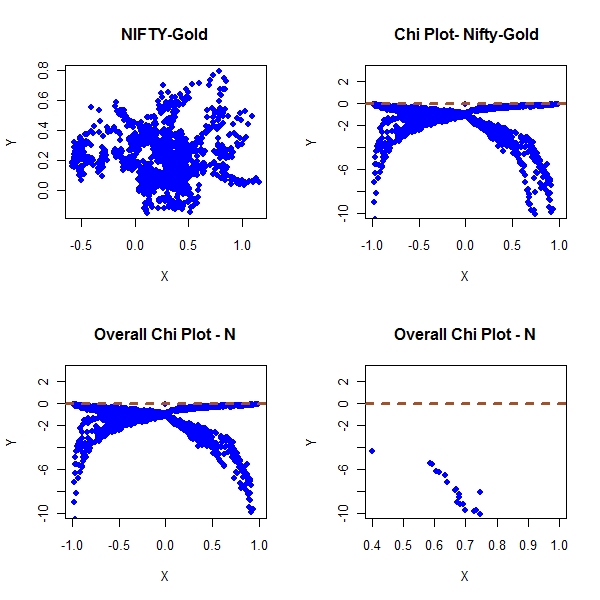
One can clearly see that there is no evidence of tail dependence between the two assets.
Thus one can safely assume a gaussian copula!!